Rowan is closing a health center for abused children because of Gov. Mikie Sherrill’s proposed budget
Layoffs will hit facilities in Camden and Cumberland Counties.
Julie Harrison, a clinical psychologist in South Jersey who works with children who have experienced abuse, received a letter from Rowan University: Notice of Layoff.
Her position as a teacher, researcher, and provider in Camden County would be eliminated “due to the loss of state appropriation funding,” the May 12 letter said. Harrison works for the Rowan-Virtua Child Abuse Research Education and Service Institute (CARES), which provides evaluation, treatment, and other services to children who have experienced abuse in South Jersey, and conducts research on the subject.
The notice came after Gov. Mikie Sherrill proposed slashing the $1.85 million line item in her state budget plan for the program.
CARES has offices in Stratford in Camden County and Vineland in Cumberland County. The Vineland location, which opened two years ago to provide better access to families in deeper South Jersey, is shutting down due to the anticipated cuts.
“With Mikie Sherrill being in office, we had a lot of hope because she really was pretty loud about wanting to help kids, wanting to help families, wanting to really champion mental health services, and so we were pretty surprised about this budget,” Harrison said in an interview.
The clinician is pregnant with twins and her job prospects are uncertain as the clock ticks until her final day at CARES. But she is mostly concerned about the impacts the funding cuts will have on children facing trauma in South Jersey, and the workers caring for them.
The South Jersey program serves more than 1,500 children across more than 4,000 visits in both locations. Though just about 200 families use the more rural Vineland location, that is where these types of services can be the most critical, Harrison said.
“It’s a pretty resource-dry community,” she said. “There’s not a ton of public transportation to get around. … The amount of services that are available to these families generally is much lower than other parts of New Jersey.”
Harrison is one of about 20 people whose jobs are being impacted by the anticipated funding cuts across both office locations, according to union members. The majority of those are layoffs, and some employees had their hours dramatically reduced to the point they lost their healthcare benefits, according to union members.
Ali A. Houshmand, president of Rowan University, said in a May 11 email that Sherrill’s proposed cuts forced the child abuse care center to pull back its services beginning July 1. He announced the closure of the Vineland office without saying it outright.
“CARES will consolidate its work into our Stratford campus offices and will continue to fulfill its mission there: delivering high‑quality evaluations and treatment, supporting partner agencies across the region and educating the next generation of physicians and health professionals,” he said in the email.
Joe Cardona, a Rowan University spokesperson, said the program also receives $3 million from other state agencies that will not be cut. He said the program’s goal is to offer the same services but reduce the quantity of care.
“The exact outcome, of course, is to be determined,” he added.
What is clear is that the closing of the Vineland center will have a domino effect on Stratford.
“It’s creating an environment where people who are already doing multiple roles, performing multiple jobs, are going to be asked to do more,” Harrison said. “It’s just that horrible ‘do more with less.’”
Harrison said she was just days away from submitting a grant application to start a food pantry out of the Vineland office when she heard the news. Her team did not submit the application after learning about the cuts and Vineland’s planned closure.
CARES is one of four legislatively mandated diagnostic and treatment centers through the New Jersey Department of Children and Family, though it provides more expansive medical and mental healthcare than legally required. The center champions trauma-focused cognitive behavioral therapy, an internationally recognized model that was developed by the South Jersey program’s codirector.
The program has tried to keep waiting lists for trauma care to under three weeks, but it has now grown to 10 to 12 weeks and the wait for care will probably get longer, Harrison said.
“There is a high cost to what untreated trauma can look like for medical, mental health, all those services down the road if trauma isn’t treated early on,” she said.
‘Tough choices’
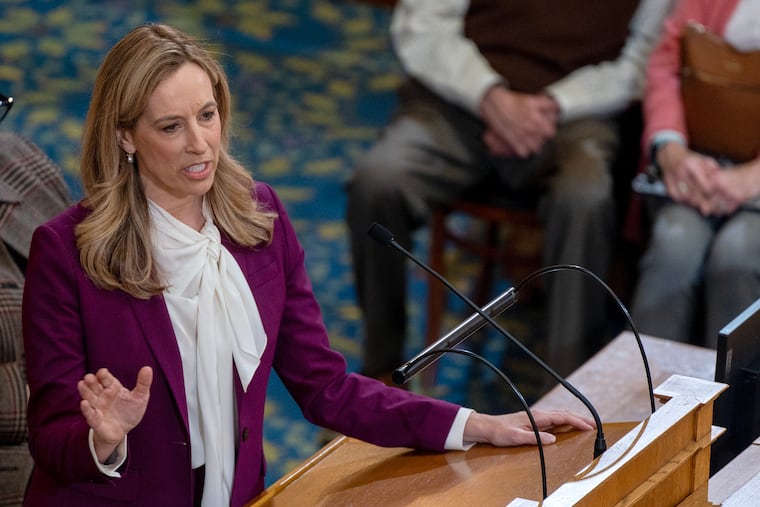
Sherrill championed improving mental health for young people on the campaign trail and in her budget proposal by allocating $33 million to expand mental health services for students with high needs in K-12 schools, $500,000 for a new social media research center focused on young people’s mental health, and $125,000 for the newly created New Jersey Office of Youth Online Mental Health Safety and Awareness.
Her office did not respond to a request for comment on her proposal to decrease funding for CARES.
In response to a request for comment for an earlier Inquirer story about Sherrill’s decision to cut all state funding for Rowan’s brand-new veterinary school, an administration official cited the governor’s “blanket cut to all legislative add-ons.” These items refer to funding allocations legislators secure for their district that are sometimes criticized as “pork” or “Christmas tree items.” They can range from improvements for a local park to community services, like CARES.
Sherrill, in her budget address, spoke about making “tough choices” in order to have “the most fiscally responsible budget that our state has seen in years.”
But the governor carved out line items for her own priority projects, like $250,000 toward a new statue of the Rev. Dr. Martin Luther King Jr. in Camden.
The state budget is a negotiation between the governor and legislative leaders due June 30, so it is unclear how much funding these programs will get in the end. But Rowan has moved forward as if the money for CARES is not on the table.
This is not the first time the program has been at risk as part of the budget dance.
Former Gov. Phil Murphy proposed cuts to the program last year, citing “belt-tightening,” but legislators were able to get the money back in the budget.
This year, Harrison said, people are not optimistic because CARES is one of so many programs Sherrill struck a pen through.
Dio Tsitouras, the executive director of the American Association of University Professors Biomedical and Health Sciences union, said he hopes Sherrill allocates more money to CARES because more state revenue has been identified since her budget proposal. But state officials have still warned of financial uncertainty on the horizon.
“The CARES program is invaluable to protecting our state’s most vulnerable children,” Tsitouras said.