Republican Brian Fitzpatrick helps Democrats pass a resolution to limit Trump’s war powers in Iran
The Bucks County Republican voted with Democrats once before to limit President Trump's ability to attack Iran. This time his vote helped the war resolution pass.
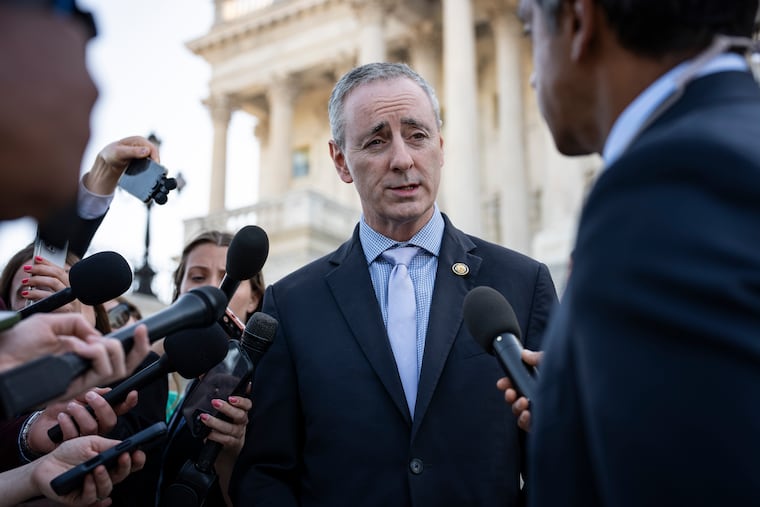
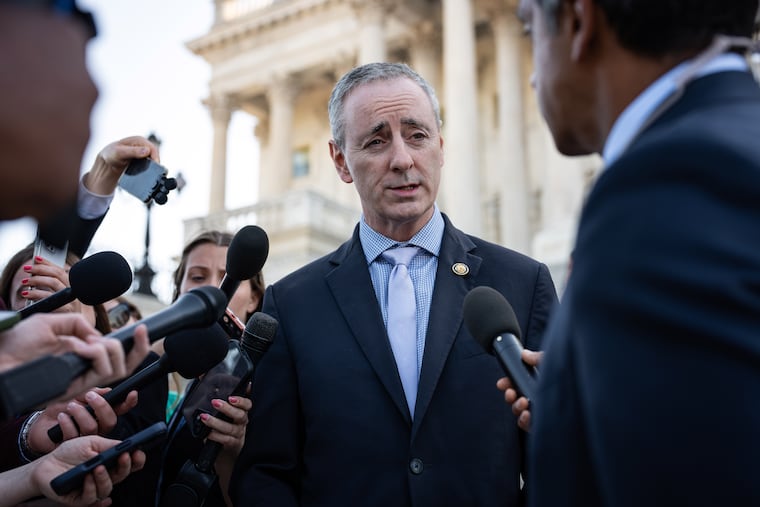
U.S. Rep. Brian Fitzpatrick, who recently kicked off a tough reelection campaign in a Bucks County swing district, was one of a handful of Republicans on Wednesday to help Democrats pass, for the first time in the House, a resolution aimed at restricting President Donald Trump’s authority to attack Iran.
The war powers resolution was approved 215-208, with Fitzpatrick among just four Republicans who supported the measure opposed by Trump and Republican House Speaker Mike Johnson (R., La.).
The five-term lawmaker’s office did not respond to a request for comment explaining his vote, though he voted with Democrats on the issue once before — when a tie vote last month meant the resolution came one shy of passage.
Fitzpatrick has not criticized Trump’s decision to attack Iran but rather his move to continue with the effort unchecked by Congress. An early May legal deadline that marked 60 days of the conflict, Fitzpatrick and others argued, required the president to receive congressional approval to continue the attacks.
“The War Powers Act of 1973 is the law of the land,” Fitzpatrick said while introducing his own version of a war powers resolution in April. “This consistent standard must be applied to all past, current, and future administrations when it comes to military hostilities abroad.”
Under Fitzpatrick’s resolution, Trump would be required to begin a “phased withdrawal” of U.S. forces from the region. Exceptions would be allowed if the president determined the forces are necessary to defend against an “imminent attack, or prevent the procurement of a nuclear weapon.”
Fitzpatrick’s resolution has stalled, and the one that advanced on Wednesday does not include similar caveats. Sponsored by New York Democratic Rep. Gregory Meeks, it requires the president to remove forces from hostilities against Iran unless explicitly authorized by Congress or a declaration of war.
Democrats have insisted that Trump’s decision to attack Iran in a joint effort with Israel was illegal from the beginning. They have also frequently referred to wide public opposition to the attacks, and the impact on the U.S. economy such as increasing gas prices, as they campaign to flip control of Congress this year.
Fitzpatrick’s narrowly divided 1st Congressional District is one of Democrats’ biggest targets anywhere in the country. Bucks County Commissioner Bob Harvie is the Democratic nominee, and ads that Fitzpatrick launched against him even before last month’s primary underscored the high stakes of the race.
The Republican’s vote on Wednesday, meanwhile, was the latest of multiple high-profile moments in which he has bucked the party line and opposed Trump — moves that have elicited threats from Trump, who has worked to defeat Republicans he sees as disloyal.
“He likes voting against Trump,” Trump said last month to reporters, including Fitzpatrick’s fiancee, Fox News correspondent Jacqui Heinrich, a day after the Pennsylvania primary. “You know what happens with that? It doesn’t work out well.”
All of the other nine Republican U.S. House members from Pennsylvania voted against the war powers resolution, as they have multiple times before.