National Democrats jump into Lehigh Valley congressional race to counter influx of last-minute spending from mysterious PAC
Democratic leaders have rallied around firefighter Bob Brooks in a competitive primary. A new, potentially GOP-led PAC has tried to lift up another candidate.
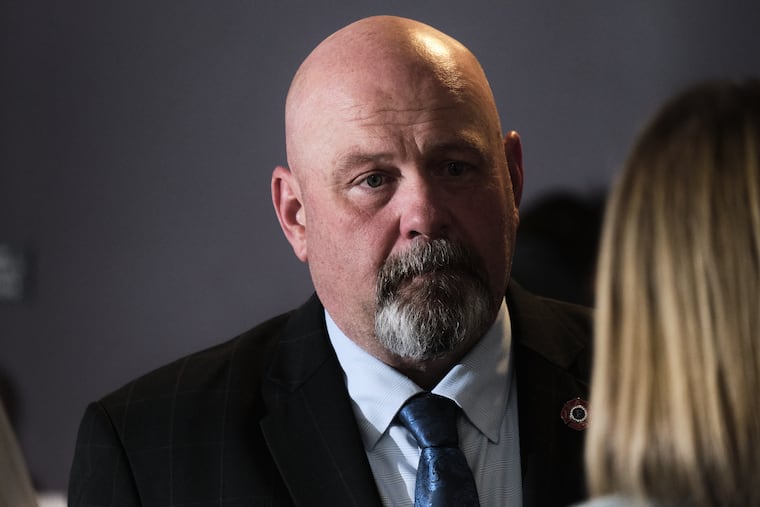
Pennsylvania’s highly competitive Lehigh Valley-based seat in Congress became the center of an all-out spending war by national political groups this week ahead of Tuesday’s primary, when Democrats will choose their challenger to one of the most vulnerable Republicans in the country.
The four-way Democratic contest in the 7th Congressional District has seen an influx of more than $1.2 million in last-minute television ads from a new and mysterious group with connections to Republican operatives.
Democrats both locally and nationally are raising alarms, calling the maneuver dishonest and aimed at boosting a potentially weaker candidate to go up against freshman Republican U.S. Rep. Ryan Mackenzie in November.
On Wednesday, they took an unusual step to counter the effort.
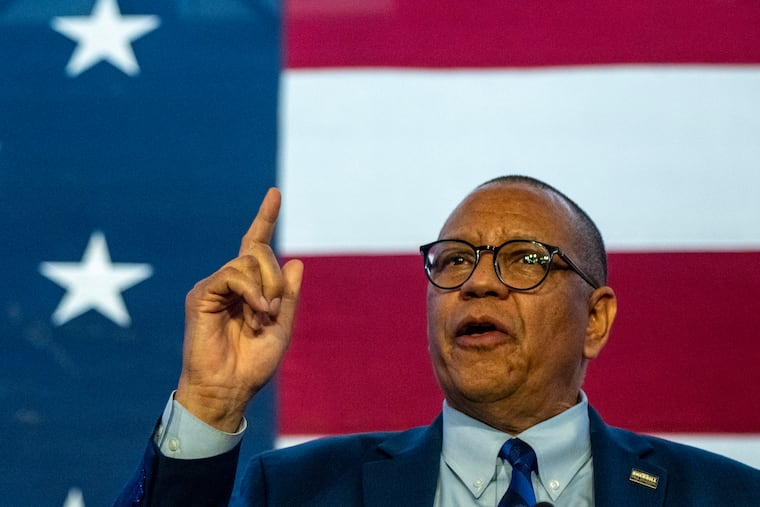
The Democratic Congressional Campaign Committee — the official campaign arm of the party’s leaders in the U.S. House — bought $102,000 in television airtime to support its preferred candidate, union president and retired firefighter Bob Brooks. Democratic leaders, including Gov. Josh Shapiro, have rallied around Brooks for months as they bet big on his ability to win over working-class voters in a swing district.
But the DCCC’s six-digit spending effort in a contested primary is a rare move for the group.
And it is the first time this election cycle that it has done so with financial resources that it typically reserves for the general election.
DCCC spokesperson Eli Cousin said that the organization “is committed to flipping this must-win seat and taking back control of the House in November” and that Brooks has the ability to “crush” Mackenzie.
“D.C. Republicans pumping in more than a million dollars to attack firefighter Bob Brooks through a super PAC tells you just how afraid they are to face him in November,” Cousin said.
That super PAC, called Lead Left PAC, emerged only late last month and then unleashed a torrent of ads criticizing Brooks and another deep-pocketed candidate, former federal prosecutor Ryan Crosswell. The ads support Lamont McClure, a former top elected official in Northampton County who has struggled to raise money and build momentum in the race.
While Lead Left appears to support Democratic causes — based on its registration with the Federal Election Commission, its television ads that criticize President Donald Trump, and its bare-bones website that calls out “MAGA extremists” — no Democrats have claimed credit for its organization. Metadata from its website, however, originally indicated the group used the Republican fundraising platform WinRed, Punchbowl News reported.
Lead Left has also waded into Democratic congressional primaries in Nebraska and Texas, where it has supported a candidate accused of promoting antisemitism. Its spending in the Pennsylvania district has far exceeded its involvement in the others, according to campaign finance records.
Due to the timing of its registration with the FEC, Lead Left will not be required to disclose its donors until after the primary.
Samuel Chen, a GOP strategist based in the district, said the group appears to be an increasingly common example of one party intervening in another party’s primary to “get the weakest or the most extreme” candidate to the November election.
Even though McClure is the only candidate in the race with elected experience — winning twice countywide in an important part of the district — he was not generating the type of excitement that Brooks and Crosswell were before the spending began, Chen said.
“This race has heightened significantly,” Chen said of the impact of the latest ads and other negative attacks in the race.
McClure did not respond to a request for comment.
Brooks, whose high-profile endorsements range from Shapiro to U.S. Sen. Bernie Sanders (Ind., Vt.), said in a statement that Republicans launched the attacks because he is “the candidate they fear the most.”
“They don’t want to face me in November because they know this firefighter will smoke Ryan Mackenzie, flip this seat, and stop Donald Trump’s cruel agenda,” Brooks said.
Crosswell’s campaign manager, Nick Mattes, said the potential GOP effort is the result of his candidate’s momentum. He also targeted the DCCC’s support of Brooks, claiming the national party “turned its back on in-district Democratic voters to prop up a deeply flawed candidate.”
Mackenzie, meanwhile, has already started targeting Brooks. In social media posts, he has leaned into Brooks’ fire imagery, calling him a “dumpster fire candidate.” Andres Weller, the Republican’s campaign manager, said in a statement that established Democrats are now “trying to carry him across the finish line.”
“The DCCC endorsement was a sign of weakness for Brooks and other outside groups clearly picked up on that,” Welles said.
The latest ads are not the only work from outside groups that has made an impact in the race.
Brooks has been the beneficiary of more than $1 million in spending from a super PAC called Stronger Together PA that launched in January, according to recent campaign finance records. The PAC has ties to another national group, called the Bench, that is supporting a select group of Democrats who are less traditional candidates. It has also been fueled by nearly $1.4 million in mostly union donations, including hundreds of thousands of dollars from firefighter unions aligned with Brooks.
Crosswell and Brooks have been the only candidates in the field — which also includes Carol Obando-Derstine, who was recruited by the last Democrat to hold the seat — to raise enough money to run their own television ads.
The 7th District includes the cities of Allentown, Bethlehem, and Easton while also reaching up into the more Republican-heavy Poconos. It is one of four districts across Pennsylvania that are represented by Republicans but are expected to be competitive in the midterm elections later this year, and could potentially determine which party controls the U.S. House.