Will Democratic leaders’ ‘working-class’ candidate in the high-stakes Lehigh Valley race be the answer they’re looking for?
Established Democrats have rallied behind Bob Brooks, a union leader and retired firefighter, in a race they aren't shying away from trying to make almost entirely about Brooks' personality.
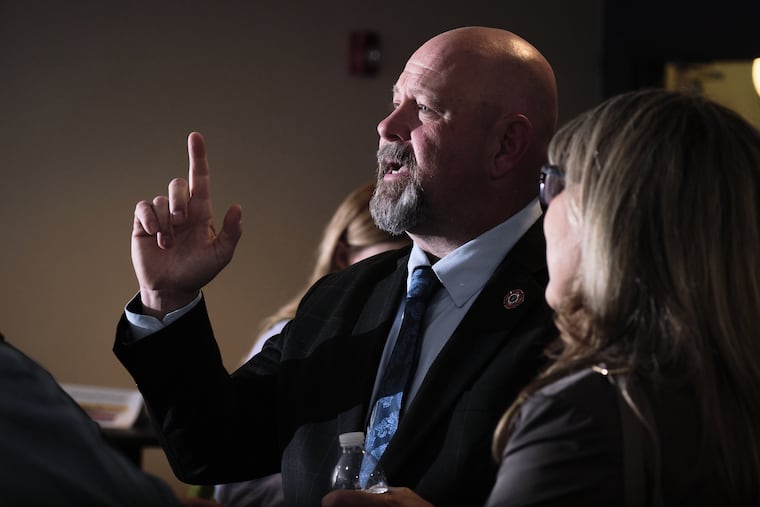
NAZARETH, Pa. — Bob Brooks needed to clear his head.
The Democratic front-runner in one of this year’s most competitive races for Congress was a little over 24 hours away from his final debate, the first since a brutal performance a few weeks earlier.
The strains of a competitive primary were adding up.
And Brooks admitted as he trudged toward a high school baseball field in the middle of the first inning that he “wasn’t used to all this political stuff.”
In a coach’s outfit that matched the players’ bright blue uniforms, he slipped behind the bleachers filled with screaming parents and into the dugout. He dropped his gear and eight bags of sunflower seeds, wedged himself between the teenagers leaning on the railing, and looked out at the Nazareth Blue Eagles’ field.
Thin Lizzy’s “The Boys Are Back in Town” blared from a speaker as the man whom national and Pennsylvania Democrats are betting big on to win back working-class voters, after years of losing them to Donald Trump, watched his team step up to the plate.
“I would like to still be a part of this if … when we win,” Brooks said a few innings later, quietly contemplating how his life could change if he wins the Lehigh Valley-based seat in Congress.
Pennsylvania’s 7th Congressional District is one of the few true swing seats in the country. Republican U.S. Rep. Ryan Mackenzie barely defeated the Democratic incumbent in 2024 and is now considered one of the most vulnerable lawmakers in a year when Democrats are widely expected to win back control of the U.S. House.
Of the four “tossup” or targeted districts in Pennsylvania this year, it’s also the only one with a robust and competitive primary on May 19 — making the contest between Brooks and three other candidates a referendum on how Democratic voters think the party should rebound after years of soul-searching.
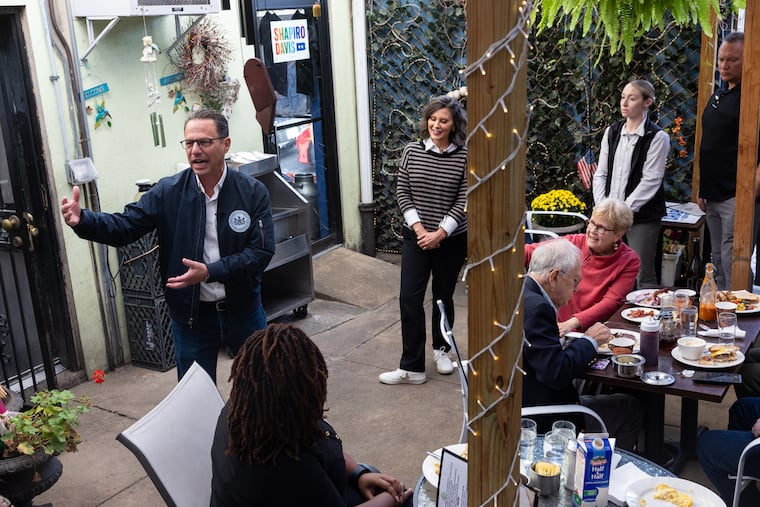
Brooks and the heavy hitters supporting him — Gov. Josh Shapiro and U.S. Sen. Bernie Sanders among them — aren’t shying away from trying to make the race almost entirely about the look, feel, and what they call the “calloused” background of the candidate himself: a 53-year-old union leader and retired firefighter who coaches baseball and drives a snowplow on the side.
An unpolished outsider committed to the party’s values, they say, is exactly what Democrats need to win over voters who turned toward Trump, another unpolished outsider on the other side of the aisle.
But in a diverse district — one packed with three urban centers including Pennsylvania’s third-largest city, sprawling suburbs, ruby red rural areas, and the Pocono Mountains — the other campaign and their supporters are taking issue with the heavy-handed approach.
And the three other candidates are also leaning into their distinct personalities and backgrounds that represent different elements of the Democratic coalition, giving them each a path to win in November, observers say.
Carol Obando-Derstine, an energy engineer who previously worked for former U.S. Sen. Bob Casey, was recruited by the last Democrat to hold the seat, is the only woman in the field and is a Colombian immigrant who says she can relate to the Allentown area’s significant Latino population.
Ryan Crosswell is an attorney with fundraising momentum after defecting from the Republican Party and resigning in disgust from the Justice Department when his team was told to drop the corruption case around former New York Mayor Eric Adams after Trump took office.
Lamont McClure is a former two-term Northampton County executive, the only experienced officeholder, and someone who could have a leg up in an important part of the district.
“They kind of fit the characters in the modern Democratic Party,” said Chris Borick, who’s followed the race closely as the director of Muhlenberg College’s Institute of Public Opinion in Allentown. “That’s what makes it so fascinating.”
Brooks and Crosswell have emerged as the two who’ve attracted the kinds of financial or organizational support that will likely set them apart before the primary, Borick said. But the personality battle is what’s defined the race, particularly as both the moderate and progressive wings of the party rally around Brooks’ persona and more limited policy chops.
“There’s a reason why Democrats have sought candidates like this to run, especially in places like the Lehigh Valley and the 7th Congressional District,” Borick said of Brooks’ reflection of the kind of working-class white male that Democrats have struggled to win in recent years.
That strategy was intentional. It’s also left the other candidates and their supporters wondering where that leaves them in the next chapter of Democratic politics.
“I think the public realizes that there is no one ‘look’ for a working-class person. Working-class folks come in every gender and every color, every ethnicity and background,” Obando-Derstine said.
In an interview near her home in the suburbs outside of Allentown, she spoke of growing up in northern New Jersey with a mom who worked as a machine operator at a factory and a dad who was a hospital technician. Many others, including those in the sizable Latino community she’s hoping to represent, have similar stories, she said.
“It’s doing them a disservice, doing all of us a disservice, when we just think that working-class people look like just one type of person,” she said. “It’s not acknowledging the struggles that so many others have.”
How the party picked Bob Brooks
A Massachusetts native who dropped out of college after a baseball injury derailed his playing career, Brooks worked as a bartender and beer truck driver in the Lehigh Valley before joining the fire department in Bethlehem. He launched a side hustle mowing lawns at foreclosed homes before pivoting to snowplowing, which he still did in between campaign events this past winter.
Brooks retired from the department after 20 years in 2025 but continues to serve as the president of the Pennsylvania Professional Fire Fighters Association, where he’s represented about 8,000 firefighters across the state since 2021.
The union gig introduced him to the world of politics and those who would eventually convince him to run. In Harrisburg, he lobbied for legislation that Shapiro ultimately signed into law in 2024 that lowered the standards for first responders to have post-traumatic stress injuries covered by workers’ compensation. In Washington, he advocated for the Social Security Fairness Act signed by President Joe Biden just before he left office in 2025, allowing firefighters and others to access more benefits.
When Democratic strategists were looking for someone to run against a longtime Republican state representative in Northampton County in 2024, Brooks didn’t say no. It turned out he didn’t live in the district, but they had him “dangling,” Brooks said.
The call for the higher-profile congressional race, he said, came first from U.S. Rep. Chris Deluzio, a Pittsburgh-area Democrat with close union ties, in mid-July last year — after the other major candidates had already launched campaigns. At the time, Brooks said he’d been considering taking a political job with the International Association of Firefighters that would’ve meant more full-time work in Washington.
But at an event with Shapiro a few weeks later, the governor — a potential 2028 presidential contender who is looking to make his mark on the 2026 midterms — put him over the edge.
“I think the Democratic Party’s figuring out where they went wrong, and they’re trying to correct that,” Brooks said in his cluttered union office in an old United Steelworkers of America building while talking about the elected officials’ pitches. “I have the ability to bring those people back to this party that have left.”
The endorsements that followed are all over the ideological map. Sanders and former Transportation Secretary Pete Buttigieg. U.S. Rep. Jamie Raskin and U.S. Sens. Ruben Gallego and Elizabeth Warren. The progressive Working Families Party and Congressional Progressive Caucus, and the moderate Blue Dog PAC.
In one of the clearest signals yet that the party establishment is rallying behind Brooks and wants to spend its resources on a matchup between him and Mackenzie, the Democratic Congressional Campaign Committee announced its support for Brooks on Monday.
Other groups have already committed financial and strategic resources, giving Brooks a lift in the primary while Crosswell personally out-fundraised him.
That’s included a boost from The Bench, a newer organization supporting a select group Democrats including Texas’ U.S. Senate nominee James Talarico.
The group’s political action committee poured $250,000 into a super PAC that, alongside other donations from unions aligned with Brooks, has spent $734,000 on television ads and other expenses to help him, according to campaign finance records.
“Anybody who thinks that money won’t be a highly determinative factor in this race hasn’t been paying attention for the last 249 years,” said T.J. Rooney, a former Pennsylvania Democratic Party chair and state lawmaker from the area who endorsed McClure.
The Bench spokesperson Andrew Mamo said the idea behind the group is to empower Democratic candidates who don’t necessarily have the traditional backgrounds or rolodexes of candidates the party would typically support. There’s “no litmus test and no ideologically purity test on this or that.” The goal, Mamo said, is to instead identify “people who look, feel, and sound like the people in their districts.”
Allentown Mayor Matt Tuerk — the first Latino leader of a 127,000-person city that has a 56% Latino population — said he’s heard Brooks’ Spanish, and it “stinks.” But after taking each of the candidates to a local Dominican restaurant and to the Allentown Fair last summer, Tuerk endorsed him.
“I wanted to see how they handled some chicharron,” Tuerk said, noting Brooks was natural and easygoing in both settings. “He’s going to show up and be genuinely interested in helping people do better.”
‘Far from Fetterman 2.0’
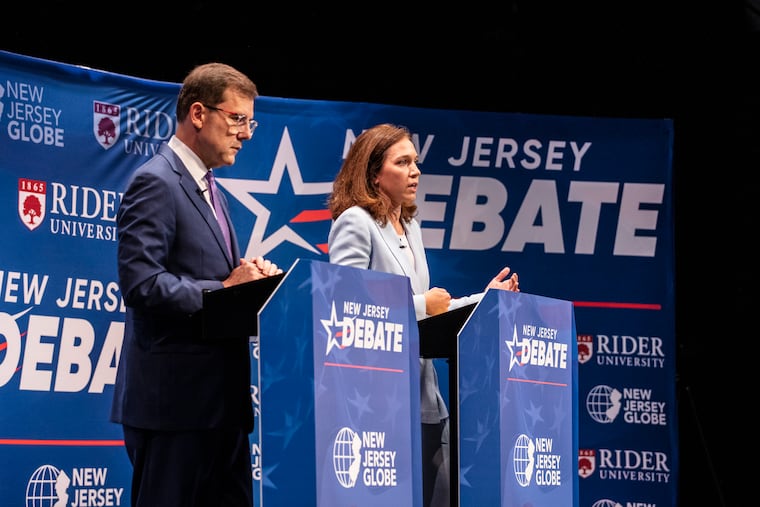
Thirty miles north of Allentown in late April, the four candidates settled into an old Jim Thorpe high school auditorium for a live television debate in the type of community where Democrats are hoping to slow the bleeding.
Carbon County is a relatively small portion of the 7th District. But some credit Mackenzie’s win there with a whopping 66% of the vote as the reason then-Democratic U.S. Rep. Susan Wild wasn’t able to hold the seat despite narrower wins in the larger Lehigh and Northampton Counties. Mackenzie, a former state representative, won the district with a 4,000-vote margin out of 403,000 votes cast.
The debate touched on local complaints of tire-burning pollution and incoming data centers. Affordability issues, which have become nearly every Democrats’ messaging focus, dominated the night.
Brooks was soft-spoken and laid back, his answers more thoughtful compared to another recent forum in which he was heavily critiqued for stumbles that he later blamed on illness. Now in Jim Thorpe, he doubled down on his pitch that he’s “lived the life that many are living in this community” while the others turned to more specific policy priorities and leaned into their own backgrounds.
Obando-Derstine — a fast-talking policy wonk who’d prefer to talk about oversight of the Federal Energy Regulatory Commission and transmission lines rather than broad ideological goals — repeatedly turned to her energy background to talk about rising utility costs. Crosswell narrowed in on the anti-corruption agenda that pushed him into the race and dropped names of specific bills he’d vote for in Congress. McClure hammered home his experience leading Northampton County and about aggressively fighting against Trump’s agenda.
“I fought Trump. I fought ICE. I fought MAGA, and I have real receipts having done that,” McClure said. “And I will go to Congress to fight like hell.”
Peter Cummings, a retired funeral director from Northampton County who traveled about an hour to watch the debate, said afterward that he was still undecided, though he was impressed with McClure’s elected experience and Crosswell’s background as a Marine.
Brooks’ candidacy, on the other hand, was confounding to him.
“I don’t know what Bob Brooks is doing up there. He has no experience at all,” Cummings said. “I don’t understand how he got endorsed.”
In the only attack on another candidate, McClure also targeted Brooks. He referenced years-old Facebook posts highlighted by the Washington Post in which Brooks had criticized former NFL quarterback Colin Kaepernick for kneeling during the national anthem to protest police brutality, and for saying “the problem is not guns” after a 2019 mass shooting in which 23 people were killed at an El Paso Walmart. McClure accused Brooks of changing “his fundamental positions” on guns and protests while Brooks smirked and didn’t respond.
In an interview at his office, Brooks called the posts “silly, maybe stupid.” He made them at a time when he had no expectations of being a public figure and he wouldn’t “hide from anything” now, he said.
Mamo, from The Bench, said the fact that his group and others supported Brooks while previously knowing about those posts “shows the Democratic Party is moving beyond the litmus tests.”
“No more of: If you say one wrong thing, you’re out of the tent,” Mamo said.
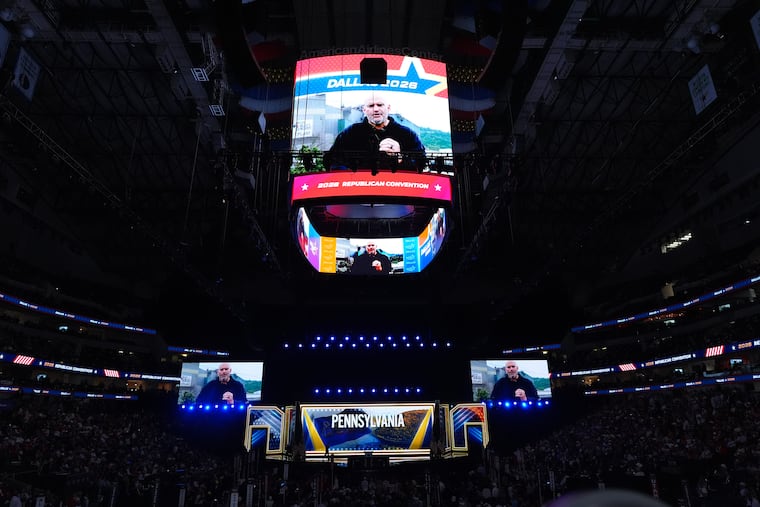
Brooks’ opponents say the posts are indicative of a larger problem, one of the Democratic establishment throwing its considerable weight behind an untested and unqualified candidate. To underscore their point, both Crosswell and Obando-Derstine have implied that Brooks’ old posts could be a sign that he’ll turn out to be like U.S. John Fetterman, a Democrat who also ran on blue-collar appeal but who’s largely lost the support of his base as he sides with Republicans in Washington.
“Our district deserves better than another John Fetterman,” Obando-Derstine said in a statement Monday that criticized Brooks and the DCCC’s endorsement. The posts, she said, had “downplayed the deadliest attack on the Latino community in modern U.S. history.”
Crosswell, at a meet-and-greet in a 55-plus community the day after the Jim Thorpe debate, told a group of two-dozen seniors that Brooks’ posts were “really disturbing.” He said the party should be more concerned about supporting a Fetterman-like candidate than someone like him, a former Republican who switched his registration to Democrat last year but who had been voting for Democratic candidates since 2016.
“Don’t be afraid of the registered Republican who’s actually a Democrat,” Crosswell said. “Be afraid of the registered Democrat who is actually a Republican.”
Brooks, for his part, doesn’t welcome the comparison.
“I’m far from Fetterman 2.0. That’s not me,” he said in his office on the same day that Fetterman voted with Republicans for a fifth time to support Trump’s controversial war in Iran. “I won’t even wear a hoodie anymore. I do not want to be compared to John, especially right now.”