Loans and layoffs: Missing $3 billion in state payments, Pa.’s public schools implore lawmakers to end budget impasse
Without a state budget, no money can flow to Pennsylvania's 500 districts, including the billions in federal dollars that first pass through the state’s coffers before being sent to districts.
HARRISBURG — Public schools across Pennsylvania have missed more than $3 billion in payments from the state, requiring the state’s 500 school districts to take out billions in loans, spend their reserves, or lay off staff as the state budget impasse stretches into its fourth month.
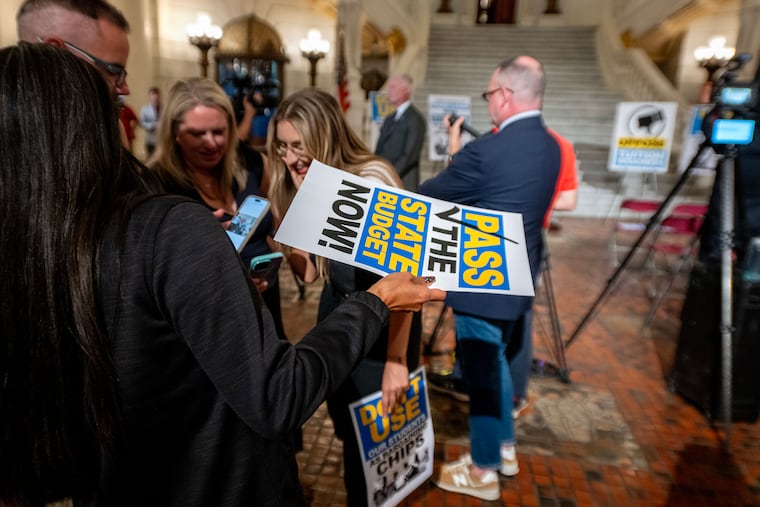
A coalition of eight statewide school organizations held a news conference on Tuesday urging lawmakers in the state General Assembly to reach a compromise budget as soon as possible, and raised the alarm that most school districts cannot wait any longer. The groups, led by the Pennsylvania School Boards Association, represented a wide variety of areas of public education, including principals, teachers, superintendents, intermediate units, and more — all of whom pleaded for the state’s elected leaders to put partisanship aside so the money their districts count on can begin flowing again.
‘Held to a higher standard’
Lawmakers in Pennsylvania’s split legislature — where Democrats control the House and Republicans control the Senate — have been unable to reach a deal on the state budget, which was due by July 1. Without a new budget, no money can flow to districts, including the billions in federal dollars that first pass through the state’s coffers before being sent to districts. This leaves districts in distressing circumstances where they are still obligated to operate — and still make hundreds of millions of dollars in payments to charter schools — with no state or federal funding.
» READ MORE: Pennsylvania’s state budget is late. Leaders still can’t agree on the basics.
House Democrats passed a nearly $50.3 billion budget last week — their second budget vote so far this year — on the 100th day of the budget impasse. Top House Democrats and Gov. Josh Shapiro maintain that Senate Republicans are holding up the budget for political reasons, while Senate Republicans counter that they are a last line of defense against the state requiring tax increases in future budgets.
“There’s multiple fingers to point in multiple directions. The fact of the matter is a budget needs to be achieved, and it can only be achieved through partnership and through compromise,” said Eric Eshbach, the executive director of the Pennsylvania Principals Association.
The school groups also highlighted the irony that each district is mandated by state law to pass its own budget by June 30 — just like the legislature, which is required to pass a balanced budget by the state constitution. When the legislature does not pass its budget on time, schools are left with no assurances of how much they will receive from the state that fiscal year. What’s more: Districts can be penalized for falling below the state-set minimum fund balance, so without state funding, most districts are forced to borrow money that they will be on the hook to pay interest and fees for once the funding comes through.
“We are being held to a higher standard than what the people we elect into office are holding themselves to,” said Sabrina Backer, the president-elect of the PSBA.
How local schools are faring
Local school districts have been feeling the heat of the budget impasse for weeks, if not for months.
The Philadelphia School District, Pennsylvania’s largest, is feeling the pinch acutely.
Philadelphia’s school board last month voted to borrow up to $1.5 billion just to pay its bills. But the temporary borrowing will sustain the school district only through December, and will end up costing the district $30 million in interest and fees.
» READ MORE: Philly schools just had to borrow $1.5 billion to pay their bills. Here’s why.
City school board members sounded the alarm when they authorized the borrowing. Board member Whitney Jones said the $30 million in costs “will never be reimbursed, and will never reach the classroom. The budget delay is costing our schools money that we do not have, and it’s further limiting what we can provide to students.”
Philadelphia officials said they were short about $400 million in state payments just for July and August. An updated missing state aid figure was not immediately available, but the bulk of the district’s funding comes from the state — and Philadelphia is the only district in the state that is unable, by law, to raise its own revenues.
In Delaware County, the William Penn School District is facing “immediate and serious” fallout from the continued impasse.
William Penn, one of the plaintiff districts in the landmark court case that resulted in Pennsylvania’s school-funding system being declared unconstitutional, relies on the state for 55% of its budget.
» READ MORE: William Penn is borrowing money due to the delayed state budget. Other school districts may, too.
Because it has seen no state aid for months, the district has had to take out a $9.9 million loan to make ends meet, Superintendent Eric Becoats said in a message to families sent this week.
“Our remaining funding from local taxes cannot sustain operations for long,“ Becoats said. That money has been necessary to cover payroll — William Penn spends more than $4 million monthly on that line item — and $2 million for utilities, transportation, and essential services.
“These reserves were never meant to replace state funding and will soon be depleted,” Becoats said.
William Penn already made cuts in staffing, transportation, and programs going into the school year.
“Continued delays will make it increasingly difficult to sustain even our current levels of operations,” officials said in a statement to The Inquirer. “At this point, the district’s focus is on ensuring that schools remain open and that students continue to receive the education and support they deserve. However, without the release of state funding, every day that passes brings greater uncertainty.”
The Norristown Area School District had prepared its budget anticipating it would receive an additional $7 million this year as part of the state’s new adequacy formula implemented last year in response to the court ruling. Officials had budgeted for 55 new staff positions, and $3 million in instructional resources, said Norristown Superintendent Christopher Dormer, who also serves as the president of the Pennsylvania Association of School Administrators.
The late budget has resulted in the Norristown Area School District pausing 20 of those new positions indefinitely and delaying $1 million in planned expenditures, Dormer added.
Wealthier school systems seem to be faring better. In Lower Merion, the district “is not making any changes related to the Pennsylvania budget,” spokesperson Amy Buckman said. “We are unable to predict what will happen in the future.”
Still, even some wealthy schools and agencies are feeling the pain, Dormer said, noting that the Montgomery County Intermediate Unit — in one of the wealthiest counties in the state — is seeking to borrow $15 million to stay afloat during the impasse.
“Folks, you have a job to do, and the job is to come together,” said Edward Albert, the executive director of the Pennsylvania Association of Rural and Small Schools, during the news conference Tuesday. “Stay at the Capitol until you get this done. Don’t go home. Because we have school districts that are hurting.”