Their kids were victimized by AI deepfakes. They told Josh Shapiro they want state action.
Gov. Shapiro hosted a roundtable on AI in schools, where Radnor parents raised concerns about the school district's response to deepfakes. The governor said his administration will look into it.
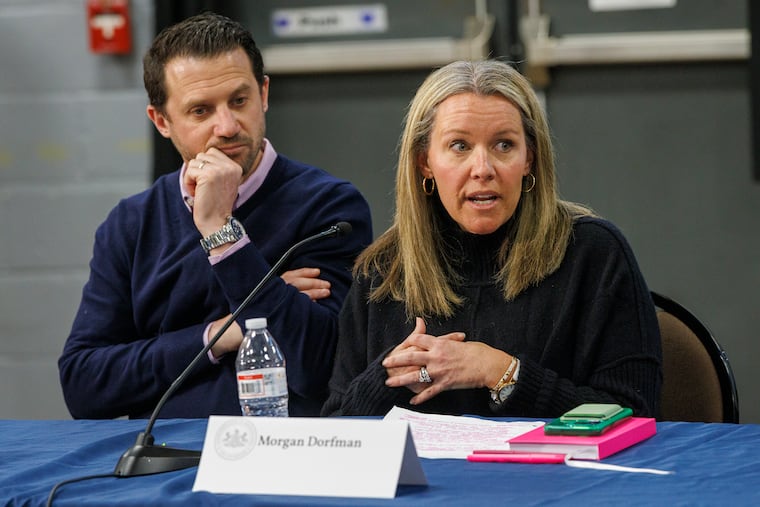
Speaking at a roundtable that included parents of two Radnor High School students victimized by AI deepfakes, Gov. Josh Shapiro said Thursday he’ll call on the Pennsylvania Department of Education to look into creating standards for how schools respond to similar offenses.
Radnor parents Adam and Morgan Dorfman and Audrey Greenberg joined a roundtable in West Chester with Shapiro, a Democrat, and Attorney General Dave Sunday, a Republican, to discuss artificial intelligence in schools and what the state should do to better protect students.
In a wide-ranging conversation, the three parents shared their experiences learning that their daughters had been victimized and their frustrations at the school’s response, which they described as dismissive.
“We were victimized more by the school than this kid who made the video,” Greenberg said Thursday.
The parents asked state officials to consider better training for students and faculty, more accountability for students who produce such images, and better resources for parents whose children are victimized.
“Having policies in place is essential, but if we don’t enforce those policies and kids aren’t held accountable and offenders aren’t held accountable, then what are we teaching our kids?” Morgan Dorfman said at the roundtable.
Shapiro has been advocating for more guardrails against AI, pushing for cell phone bans in the classroom and directing the Pennsylvania Department of State to investigate chatbots that represent themselves as licensed medical professionals.
The governor has worked alongside Sunday, who says his office is investigating criminal uses of AI technology as well as consumer protection issues in the space.
Thursday’s event in West Chester was the second roundtable Shapiro has held with students, parents, and representatives from schools seeking input on the role of AI in education and how the state should respond.
The Radnor parents argued that statewide policy was necessary to address deepfakes because the issue was not limited to their school district.
Radnor parents have accused the school district of minimizing the deepfake incident, which came to light in early December as freshmen girls heard that a male classmate had made pornographic videos of them using AI.
Greenberg asked for state level action or guidance for how schools should respond and hold bad actors accountable.
“One of my takeaways from this is our Pennsylvania Department of Education needs to get far more aggressive with school districts to build up not just a curriculum for students but really for parents and of course teachers to be able to understand these issues a bit better and have the protocols in place should there be an urgent moment or urgent event like what Radnor’s experienced,” Shapiro said.
Speaking to reporters after the event, Shapiro said that there was a hole in the state’s approach to the issue in schools and that he would be asking the Pennsylvania Department of Education to address it immediately.
The governor also pledged to follow up with Morgan Dorfman, who said there should be clear guidelines for parents on whom to call if something similar happens to their child.
“We didn’t know where to go,” she said.
In a January message to Radnor families and staff, Superintendent Ken Batchelor said that a police investigation had found that a student used an app to make images of classmates that “move and dance.”
The message, which was also signed by Radnor Police Chief Chris Flanagan, said police had not found evidence of “anything inappropriate.”
It didn’t mention that police had charged a student with harassment after an investigation into alleged sexualized images of multiple girls.
District officials said the alleged images were never discovered. Parents of victims who spoke with The Inquirer said that the images had been deleted from the student’s phone and that police investigating the incident hadn’t subpoenaed any app or social media companies to try to find them.
They also faulted the district for characterizing the incident as something that happened outside of school and not subject to a Title IX harassment investigation, and accused it of failing to adequately protect victimized girls.
The Radnor school board has been considering policy changes, including to explicitly characterize AI deepfakes as a form of cyberbullying, though it’s not clear how the proposed updates would have changed the district’s response.
Similar frustrations have been voiced in the Council Rock School District, where parents said nearly a dozen girls last year were victimized by AI deep fakes. County officials said two boys were charged with unlawful dissemination of sexually explicit material by a minor.
Parents said the district had waited five days to contact police, and said the accused boys were given more deference than the victims. The boys were transferred to different Council Rock schools but only after they were adjudicated delinquent, according to a lawyer for victims.