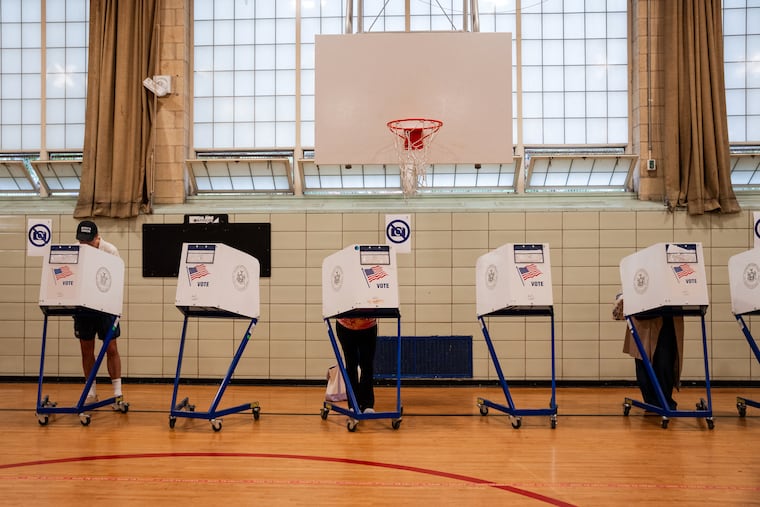
Federal shutdown may bring a halt to food assistance for half a million Philadelphians
Most SNAP households have elderly people, children, or individuals with disabilities.

Nearly 2 million Pennsylvanians — including 500,000 Philadelphia residents — won’t receive SNAP benefits in November if the federal government shutdown continues, state officials said.
The Supplemental Nutrition Assistance Program provides $366 million a month to low-income people in the state, according to the Pennsylvania Department of Health and Human Services (DHS). Most households that receive SNAP benefits consist of elderly people, children, or individuals with disabilities, according to hunger experts.
This is the first federal shutdown in at least 20 years in which SNAP will not be made available, said George Matysik, executive director of the Share Food Program, a food bank that serves 500,000 people living in the region.
“It’s like a horror movie where the call is coming from within the house,” Matysik said in an interview last week. “Our own federal government is making the choice to take benefits from Pennsylvanians,” who are among 42 million people nationwide who participate in the program.
In Philadelphia, Share has seen a 120% increase in food need over the last three years, Matysik said. “And that was with SNAP,” he added, saying the city faces a greater food crisis now than it did during the pandemic.
In an email Monday, the Pennsylvania DHS blamed Republicans “who control the U.S. Senate, the U.S. House, and the White House” for failing to pass a budget and causing the current difficulties Americans endure.
“We urge Republicans in Congress to reopen the government and protect vulnerable Pennsylvanians at risk because of this inaction,” the email said.
Gov. Josh Shapiro’s office could not be reached for comment. In May, Shapiro said that the commonwealth would be unable to replace lost funding for SNAP should the federal government fail to pay.
The U.S. Department of Agriculture, which administers SNAP, did not return calls for comment. The White House issued a statement that the shutdown is affecting personnel in its press office, delaying responses. The statement blamed Democrats for the government’s closure: “Please remember this could have been avoided if the Democrats voted for the clean Continuing Resolution to keep the government open.”
To receive SNAP benefits, individuals carry EBT (electronic benefits transfer) cards that are loaded monthly with the amounts to which they are entitled.
The shutdown began Oct. 1 after Congress could not reach a compromise to allow funding to continue. The region’s 46,000 federal workers found themselves without paychecks. The Trump administration, meanwhile, began laying off federal workers, with a goal of sacking 4,000 of them. A federal judge in California intervened to halt the layoffs. A hearing is scheduled for Tuesday.
Like other states, New Jersey faces the same funding difficulty. If the federal government remains closed by Nov. 1, about 800,000 people will be without SNAP benefits.
Elderly people who rely on SNAP will suffer throughout Pennsylvania because, for them, “food is medicine,” said Allen Glicksman, director of research at the Eastern Pennsylvania Geriatrics Society in Newtown Square. “Without it, there’s the chance of a health catastrophe that will cost more money in Medicaid and in emergency room visits.”
There are 234,638 Philadelphians age 65 and older, 104,972 (45%) of whom live below the federal poverty line ($21,150 for two individuals in a household), Glicksman calculated.
Brian Gralnick, executive director of the Center for Advocacy for the Rights and Interests of Elders (CARIE) in Center City, agreed. “Consequences will be devastating. Without federal government dollars, ending or even addressing hunger in the region will be as successful as draining the Delaware River using Eagles helmets.”
For children, the potential shortage of SNAP benefits will be no less calamitous, said sociologist Judith Levine, director of the Public Policy Lab at Temple University.
“Food is a necessary element for brain development and growth,” she said. “And there’s a clear connection between hunger and the ability to perform in school.
“This is a complete crisis we are facing.”
One in four Philadelphia children experiences food insecurity — lack of enough food over the course of a year to live a healthy life — according to a City Council report.
In the neighborhoods, the word about the halt to SNAP benefits is circulating. Fear and confusion had already been growing after the Trump administration announced changes to the SNAP program that would make it more difficult for some people to access benefits.
Among the changes: Some SNAP recipients ages 18 to 54 who are able to work and do not support a child under 18 are now required to report at least 20 hours of work, training, or volunteering per week, or 80 hours per month, to keep their benefits.
Despite the revisions to the program, however, many people these days are more worried about what happens if SNAP halts.
“People are very anxious about that,” said Pastor Tricia Neal, director of the Feast of Justice food pantry at St. John’s Lutheran Church in the Northeast.
“The anxiety level is driving more people to come here, and, because we serve 5,500 households, we are well beyond the capacity of what we can support. It’s really horrendous to look at what’s happening here.”
That much is clear, according to Rosemary Diem, who tries to stave off hunger for her and her husband by combining SNAP benefits with visits to Feast of Justice.
“Everything at the pantry is running low,” said Diem, 60, who is disabled, as is her husband, Joseph, 63. “I see us getting hurt without SNAP. There won’t be money for milk and eggs.
“How am I going to get through?”