Philly moms and babies would face steep cuts to the federal WIC nutrition program if GOP bill passes
The Trump administration wants to decrease a mother's allotments for fruits and vegetables from $52 to $13 a month.
President Donald Trump and congressional Republicans are pursuing steep cuts to the federal WIC program — a bipartisan favorite once considered to be untouchable — which provides access to nutritious food for mothers with low incomes and their babies and young children.
Roughly 35,000 people in Philadelphia rely on the U.S. Department of Agriculture’s Women, Infants, and Children program, which provides food, nutrition education, and other assistance to low-income pregnant, postpartum, and breastfeeding women, as well as infants and children under age 5. More than 20,000 beneficiaries are spread throughout the four collar counties.
The Republican-controlled U.S. House is currently considering a bill that would slice $200 million from the program’s overall $8.2 billion budget.
The bill would also slash 10%, or $141 million, of the vouchers given to qualified women for fruits and vegetables. The House pursued cuts to WIC last year, but the idea failed to win approval in the Senate.
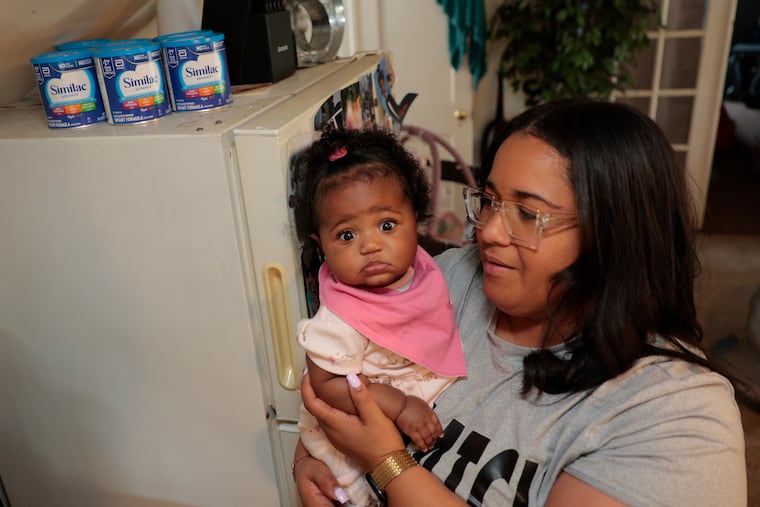
“They just don’t care what they’re cutting,” said Myriah Hamilton, 35, of Marcus Hook, who receives WIC benefits for her 4-month-old son, Bronx. With grocery prices spiking, she said, “this is the kind of thing that upsets a household like mine. How much more do you think I can bear?”
In his budget proposal submitted last month, Trump called for slashing $1.4 billion in fruit and vegetable benefits from the WIC program next year. For breastfeeding mothers, that would reduce the monthly allotment of those foods from $52 to $13; pregnant mothers would see a reduction from $47 to $13; and children under 5 would experience a drop from $26 to $10.
Cristina Codario, children’s policy director at Allies For Children in Pittsburgh, warned that reducing the program could stymie children’s growth and life chances if it makes it tougher to access healthy meals or baby formula.
Statewide, 174,000 people participate in the WIC program, according to the Pennsylvania WIC bureau. Nationally, there are 6.8 million recipients, nearly 4 million of whom are children.
“My gosh, making cuts to WIC will make things tough,” said Maritza Santana, 38, of Coatesville, the mother of a 7-month-old daughter named Meelan. “If I didn’t have enough WIC, I don’t know how we’d have enough to eat. I don’t care about me. But it’s her I worry about.” Santana makes $19 an hour as a receptionist, an insufficient salary to afford the nutritional foods her daughter needs.
Combined with the loss of Supplemental Nutrition Assistance Program (SNAP) benefits this year for roughly four million Americans — 144,000 of them in Pennsylvania — under the One Big Beautiful Bill Act, the potential downsizing of WIC could tear an already fraying safety net.
“I can’t tell you how devastating this can be,” said Joanne Craig, the WIC administrator for Delaware County.
WIC recipients are issued EBT cards that load monthly food benefits such as fruits, vegetables, milk, and infant formula based on a mother’s particular nutrition plan. The mother swipes the card at the register to pay for WIC-approved items.
WIC has long been regarded as one of the “most cost-effective, life-saving public health and nutrition programs,” according to the USDA, which administers it. For decades, both political parties committed to keeping WIC fully funded.
“Cutting WIC would be baffling and cruel,” said Sara Jann, director of policy and advocacy at the Maternity Care Coalition, advocates for children and pregnant women headquartered in Kensington.
Unlike Social Security, WIC is not an entitlement program, which means Congress must vote to fund it every year, according to the USDA.
A spokesperson for the White House Office of Management and Budget said in a statement that Trump’s budget returns benefits “back to pre-pandemic levels.” Benefits had increased when the country dealt with COVID-19. That cut will ensure that “more women, infants, and children have access to supplemental foods,” the spokesperson said, without details.
He added that the budget also proposes the “largest WIC contingency fund ever ($500 million), so that in the case of another Democrat shutdown [of the federal government], the most vulnerable Americans are protected for at least a month.”
The establishment of a contingency fund is “the only bright spot” amid the proposed cuts, according to a National WIC Association statement.
Despite the OMB statement, not everyone in the Trump administration agrees with decreasing the WIC budget. Health and Human Services Secretary Robert F. Kennedy Jr. has said he is “not happy” with the cuts to WIC, which was lauded last year “for improving children’s health” in the White House’s Make America Healthy Again (MAHA) report.
The USDA declined to comment on the proposed cuts. The Republican-led House Appropriations Committee, where the WIC bill now sits, did not respond to requests for comment.
Along with proposed cuts, Pennsylvania women who receive WIC benefits face another hurdle.
Pennsylvania is one of just eight states that use an offline EBT system, meaning that mothers must travel to WIC offices every three months to have their cards reloaded. Advocates believe the inconvenience keeps eligible women from signing up.
In every state other than Pennsylvania, Arkansas, Louisiana, New Mexico, Ohio, Texas, Utah, and Wyoming, cards are reloaded virtually, according to the Food Research and Action Center in Washington, the largest anti-hunger lobby in the United States.
As a potential remedy, Republican U.S. Rep. Brian Fitzpatrick, who represents Bucks County and a portion of Montgomery County, cosponsored a bill last year that would allow mothers in the WIC program to reload their cards virtually, and to recertify their eligibility when needed.
Making EBT cards easier to manage would be a welcome development for Hamilton, the mother from Marcus Hook, who does not relish trips to the WIC office.
But, she said, the proposed cuts to the program make her feel resentful toward Congress and the president.
“It’s always the bigger man making decisions for me without my say-so,” she said. “I want my son to have what I didn’t. But if children are the future, let’s set them up, not set them up to fail.”