A new Pa. tax credit could put up to $805 in your pocket. Here’s what to know.
State lawmakers have created a new Working Pennsylvanians Tax Credit. It'll be tied to the federal Earned Income Tax Credit and could mean extra dollars for roughly 1 million people.
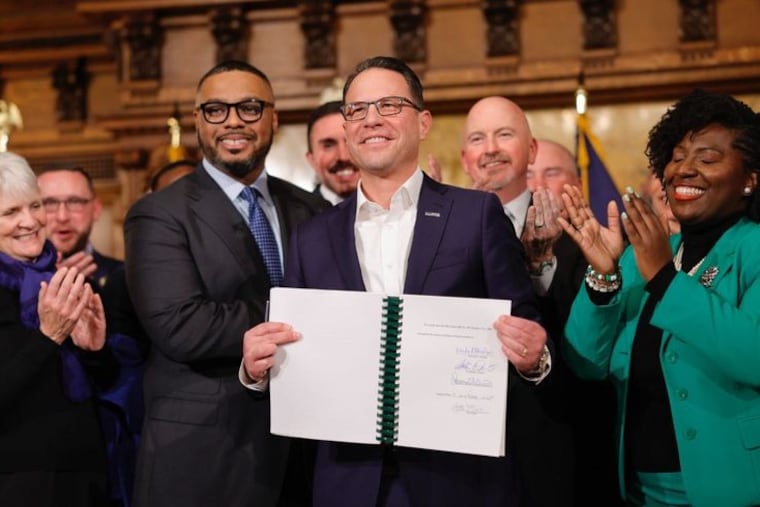
Nearly 1 million Pennsylvanians are expected to qualify for a new state tax credit that is meant to ease the burden of making ends meet.
The new Working Pennsylvanians Tax Credit will allow eligible low- and moderate-income filers to receive a state tax credit that is equal to 10% of what they qualify for through the federal Earned Income Tax Credit (EITC). Like the EITC, the state credit will depend on income and number of children. The highest credit will be $805 and, according to Gov. Josh Shapiro’s office, the average credit will be around $240.
In Philadelphia alone, 175,393 people are estimated to benefit from the new state tax credit totaling $41.7 million, according to Shapiro’s office. Statewide, it is expected to provide a total of $193 million in tax relief to 940,000 Pennsylvanians.
The policy had bipartisan support since 2023, and was led by State Rep. Christina Sappey, a Chester County Democrat. Sappey and a team of Democrats sponsored a bill that passed the Democratic-led House in May that would have allowed a 30% credit, but that figure was lowered to 10% as a result of budget negotiations with the Republican-led Senate and Shapiro.
It’s one of the measures being hailed as a major win for Democrats in the $50.1 billion state budget deal, which was approved last week after a more than four-month impasse.
Sappey said that she was approached by the United Way of Pennsylvania “several years ago” about the idea.
“I think of all of the folks who are really just struggling right now to make ends meet — but they’re working,” Sappey told The Inquirer.
“They get thrown a curveball, like an unexpected healthcare expense, get in a car accident, need a giant car repair, something like that,” she added. “They really get kind of knocked off the rails, and then they kind of spiral.”
At a news conference on Tuesday, Shapiro listed examples of Pennsylvanians who will qualify for the tax credit.
“That single mom who’s raising three kids whose making about $25,000 a year as a waitress, she can get $770 back on her state taxes on top of whatever relief she was going to get from the federal government,” Shapiro said.
“This isn’t some giveaway … we’ve come together on a bipartisan basis to say, ‘If you’re working, if you’re doing everything right by the book, we’re going to put money back in your pockets,’” he added.
Who is the Working Pennsylvanians Tax Credit for?
The tax credit is designed for working Pennsylvanians with a total income up to $61,555 if filing alone, and up to $68,675 if filing jointly as a married couple, according to the IRS guidelines for the EITC.
Eligibility for the state credit is based on the federal EITC, which is meant for low- to moderate-income workers. Workers with kids can qualify for a bigger credit that increases with the number of children up to three or more kids.
Individuals must be employed and earn income to qualify.
Households that can benefit from this program may earn too much to qualify for public assistance while not earning enough to be able to handle an unplanned financial emergency, according to the United Way. About 28% of Pennsylvanians fall into this group, according to testimony from the United Way of Pennsylvania president Kristen Rotz.
How does the tax credit work, and how much is it for?
Pennsylvania’s state credit will be 10% of the EITC amount a filer qualifies for. Filers will automatically qualify for the state credit.
“This is probably one of the more easy tasks you’re going to have to deal with as you’re helping people fill out their taxes,” Shapiro told a group of Widener University students Tuesday.
The program will begin for tax year 2025, so Pennsylvanians can use it this forthcoming tax season. The credit is refundable, so taxpayers will get money back if the credit exceeds how much they owe.
The credit amount initially increases based on how much money the earner makes and then decreases after it reaches a certain amount, resembling a bell curve, said Montgomery County accountant David Caplan. That “tipping point” differs depending on the tax filer’s status and number of dependents, he said.
The maximum state credit for filers with no kids is $65, and about 261,739 Pennsylvanians are expected to fall in that tier, according to the Office of state House Speaker Joanna McClinton, a Philadelphia Democrat.
That maximum raises to $432 for households with one child, $715 for two children, and $805 for households with three or more kids. About 133,641 Pennsylvanians are expected to fall in that maximum credit tier, according to McClinton’s office.
There were 802,000 claims for the federal EITC in Pennsylvania for the 2023 tax year, totaling $2.086 billion, according to the IRS. The average federal credit amount was $2,600. Under the new state credit, that would amount to $260.
“While it’s not much, it’s certainly a help, and that’s something that’s tangible,” said State Rep. Tarik Khan, a Democrat who cosponsored the state tax credit bill and represents parts of Philadelphia.
Do other states have a credit like this?
According to the National Conference of State Legislatures, 31 states, D.C., Guam, Puerto Rico, and some municipalities have their own version of the EITC.
Most of those states calculate their credit as a percentage of the federal program, ranging from 4% in Wisconsin to 125% in South Carolina, according to the group.
Neighboring New Jersey offers a 40% credit and Delaware has 4.5% refundable and 20% nonrefundable credits.
State Rep. Steve Samuelson, a Northampton County Democrat who chairs the House Finance Committee and cosponsored the tax credit bill, called the credit a “commonsense” measure. He pointed out how existing states have varying political leanings, from the redder Oklahoma, Indiana, and Kansas to bluer states like New York, Hawaii, and California.
“Better now than never,” Samuelson said.
Is a 10% tax credit the right amount?
Sappey and other Democrats see the 10% credit as a starting point. They hope to increase the size of the credit in future years.
“If this is a program that both sides can agree to, getting a program established is more important than, you know, how big it is at the beginning,” she said in an interview.
Caplan, who chairs the Pennsylvania Institute of Certified Public Accountants’ Local Tax Thought Leadership Committee, said he believes the 10% tax credit could be higher, but maybe not as high as the 30% initially approved by the House.
“I don’t think the 10% is outrageously low that it’s kind of chintzy,” he said. “I think it’s just a nice thing to do.”
Sen. Lynda Schlegel Culver, a Republican from Northumberland County who said she championed the policy, lauded the program for helping taxpayers who work.
“This credit rewards work, strengthens household stability, and helps those doing everything right, working, paying their bills, and supporting their families,” she said in a statement. “This is a commonsense investment in both our workforce and the future of our Commonwealth.”
Concerns from other Republicans about the program were related to the cost and its size.
Sappey said “that’s legitimate” but contends that the program helps people “increase their earning power” and that the hope is, in turn, for them to no longer be eligible for the credit. And when they get it, she argues, “they are spending it in really good ways.”
“We’re keeping people in the workforce, we’re generating revenue, and we’re keeping them out of social safety net programs,” she said.
Rotz, of the United Way, said in her testimony that EITC recipients often spend their credit on grocery stores, vehicle and home repairs, paying off debt, and sometimes education.
Khan lauded House Democratic leaders for holding onto the tax credit in negotiations — and compared their long-delayed negotiations to the Eagles’ season, which has seen the team rack up wins despite offensive struggles.
“You love them, and then you watch the game, and you’re like, ‘Goddamn it. Why can’t you just play like a normal team?’ But then they win in the end, and you’re like, ‘You know what? That was a tough game, but damn it, I’m so happy right now,’ and so that’s how I feel with this.”