Mayor Parker’s administration opposed giving death benefits to families of first responders who die by suicide. Council called it ‘cruel’ and ‘outrageous.’
City Council members erupted Wednesday after a Parker administration official testified the mayor opposes legislation to extend death benefits to the families of first responders who die by suicide.
Philadelphia Mayor Cherelle L. Parker’s administration on Wednesday came out against a proposal to provide death benefits to the families of first responders who die by suicide, sparking a fierce backlash from City Council members who called the position “cruel” and “outrageous.”
“This is possibly the saddest and most bizarre testimony I’ve ever heard from the administration,” said City Councilmember Rue Landau, one of a half dozen Democratic city lawmakers who voiced sharp criticism of the Parker administration on Wednesday. “It is painful and so deeply cruel that it is a little shocking that it’s so public and matter of fact.”
The exchange took place during a hearing of City Council’s Finance Committee, which is considering a bill to extend the city’s practice of providing death benefits to the families of city workers who die in the line of duty. Those benefits include pension payments, healthcare coverage, and other forms of compensation.
Under the legislation, the families of first responders who die by suicide can be eligible for those benefits if the individual had a diagnosed psychiatric disorder due in “significant part to exposure to one or more traumatic events in the line of duty,” or if the person died by suicide within 45 days of exposure to a traumatic event at work.
Thomas Kane, a fire department employee who coordinates a peer support team organized by the union that represents Philadelphia firefighters and paramedics, said that under the current system, a first responder could die by suicide and their family’s benefits could be cut off days later.
“This bill would take that to another level,” he said, “where they’re going to have benefits throughout. And it makes a big difference. It really does.”
But Sharolyn Murphy, the city’s risk manager, said the Parker administration opposes extending the death benefits, adding that there may be other factors outside of work events that contribute to suicidal ideation.
She did not provide a cost estimate or the number of Philadelphia first responders who die by suicide annually but said the expectation is that extending the death benefits would result in more applications at a higher cost to the pension fund.
Murphy said the administration is focused instead on suicide prevention.
“What we’re saying to the families is, we hear you that you don’t want any other families to go through what you’ve gone through,” Murphy said, “so we want to focus on preserving life. We want to focus on prevention.”
That did not sit well with Council members, who said that suicide will continue to happen even under the most effective prevention programs.
“For us to say that the work does not have an impact on the mental health — the kind of work they do is rushing into situations that we all rush to leave,” said Councilmember Nina Ahmad. “It just tells me we’re losing our humanity if we are trying to push this nonsense.”
Landau added: “You are now parsing out acceptable types of death and unacceptable types of death, and I find that outrageous.”
Perhaps the most emotional response came from Councilmember Jim Harrity, a Democrat who represents the city at-large. The son of a police officer and the grandson of a firefighter, Harrity choked up as he spoke of the toll that the work takes on first responders.
“They’re that guy that runs into the burning building, or that woman that runs at the bullets. Do you think when they get home at night, they’re not crying to themselves?” Harrity said. “I’ve seen it. My father suffered from post-traumatic stress from Vietnam and ended up in the police department, where it just got worse.”
Murphy said that the administration has spoken to the families of workers who have died by suicide, and relayed that they “said prevention was the key, money can’t bring their loved one back.”
Harrity said into his microphone: “Bulls—.”
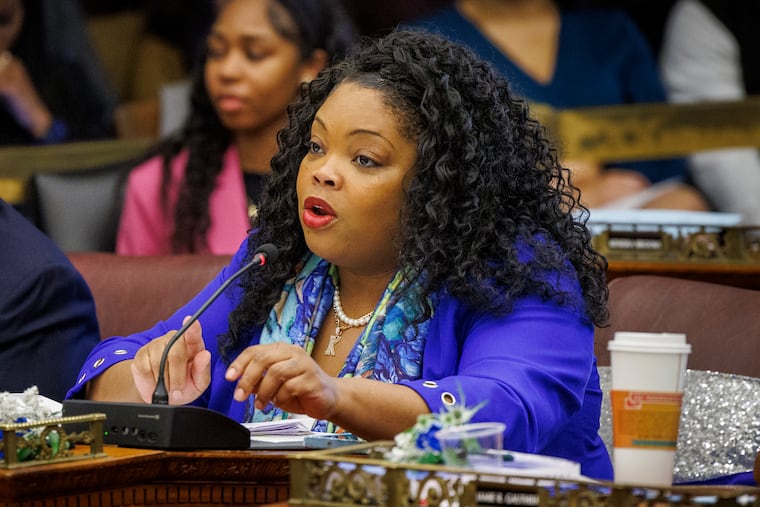
Shortly after, Majority Leader Katherine Gilmore Richardson, who chairs the Finance Committee, told Murphy that the administration’s testimony was “rough.”
“Many of us in this room have lost loved ones to this very issue, and folks that we actually know who have worked for the city of Philadelphia previously who we have lost,” Gilmore Richardson said.
She then apologized to anyone listening to the hearing.
“I’m very, very sorry,” she said. “I just want to apologize for just how traumatic and triggering I’m sure that was for so many people and their families who may have been impacted through the years.”
Gilmore Richardson recessed the hearing for several hours. Members returned hours later and passed the legislation unanimously. It is likely to come up for a full vote in Council next week.
A spokesperson for Parker declined to comment further, saying the administration stands by Murphy’s testimony.