Philadelphia FIFA World Cup committee releases a ‘thin’ human rights plan two weeks before first game
After declining to release its plan, the Philadelphia Soccer 2026 host committee finally made it public. Human rights advocates say the plan lacks specifics and comes too late.
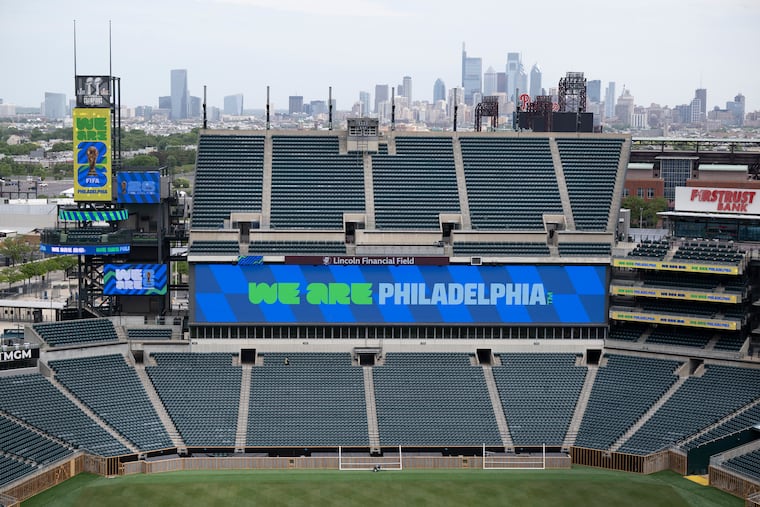
The committee charged with hosting the FIFA World Cup in Philadelphia released its plan to address human rights during the tournament Thursday, just two weeks before the first game on June 14 and after having kept the plan private in violation of FIFA guidelines.
The plan, which is intended to provide protections for fans, workers and vulnerable communities — such as people experiencing homelessness — is a new FIFA requirement for its 11 U.S. host city committees. Instituted as part of a human rights framework adopted for the first time in 2026 in response to accusations it had violated the human rights of construction workers in Qatar during the 2022 World Cup, the plan was supposed to be shared online by the host committee organizing events by May 11.
The committee, which is run by a board of local leaders including the CEO of Comcast Spectacor and the president of City Council, was asked by The Inquirer last week about its choice to not disseminate its plan online.
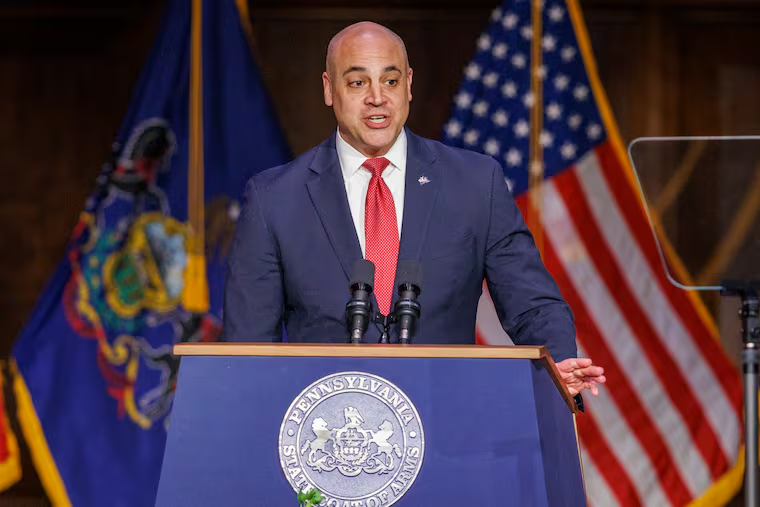
A spokesperson for the office of Mayor Cherelle L. Parker said Thursday evening that the administration supports the committee’s decision to share the plan “in the interest of transparency for the public. It’s the right decision.”
Parker serves on the host committee board as an honorary cochair.
Still, advocates say the plan is lacking.
While host cities such as Atlanta and Vancouver have published documents of 55 and 69 pages, respectively, detailing ways to improve human rights that will last beyond the tournament, the local Philadelphia Soccer 26 plan is just 17 pages long with few specifics.
“It’s absolutely thin,” said David Fair, chair of the Philly Homes 4 Youth Coalition. “The document is a Statement of Principles, not a plan. If they had a plan for the homeless, they’d be proud and mention it.”
He said he is unaware of any outreach to homelessness advocates done by the committee as it prepared the plan. “We haven’t heard anything,” he said.
Meg Kane, the CEO of Philadelphia Soccer 2026, deferred to the Parker administration on questions about how the host committee plans to address homelessness during the World Cup. She said that the committee did not meet with homelessness service providers. “Leading work with vulnerable populations is not our expertise, nor our role,” she said.
Fair is concerned that without a strategy, people who live on the streets or in public spaces will be treated by police and others running the international event like they were during Pope Francis’ visit in September 2015. “Belongings were torn up, and people were rounded up like cattle,” he said. “It was inhumane then and will be inhumane this summer if [the committee document] is the plan.”
Kane said the committee had worked for years on what she described as a “social impact agenda anchored in economic inclusion, youth engagement, and community empowerment.” It addresses “the substance of what FIFA asks,” she added.
Rather than delineating new plans, much of the committee document references how the group is “in alignment” with on-the-books laws about human rights and general city policies. And that’s a problem, said Jennifer Li, a policy lawyer at Georgetown Law who leads the World Cup Dignity 2026 Coalition, an umbrella group of nonprofits advocating for the protection of the civil rights of individuals living in host cities.
“Yes, they’re aligned with the city, but what is the committee actually doing?” she said. “FIFA had asked committees to explain enhancements and changes to already existing measures to deal with risks to human rights.”
And, Li added, being in alignment with city policies doesn’t help during a period when Philadelphia will be transformed by the influx of large crowds. “Existing city practices won’t hold up in that changed environment,” she said. “This isn’t business as usual. This plan says way too little, far too late.”
The committee released its plan amid outrage from local, national, and international advocates who wanted to know how it would handle human rights in the city during the tournament, expected to draw 500,000 visitors over six games with the official FIFA Fan Festival at Lemon Hill in Fairmount Park projected to attract more than 15,000 guests per day.
For initially withholding the document, “the Philadelphia committee gets a grade of ‘F,’” said Minky Worden, a Columbia University professor and a director at Human Rights Watch, a nonprofit that investigates human rights abuses worldwide.
“Even if their homework was done poorly, I wanted to see it,” Worden added.
The host committee board comprises leaders in Philadelphia’s business and political circles, including cochairs Daniel J. Hilferty, chairman and CEO of Comcast Spectacor, and Michelle Singer, senior vice president of political engagement at Comcast. Also on the board are Don Smolenski, president of the Philadelphia Eagles, and City Council President Kenyatta Johnson.
Honorary cochairs include Gov. Josh Shapiro, Mayor Cherelle L. Parker, former Gov. Tom Wolf, and former Mayor Jim Kenney.
Host committees are in charge of organizing fan festivals, community engagement events, logistics and infrastructure, security, ticketing, sponsorships, and other responsibilities.
According to FIFA guidelines, advocates say, the committee had about two years to write the action plan, which it was supposed to share with local stakeholders — including unions, nonprofits, and community groups — by Feb. 16 for their input before publishing the document online by May 11. Instead, the committee submitted the plan to FIFA in private in early February.
As for not previously publishing its human rights plan, Kane said that in February, FIFA changed its rule to make public dissemination of its plan optional.
“That’s incorrect,” said a source familiar with FIFA’s process. The source was granted anonymity because the person wasn’t authorized to speak for FIFA. The source explained that in February, FIFA briefly considered allowing host committees to refrain from publicizing their plans. “But in the end, the rule to publish was reasserted,” the source said. “To me, the real story here was the committee’s failure to put the plan on its website.”
Worden concurred: “FIFA had not rescinded the requirement to publish plans. It’s a ‘dog-ate-my-homework’ excuse.”
To address worker rights, Kane added, the committee has been interacting with local union officials to discuss labor relations and potential job training and placement for workers at the Fan Festival.
Referencing Danny Bauder, president of the Philadelphia Council AFL-CIO, Kane said that he and the union “have been briefed on our operational planning multiple times over the past two years.”
Bauder tells a different story.
“I’m sure the committee will put on a good show for the Fan Festival,” he said. “And we had good meetings with them last summer. But that was the extent of our contact. When it comes to the human rights plan, we haven’t worked on that with them, though I’d love to.”