Philly FOP gets pay raise in new contract, but Citizens Police Oversight Commission can’t conduct independent investigations
The FOP's proposal to fully exclude Citizens Police Oversight Commission was denied in arbitration.

Philadelphia police officers will receive a pay raise this year and next, but there won’t be rollbacks on transparency and accountability measures in their newly awarded contract as their union had initially proposed.
A panel awarded members of the Fraternal Order of Police Lodge 5 a two-year contract that Mayor Cherelle L. Parker said would cost the city a total of $343 million over five years. FOP Lodge 5 members, who are uniformed employees of the department, will receive a 3% pay increase this fiscal year and next, along with a one-time cash payment of $3,000 within 30 days and changes to improve sick leave and wellness offerings.
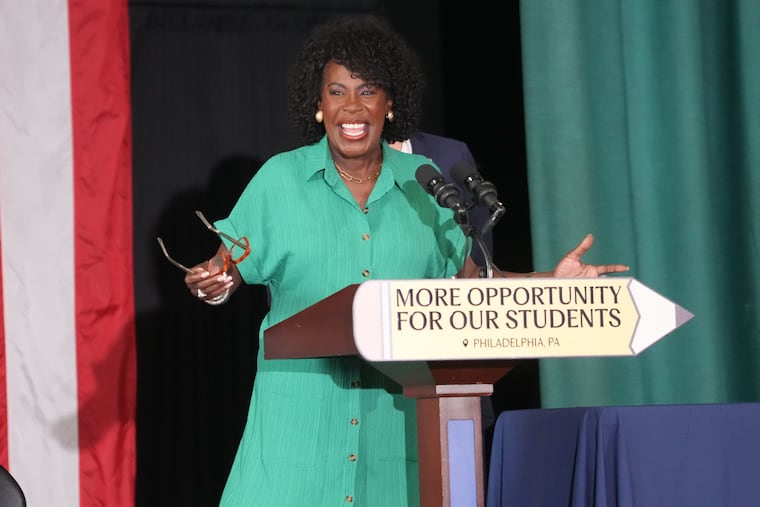
During a news conference Friday to announce the contract, Parker touted the deal and the bonus payment in particular, saying it was intended to “recognize the efforts and the sacrifices of Philadelphia’s police officers.”
Philadelphia Police Commissioner Kevin Bethel said Friday that the contract was a step toward “making us on par with our colleagues and our collar counties.”
The contract marks the third major labor agreement that Parker has announced this summer after a one-year contract extension for the city’s four largest unions expired on July 1. Last month — after a tumultuous eight-day strike — the American Federation of State, County and Municipal Employees District Council 33 reached a three-year contract with the city. A few days later, AFSCME DC 47 reached its agreement with the city.
But the contract process is different for police officers. Police, firefighters, and other public safety personnel are prohibited by state law from going on strike. Since this weakens their leverage at the bargaining table, the law, in exchange, outlines a process known as interest arbitration. A three-person panel — one chosen by the city, one from the union, and the other from the American Arbitration Association — hears from both sides and issues the contract, known as an arbitration award.
The resulting award gave the FOP a pay raise as they sought, but denied the union its bid to lessen independent oversight of officers’ conduct.
As The Inquirer reported earlier this year, the FOP wanted to end a longtime department policy of releasing the names of most officers involved in shootings; it sought to prevent the Citizens Police Oversight Commission from investigating police misconduct; and it wanted to restrict outside access to available records.
The city, meanwhile, had sought to expand independent oversight.
Instead, the arbitrators chose to largely maintain the status quo.
“The Panel has declined the City’s proposal to expand the role of the Civilian Police Oversight Commission and the FOP’s proposal to exclude the Commission from the various roles it currently plays in the discipline process,” the panel wrote in the arbitration award. “Moving forward, the Panel recommends that the Commission invest in fostering stronger relationships with both the Police Department and the FOP as it fulfills its current role.”
A spokesperson for the FOP did not immediately return a request for comment Friday, but in a letter on the the union’s website, union President Roosevelt Poplar wrote and highlighted in yellow: “Police Oversight Commission proposals all denied by the Panel.”
Tonya McClary, executive director of the Citizens Police Oversight Commission, lamented the denial of expanded oversight, but said she would keep pressing for that.
“We came prepared, we made the case, and we spoke with one voice alongside the community,” McClary said. “...Philadelphia still needs and wants independent investigations that are fair, thorough, and unbiased.”
The arbitration award also provides officers with one “wellness day” each year, effective 60 days after the issuance of the award. The day must be requested at least 48 hours in advance and cannot be used in June or July, according to the award document. The summer months tend to be the most active for Philadelphia police.
The police department will also begin a pilot program that allows members to use five days of accrued sick leave each year to care for family members. And the award calls for the city to make a $5 million lump sump payment into the FOP Retiree Joint Trust Fund and an increase in the union’s longevity scale, which is additional compensation for longtime employees.
Staff writer William Bender contributed to this article.