Housing could be built at the former Budd Co. plant in North Philly under the latest Council proposal
The sprawling former industrial site could still have life sciences and other commercial uses.
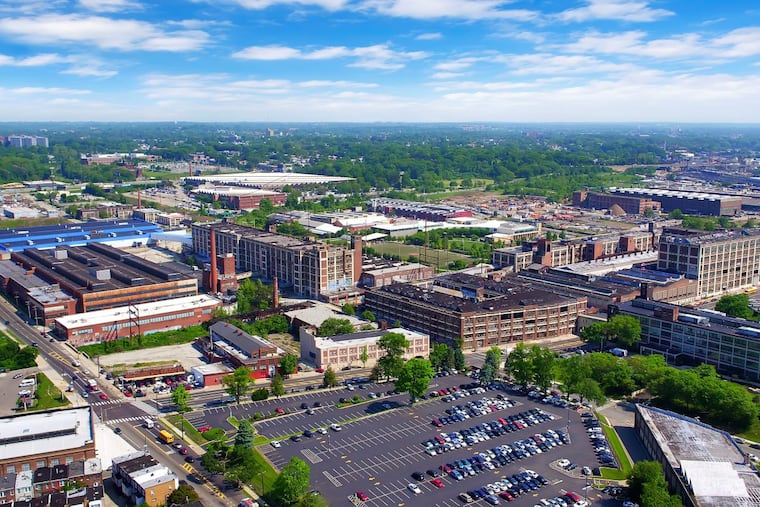
The sprawling former Budd Co. Hunting Park Plant in North Philadelphia is having its zoning changed in a move away from purely industrial land use and toward rules that would allow residential development.
The bill was introduced Thursday by Councilmember Curtis Jones, who represents the area.
It would change much of the zoning in the area between Roberts Avenue, Wissahickon Avenue, Hunting Park Avenue, and Fox Street from allowing only industrial-commercial to one of Philadelphia’s more generous land use categories, which would encourage residential building.
“This change was sought to move from purely industrial zoning to a more flexible use that allows for commercial, residential, and mixed-use development, which the market seems to be seeking for at least part of the remaining core of the Budd complex,” said Michael Davis of the Plymouth Group, which acquired the 25-acre site in 2019 for $6.5 million.
The Plymouth Group positioned the site as a “life sciences hub” following the COVID-19 pandemic.
They rehabilitated a large building on site for bio-manufacturing purposes without a specific tenant in mind and have about 600,000 square feet of space ready for use.
At that time, the real estate industry expected that biotech and pharmaceutical facilities would boom, especially as the office market struggled with the implications of hybrid work.
Instead, the sector faltered as interest rates rose and venture capital was cut off just as a lot of new laboratory space was under construction.
According to real estate services firm CBRE, the Philadelphia area’s life sciences vacancy was 22.5% in the first quarter of 2026. Competitors like the San Francisco Bay Area and Boston saw even higher vacancy.
“While a robust construction pipeline delivering mostly empty space to the market during 2024 and 2025 pushed vacancy well above even pre-pandemic levels, demand softening in the past few quarters accounted for shrinking occupancy within the life sciences real estate market,” reads CBRE’s most recent report on the region’s life sciences market.
Still, the zoning change doesn’t mean that the Plymouth Group is abandoning possible life science uses at the old Budd Plant. The property owners were looking at the two buildings on Fox Street for biomedical uses and still have hopes for that area.
“We remain committed to the Budd bio strategy on the part of the campus dedicated to biomanufacturing,” Plymouth Group’s Davis said in a statement.
But the new zoning could open up fresh possibilities for the four buildings along Hunting Park Avenue.
“We are fortunate enough, with more than 2.5 million square feet, and more than a half million square feet ready for occupancy, to be able to simultaneously accommodate a wide variety of uses,” Davis said.
The Budd Plant closed in 2003 after almost a century of life as a manufacturing center for automobiles, trains, and weaponry. During World War II, Budd employed 20,000 workers.
Soon after the closure, Trump Entertainment Resorts Inc. and partners sought to build a $350 million casino on the premises, but the future president’s company failed to obtain a state gaming license.
More recently State Sen. Sharif Street — now running for Congress — sought to locate the police department’s forensic laboratory within the Budd complex. Instead it went to another life sciences building in West Philadelphia at 4101 Market St.
There have been some successful gambits at the old industrial site. The Salvation Army’s Kroc Center and the headquarters of Temple University Health System are based at the location.
“The Budd site remains a major hub of employment in my district,” Councilmember Jones said in a statement. “This zoning change gives the parcel additional flexibility so ownership can attract a wide variety of businesses that will continue to make the site appealing and attractive to potential tenants.”