Market East stakeholders weigh revitalization plans after Sixers and Comcast announce building demolitions
Mayor Cherelle L. Parker is kicking off the public planning process for East Market Street next week.
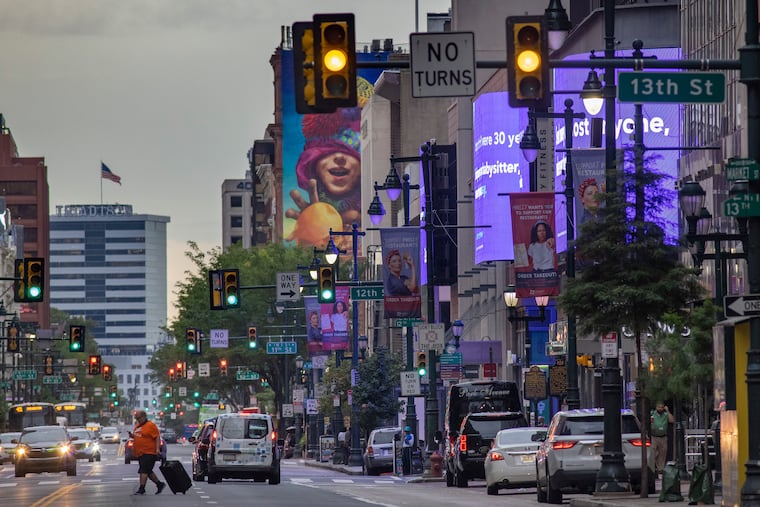
At the beginning of 2025, as the Philadelphia 76ers abandoned their planned Center City arena and the Macy’s in the Wanamaker Building announced its closure, Mayor Cherelle L. Parker promised that revitalizing East Market Street would be a top priority.
Now with the 76ers and Comcast revealing plans to demolish some of their recently acquired properties on the beleaguered corridor, Parker is making moves, too.
On Monday, the first meeting of the mayor’s long-promised Market East Advisory Committee will be held at the Convention Center. The group is chaired by Jerry Sweeney, CEO of Brandywine Realty Trust, the largest office building owner in Philadelphia.
The meeting comes as demolition notices have been posted on the former Robinson department store on 1020-1024 Market St. and a couple neighboring buildings, which the Sixers and Comcast officially purchased this summer.
“Demolition is expected to begin by the end of this year and we anticipate its completion before next summer,” said Jacklin Rhoads, spokesperson for the Philadelphia 76ers.
There are no stated plans to raze the buildings the partners purchased on the 900 block of Market.
Plans for Market East in 2026
The Sixers said last week that the vacant lots created by the demolition could be used for a pop-up events space next summer when Philadelphia will host World Cup games and celebrations for the United States’ 250th anniversary of independence.
“Our hope is these sites will be available for community programming to support increased visitation and drive foot traffic in Market East, aligning with the city’s broader revitalization efforts in this corridor,” said Rhoads.
Councilmember Mark Squilla, who represents the area, last week suggested the vacant lots created by the demolition could be used as a mini soccer pitch or a beer garden. But there are no specific plans yet.
“Comcast and the Sixers have offered to cooperate with the city and the greater Market East community to make their property available for activation in 2026,” said Karen Guss, a city spokesperson. “Discussion of what that might look like is in very early stages.”
Spurring long-term growth on Market
The Sixers’ and Comcast’s long-term plans for the site are not clear either, although the site has the most flexible zoning Philadelphia offers in terms of height and density.
The Sixers declined to comment on development plans. Building during the hectic and events-packed summer of 2026 would be logistically difficult, given the effects it could have on East Market.
“I don’t see development [happening] until 2027,” said Squilla.
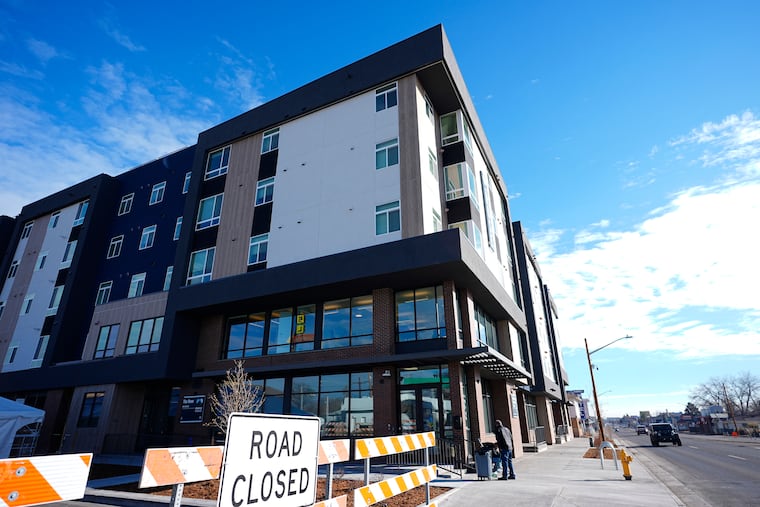
A potential model for the Sixers and Comcast is the mixed-use project National Real Estate Development built on the 1100 block of East Market.
The mix of housing, office, and retail regenerated the whole block and is considered by many real estate experts, including Inquirer architecture critic Inga Saffron, as the most successful recent development on the corridor. It includes pathways through the block, street furniture, and storefronts throughout the complex (not just on major streets).
“We wanted it to have a pedestrian scale, and that meant breaking down the super block and creating four separate development parcels,” said Daniel Killinger, president of National Real Estate Development. “We really tried to create a place with activated ground floors, at a scale that feels right for pedestrians.”
With the announcement in September that Stateside Vodka will move its corporate headquarters to the complex, the 178,081 square feet of office space at the site is 100% occupied.
The residential towers at the 322-unit Ludlow and the 240-unit Girard are at 95% occupancy. The closure of the complex’s 9,046-square-foot Iron Hill Brewery — after the whole company went bankrupt — was a setback, but the company says they have several new restaurant deals in the works. First up is the opening of Mi Vida, a national high-end Mexican chain, next to the MOM’s Organic Market at 34 S. 11th St.
Accelerated redevelopment, or rushed demolition?
Parker’s Market East Advisory Committee is not simply concerned with the Sixers and Comcast development. The group is strategizing around potential policies that could spur growth and foot traffic along the corridor, which used to be the heart of Philadelphia’s shopping district.
Monday’s session will formally open the dialogue, and Parker is expected to make public remarks on East Market at a news conference Friday. Legislation is technically possible this year, but Council’s fall session is roughly half done.
Prema Katari Gupta, CEO of the Center City District, said incentives from City Hall or Harrisburg could be key for revitalizing East Market. She cited possibilities like tax abatements, opportunity zone tax breaks, or an effort like Gov. Josh Shapiro’s initiative to revitalize downtown Pittsburgh with a mix of state, city, private, and foundation funding.
“We’re excited that the city is moving forward with planning around Market East,” Gupta said. “We’re eager to see incentives that will accelerate redevelopment. It’s critically important that the city and state play a role in creating a market for a site that’s a one-seat transit ride from one million people.”
Squilla said legislative details will be hashed out by the advisory committee and also mentioned abatements as well as zoning overlays as possibilities.
But a note of dissent has already been heard from a group of 2,400 architects, planners, and building experts about the demolition-first approach on Market East.
In a statement, the steering committee of the Design Advocacy Group (DAG) warned against razing a chunk of East Market Street without clear plans for new construction. They denounced that public planning is starting only after the private sector has begun to act.
The statement noted that a surface parking lot at 13th and Market or the “Disney Hole” at Eighth and Market could be repurposed for pop-ups of the kind Squilla described, while vacant buildings slated for demolition could be spruced up instead.
“Not far away is the gaping void on Jewelers Row, a cautionary tale about premature demolition,” the DAG statement reads. “These places remind us of past failures where rushed demolition yielded no replacement.”
DAG noted that the “the funky, curvaceous, tile-clad facade” of the former Robinson department store is slated for demolition, which they called a missed opportunity for creative redevelopment.
“A bit of strategic reuse can provide new developments with some character,” the DAG statement reads. “But the Robinson store is slated to be torn down. Once demolished, those opportunities are forfeited forever.”
Staff writer Sean Collins Walsh contributed to this article.