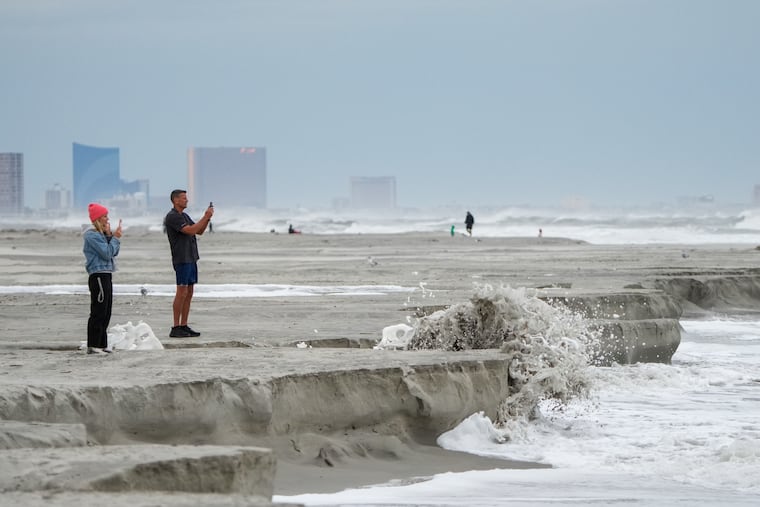
Near North Wildwood, Grassy Sound residents fear their homes will soon float away
The unique community dates to the 1880s, but sea level rise and erosion have put homes at risk.
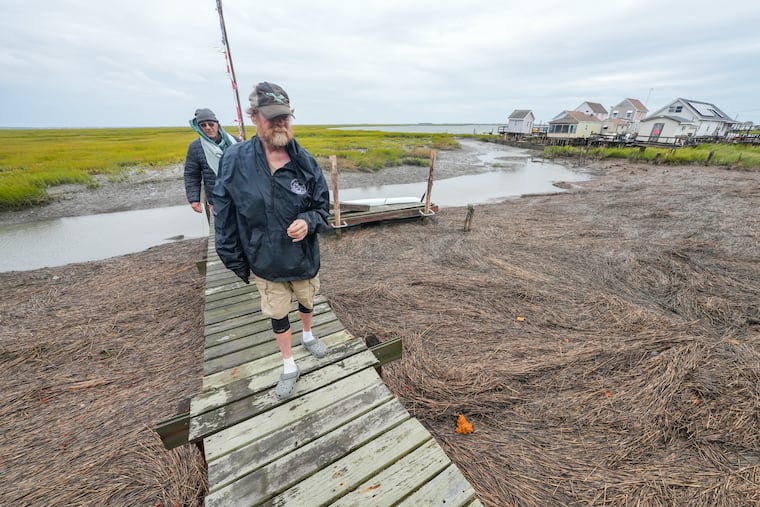
Haldy Gifford, 78, owns the outermost home at the edge of Grassy Sound, a chunk of marshland strung along the Intracoastal Waterway in Middle Township, Cape May County.
Ten years ago this month, the previous outermost home broke from its pilings and drifted into the channel during a powerful nor’easter, floating away as residents watched from the boardwalk that connects the community.
Gifford fears erosion is coming for his home, too. He and his wife, Patty, live their summers perched at the edge of the boardwalk, watching spectacular sunset views a few thousand feet from the Atlantic Ocean.
During a recent September storm, Gifford was blunt as wind whipped his poncho and battered the marsh: “We’re going to wash away. There’s no saving it.”
Unless, he said, there’s some major help from the state or federal government.
Gifford, a retired artist who lives primarily in Fort Washington, is one of multiple residents sounding the alarm over what they say is worsening erosion.
He says the marshland of Grassy Sound — a roughly 180-acre island straddling both sides of North Wildwood Boulevard — is deteriorating rapidly, and he fears it will eventually wash away.
Grassy Sound has always been at the mercy of weather, and erosion has always shaped the land. The community’s historical footings stretch to the 17th century, when whalers and fishermen plied the coast.
By 1880, a small village of several dozen homes with a boardwalk had developed around a stop on the Anglesea Railroad. Eventually, the village was incorporated into Middle Township.
There are no streets at Grassy Sound, just a boardwalk that threads among cottages. Residents park their cars at a distance and carry supplies onto the boardwalk. Macerators dispose of sewage.
The 1962 Nor’easter, Hurricane Sandy in 2012, and a string of unnamed storms have taken a toll on Grassy Sound.
Scientists say sea-level rise is hastening destruction of New Jersey’s vast marshlands. But Gifford and some of his neighbors are skeptical. They believe other forces are at work, too.
Among the factors Gifford cites are wracks — large unchecked mats of dead marsh grass that move about like floating islands looking for a place to land.
What’s a wrack?
Wracks are deposits of dead vegetation, such as cordgrass and saw grass, that interweave and are part of a marsh’s normal life cycle, even providing habitat or food for aquatic life and birds. However, excessive amounts smother marshes, converting them to bare mud, leading to erosion.
Houses at Grassy Sound are built on deep pilings. The solid marsh that borders the homes is disappearing, Gifford said, pointing at a new deposit of wracks that appeared overnight.
“The depth of water from in front of my house has gone from 23 feet to 33 feet,” Gifford said. “The channel has increased as the marshes have calved off.”
Wracks float like rudderless rafts at high tides and during storms before settling onto healthy marshland. Gifford has had someone cut the wracks with a weed whacker to break them apart so they will float off. But keeping up is impossible.
Tom Hunt, another Grassy Sound resident, said his family has owned a home there for decades. His fear is that Grassy Sound will disappear.
“The banks are coming back farther and farther,” Hunt said.
Hunt and Gifford believe erosion has also been exacerbated by human interventions, such as the construction of the bridge on North Wildwood Boulevard in the 1990s, which they say altered channel flow.
Henry Bruce, 90, who has owned a home at Grassy Sound for 55 years, said he suspects that changes in the flow at Hereford Inlet in North Wildwood’s Anglesea section have hastened erosion.
He said saw grass-covered marshland he used to walk on decades ago is largely gone.
“It is all mud there now,” Bruce said. “There’s no grass. That mud and islands of dead grass just seems to float back there. That is a major change.”
Neighbors say they need help from either the New Jersey Department of Environmental Protection (DEP) or the U.S. Army Corps of Engineers. They believe the problem could be tackled by managing the wracks on a large scale, putting in bulkheads, or using other controls.
New Jersey’s disappearing marshland
Vincent Grassi, a spokesperson for the DEP, said Grassy Sound‘s erosion is mirrored across the state’s wetlands, and cites sea-level rise.
The DEP has no program designed specifically for Grassy Sound, which does not fall within state land managed as part of the nearly 18,000-acre Cape May Coastal Wetlands Wildlife Management Area.
However, the DEP has used clean dredged material to elevate and buttress “several tracts of which are positioned around Grassy Sound,” Grassi said.
“In many parts of New Jersey, wetlands are not gaining elevation at a rate that equals or exceeds local rates of sea-level rise,“ Grassi said. ”When wetland surfaces do not keep pace with sea-level rise rates, high marsh may convert to low marsh and low marsh to mud flats or open water.”
As a result, Grassi said, birds and fish lose habitat, businesses focused on recreation or fishing can suffer, and communities lose valuable protection from storm surges.
Beyond the Sound
Two miles north of Grassy Sound in Stone Harbor, Lenore Tedesco is fighting her own battle with disappearing marshland. She is executive director of the Wetlands Institute in Stone Harbor.
» READ MORE: Racing to save Stone Harbor’s Scotch Bonnet Island before it’s swallowed by rising seas
She has been trying to save Scotch Bonnet Island, a patch of marshland behind the institute, which studies coastal ecosystems. The island is being swallowed along with New Jersey’s other tidal wetlands. Scotch Bonnet Channel, a waterway that cuts through the bay to connect the barrier island to the mainland, has widened by 70 feet since 1970.
Scientists say sea-level rise in New Jersey is running at twice the global average. They estimate the sea could rise 2 to 5 feet along the coast by 2100. That is sobering news given that New Jersey has 200,000 acres of tidal wetlands, valuable habitat used by shorebirds and other wildlife.
The state Department of Environmental Protection estimates 61% of the state’s coastal wetlands might be vulnerable. A DEP program has helped raise Scotch Bonnet Island several feet by pumping dredged sand onto it.
Tedesco, who holds a Ph.D. in marine geology and geophysics, says sea rise is a chief culprit in marsh loss and drives more flooding. That, along with overdevelopment, can hasten the collapse of marsh edges.
“The highly modified marsh area they [Grassy Sound] are in is under a lot of stress separate from sea-level rise, too,” Tedesco said.
Tedesco said healthy marshes can withstand regular assaults by wracks. Unhealthy marshes cannot.
“Wracks have been part of the ecosystem for as long as we have had marshes,” Tedesco said. "What is changing, however, is how often the marsh floods and how far into the marsh the flooding reaches. That may be accessing more volume of wrack that is moving around and also where the wrack can be deposited.”
Tedesco said marshes around Grassy Sound can turn to bare mud as storm winds pile wrack against the roadway, repetitively smothering marsh.
“I am sure it’s getting worse,” Tedesco said of erosion around Grassy Sound. “I don’t know a place that’s getting better.“