Good luck affording an apartment in Philly if you earn minimum wage
Two workers who make Pennsylvania’s minimum wage would each have to work 96 hours per week to afford the area’s median asking rent. The Philly metro is the least affordable of the 50 studied.
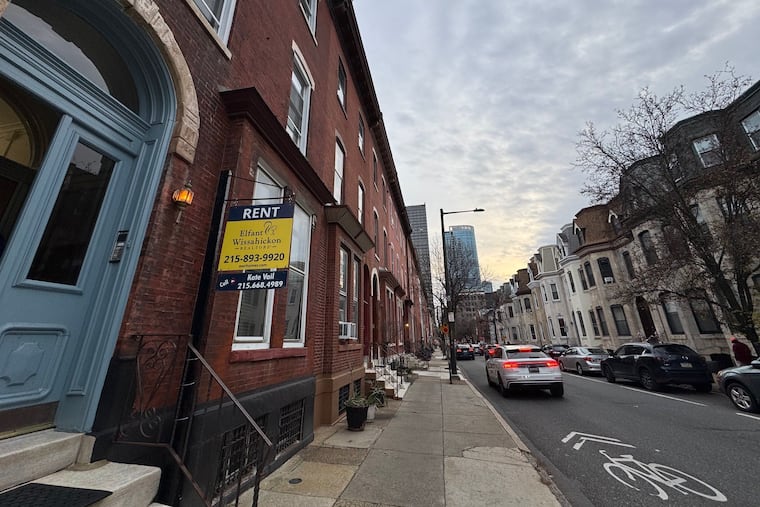
Out of the 50 largest metropolitan areas, the Philadelphia region is where minimum-wage earners must work the most hours to afford rent.
Two workers who make Pennsylvania’s $7.25 minimum hourly wage would each have to work 96 hours per week to afford the Philadelphia metropolitan area’s median asking rent of $1,739 in November, according to an analysis by Realtor.com.
» READ MORE: More Philly renters are ‘scraping by’ each month, saddled by low incomes and higher costs
Only five of the top 50 metros have rents that are affordable without overtime for a household in which two workers make the minimum wage. In all five metros, the minimum wage is above the federal floor of $7.25, and the median rent is lower than the median across the 50 metros.
The most affordable metro is Buffalo, N.Y., where two workers making the state’s minimum wage of $15.50 would need to work only 30 hours per week each to afford the region’s median asking rent of $1,176 in November.
For Pennsylvanians in the Philadelphia region, the state and federal minimum wages are the same, and the median rent is above the $1,693 median rent for the 50 metros.

Pennsylvania: $7.25
New Jersey: $15.49
Delaware: $15
Minimum wages as of Sept. 30, according to the National Conference of State Legislatures.
Joel Berner, senior economist at Realtor.com, noted that demand for workers often pushes the lowest actual starting wages above mandated minimums. But in areas with high costs of living, even wages driven higher by market forces or increases to the state minimum don’t close “the affordability gap.”
“It’s a clear signal that housing costs continue to pose a massive hurdle for those at the bottom of the pay scale,” Berner said in a statement.
Rents were considered affordable if they were no more than 30% of renters’ income.
Nationwide, rents have moderated in recent years. But in November, the median rent across the top 50 metros was still 17% higher than just before the pandemic in November 2019.
Danielle Hale, chief economist at Realtor.com, pointed out that some states’ minimum wages are scheduled to increase in the new year, which “will help to improve affordability for the most burdened households.”
“While the challenge remains immense, particularly in high-cost areas, the number of metros where two minimum-wage earners can afford a typical rental without working overtime will grow in 2026, a positive sign,” she said in a statement.
» READ MORE: Supporters rallied at City Hall for Philadelphia to get its own minimum wage and ‘free’ it from Pa. rules
Two metros are set to join these ranks next year: Detroit, where the minimum wage is scheduled to increase from $10.56 to $13.73; and Jacksonville, Fla., where the minimum wage will increase from $13 to $15.
The number of hours people need to work will drop most in Florida metros. Two minimum-wage workers living together in Tampa would each need to work 45 hours per week in 2026 to afford the median asking rent. That’s down seven hours from this year.