Educational play spaces were built at two North Philly affordable housing sites. Could they inspire similar projects nationwide?
Playful Learning Landscapes, an organization founded in Philadelphia, hopes the city can be a leader in incorporating play spaces into affordable housing communities to increase educational equity.
Regina Robinson isn’t used to being asked what she wants out of her home.
But for about a year, architects and designers had detailed discussions with her and other tenants at the Susquehanna Square subsidized apartment community in North Philadelphia about how to transform the look and feel of the development.
Robinson and her now 8-year-old daughter, Faith, went to every meeting. Residents talked about their love of graphic novels and the inspiration they found in superheroes — not just those who can fly, but real people they saw making a difference in their own families and communities.
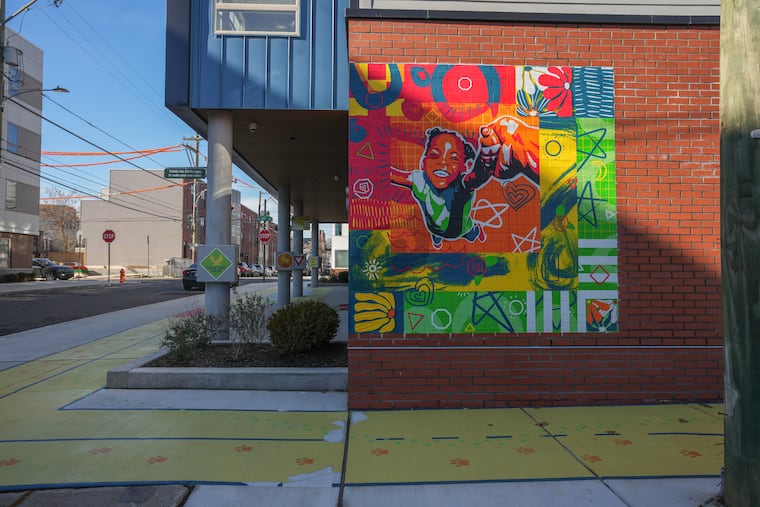
Blank white walls in apartment hallways became canvases for colorful murals of people in capes meant to inspire children and adults to have self-confidence and set goals. A previously unused bike shed now stores bikes but is also a stage for acting out stories and a puzzle wall for spelling words. In courtyards, residents got new places to sit that double as little libraries. Prompts ask them to think about the books they read and create characters and stories of their own.
“They really listened to us. … They were taking our ideas and they actually brought it to life,” Robinson, 52, said. “It really brought tears to my eyes.”
The project was an initiative of Playful Learning Landscapes, cofounded in Philadelphia in 2009 by Temple University professor Kathy Hirsh-Pasek and University of Delaware professor Roberta Michnick Golinkoff. The organization has brought the concept of playful learning — engaging children and their caregivers in skill-building lessons through play — to spaces such as laundromats, parks, grocery stores, sidewalks, and subway stops.
But installations at two sites in North Philadelphia are the organization’s first that bring playful learning to subsidized housing. And the organization and its partners hope the Live and Learn pilot will lead to similar projects across the country that help vulnerable children catch up to peers who have access to more educational opportunities.
The goal is to incorporate playful learning into all subsidized housing developments, said architect Heidi Segall Levy, project manager of the Live and Learn initiative and an associate at Watchdog, a Philadelphia-based real estate consulting firm.
“We were really trying to increase educational equity,” she said. “And the way to do that is to really bring it into [people’s] homes.”
About playful learning
Adults might not immediately understand what playful learning is until they’re reminded of childhood games.
Take Simon Says, for example. Children learn to retain information, evaluate the directions they’re given, and follow through. I Spy helps children learn how to describe their surroundings. Matching games strengthen memory and help kids recognize patterns.
Playful Learning Landscapes wants to transform any space where children and caregivers spend time into somewhere they can engage with each other. The organization has dozens of installations in Philadelphia and projects in about 30 U.S. cities and about 10 countries.
One goal of the Live and Learn pilot was to train housing providers to continue the work.
“Our hope in the future is that developers and designers will be thinking about how to build playful learning into the architecture,” Segall Levy said. And eventually, “playful learning will just be included in public space design.”
Most of the pilot’s funding came from the William Penn Foundation, which contributed $647,250.
The foundation has invested about $26 million in playful learning projects in Philadelphia over the last decade and wants to see playful learning elements become standard in recreation centers, parks, libraries, and other places, said executive director Shawn McCaney.
“We believe every neighborhood should have access to high-quality public spaces” that can support community building, safety, and children’s development, McCaney said. “These kinds of spaces can become really important points of pride and engagement in communities.”
Super at Susquehanna Square
David La Fontaine, who recently retired as executive director of the nonprofit housing developer Community Ventures, was immediately interested when he was approached about adding playful learning to his Susquehanna Square apartment complex.
“A program that helps young kids in school was really what made me most interested,” La Fontaine, the son of a public schoolteacher, said.
Community members’ vision came to life with the help of KSS Architects.
Susquehanna Square resident Merlyn DeJesus, 61, likes to sit in her building’s backyard and take in what the space has become. Young residents now have things to do when they go outside. They draw on a chalkboard, spin the letter tiles of a puzzle, and turn wheels to create their own superheroes.
DeJesus and her 8-year-old granddaughter read books together from the little library, where community members can take and leave titles. Her granddaughter also helped paint superhero murals, which are on each of her building’s three floors.
It all makes the space feel “more homey,” DeJesus said.
“I feel proud inviting people to come to my home,” she said.
Transforming community spaces
Playful Learning Landscapes focuses on tailoring projects for specific communities based on extensive outreach.
For example, residents in the Sharswood area of North Philadelphia noted that nearby Ridge Avenue has lots of fast-moving traffic. So they said they wanted their children to learn about street safety in the Live and Learn project that was focused on subsidized homes developed by Pennrose in partnership with the Philadelphia Housing Authority.
At the “Run the Road” installation, a colorful street is painted on a sidewalk. Children can spin traffic signs and learn what “yield,” “keep right,” and “one way” mean. They learn about crosswalks. They can step on animal prints and walk like the creatures.
Residents also said they didn’t have open space they could enjoy. So the Live and Learn project transformed a small strip of unused land into a pocket park. It has seating and a little library. There’s a puzzle and matching game and wheels children can turn to create their own animals and tell stories based on their creations.
Darnetta Arce, executive director and founder of the Lower North Philadelphia Community Development Corp., said the space has become a safe, peaceful place for neighborhood residents.
“Anytime you take blighted property and change it into a beautiful play and sitting area, I think that’s great,” she said. “There is no longer an eyesore in this community.”
Inside the community room of a new subsidized apartment building at 2000 Ridge Ave., what was originally going to be a blank white wall became a mural featuring a map of the neighborhood with cultural landmarks. The room also features tabletops with activities, such as chess, matching games, word games, and storytelling prompts.
Architecture firm WRT worked on the installations. Associate Lizzie Rothwell has been an architect for more than 15 years and said she doesn’t usually get so much breathing room to collaborate with community members.
“Within my professional career, it was a pretty unique opportunity,” Rothwell said. “It was one of the more rewarding experiences I’ve had working with a community on a design.”
Looking ahead
Now, Playful Learning Landscapes wants to pursue public policies that support the expansion of playful learning projects and provide incentives for developers and architects to incorporate this work into their plans, said Sarah Lytle, the organization’s executive director.
Playful learning advocates briefed City Council members this fall about their work. In September, the city’s Department of Planning and Development issued a call for proposals to create or preserve affordable housing and encouraged developers to include art or design elements that foster children’s development.
“We’re starting to see some traction,” Lytle said.
More than seven months after the opening of the play spaces at Susquehanna Square, Robinson and her daughter now live in South Philadelphia, but they’ve come back to visit the murals they helped paint and the installations they helped develop.
“To see it and to know it’s going to always be there,” Robinson said, “it brings a lot of joy to me.”
