Eat catfish, save the blue crab: How Chesapeake Bay restaurants are helping save the iconic crustacean
Eating blue catfish has become one way of helping protect the region’s iconic blue crabs, which have been in decline for decades, and are savored by the fish.
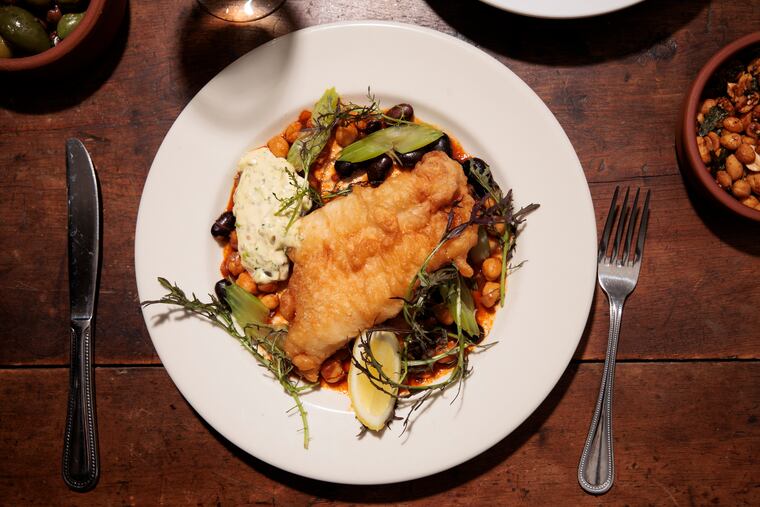
Chef Scott Harrison of Boatyard Bar & Grill in Annapolis, Md., has taken on a dual mission in recent years: aid in restoration of the Chesapeake Bay by elevating the invasive blue catfish as a culinary star.
The restaurant’s menu showcases the versatility of the fish, featuring it as filleted, stuffed, smoked in a dip, prepared as croquettes, or placed in a po’boy with Cajun remoulade.
Harrison says the fish is easy to prepare and can be panfried, sauteed, or broiled. The flaky, mild-tasting flesh resembles that of striped bass, he said.
“We’re pushing hard to try and get this fish out of the water and create more of a better view of it from the prospective customer,” Harrison said. “Blue catfish is a great fish to eat.”
August has been designated Catfish Month around the Chesapeake Bay, where restaurants are encouraged to feature the fish on their menus as a way of protecting the region’s iconic blue crabs.
Think beloved blue crab vs. voracious blue catfish.
While the blue crab’s population decline is multifaceted, the millions of blue catfish now inhabiting the waterways are accelerating the drop. Harrison said blue catfish now constitute 80% of the watershed’s biomass and prey on blue crabs, and nearly everything else.
Unlike other bottom-feeders, he said, blue catfish consume prey throughout the entire body of water, and are not oily to eat.
Indeed, eating blue catfish has become a gastronomic act of duty around the bay. Restaurants proudly announce it on their menus. The Maryland Department of Agriculture features a list of restaurants that serve it.
Blue catfish are introduced
White catfish are native to the Chesapeake watershed, but blue catfish, I. furcatusis, are native to rivers in the U.S. South.
Virginia introduced blue catfish from Mississippi into the James and other rivers in the 1970s as a sporting fish. It took years, but blue catfish eventually found their way to the main stem of Chesapeake Bay.
By 2011, the population had swelled so much that the Atlantic States Marine Fisheries Commissions officially declared it to be an invasive species and issued a directive that “all practicable efforts” were to be made to reduce the expansion.
Blue catfish began outcompeting native species through predation or gobbling up much of the food. White catfish populations declined.
As the numbers of blue catfish increased, they began to deplete the amount of blue crabs, Callinectes sapidus, one of the most valuable species of seafood harvested in the region.
Blue crabs have been found in 32% of stomachs from blue catfish sampled, researchers noted in a recent paper published in the journal Marine and Coastal Fisheries.
Commercial fishing operations and recreational anglers now widely fish for the species, said the research, led by the U.S. Department of Fish and Wildlife Conservation and Virginia Polytechnic Institute and State University.
As a result, competing interests emerged as trophy and commercial fishing for blue catfish grew while others were trying to limiting the fish’s ecological impacts.
The Oyster Recovery Partnership, dedicated to oyster restoration, notes that commercial harvest of blue catfish grew from 600,000 pounds in 2013 to over 4.2 million pounds in 2023. The partnership is concerned because blue catfish prey on young oysters.
Decline of crabs in the bay
Meanwhile, blue crabs are in decline.
Chesapeake Bay natives have long been proud of the crabs, a staple for restaurants that draw natives and tourists who hammer away at the shells to extract the tender meat, often washed down with beer.
Maryland has conducted an annual survey on the state of the crabs for 30 years as a way of measuring not only the health of the crabs, but also that of the bay. The state coordinates with Virginia and the Potomac River Fisheries Commission.
Though the number of crabs bounces around from year to year, the downward trend is clear. In 1991, the bay contained an estimated 828 million crabs. By 2025, that had fallen to 238 million, a 71% decrease.
This year saw the second-lowest number of crabs since surveys began in 1990, and the lowest number of male crabs ever.
‘Facing some challenges’
According to Chris Moore, executive director of the Chesapeake Bay Foundation in Virginia, blue crabs are “definitely facing some challenges.”
Crabs have declined for a number of reasons, including climate change, pollution, and habitat loss, according to Moore’s organization, a nonprofit that advocates to protect the bay.
While many factors contribute to the crabs’ decline, Moore said, the non-native, invasive blue catfish is “definitely impacting the blue crab population.”
He emphasized the need to address the blue catfish population not only for the blue crabs but also for other species like American shad, striped bass, and river herring.
A 2002 study by the Chesapeake Bay Program, a partnership devoted to restoring the bay, and the National Oceanic and Atmospheric Administration (NOAA) found that blue catfish consumed 2.3 million juvenile blue crabs over 40,000 acres of the James River.
Eating blue catfish has become one way of fighting the decline.
Kevin Schendel, general manager of Boatyard Bar & Grill, said his and other restaurants are working to get the word out, and to overcome a bias many people have against consuming catfish. Blue catfish are better eating, he said.
“It’s all about educating people,” Schendel said. “Blue catfish is a really versatile fish. There’s a lot of ways you can go. It’s inexpensive and it’s plentiful.”