‘Drumming saved my life’
The Sixers Stixers bring more than just the team’s gameday beat — the drum line also provide opportunities for inner-city youth.
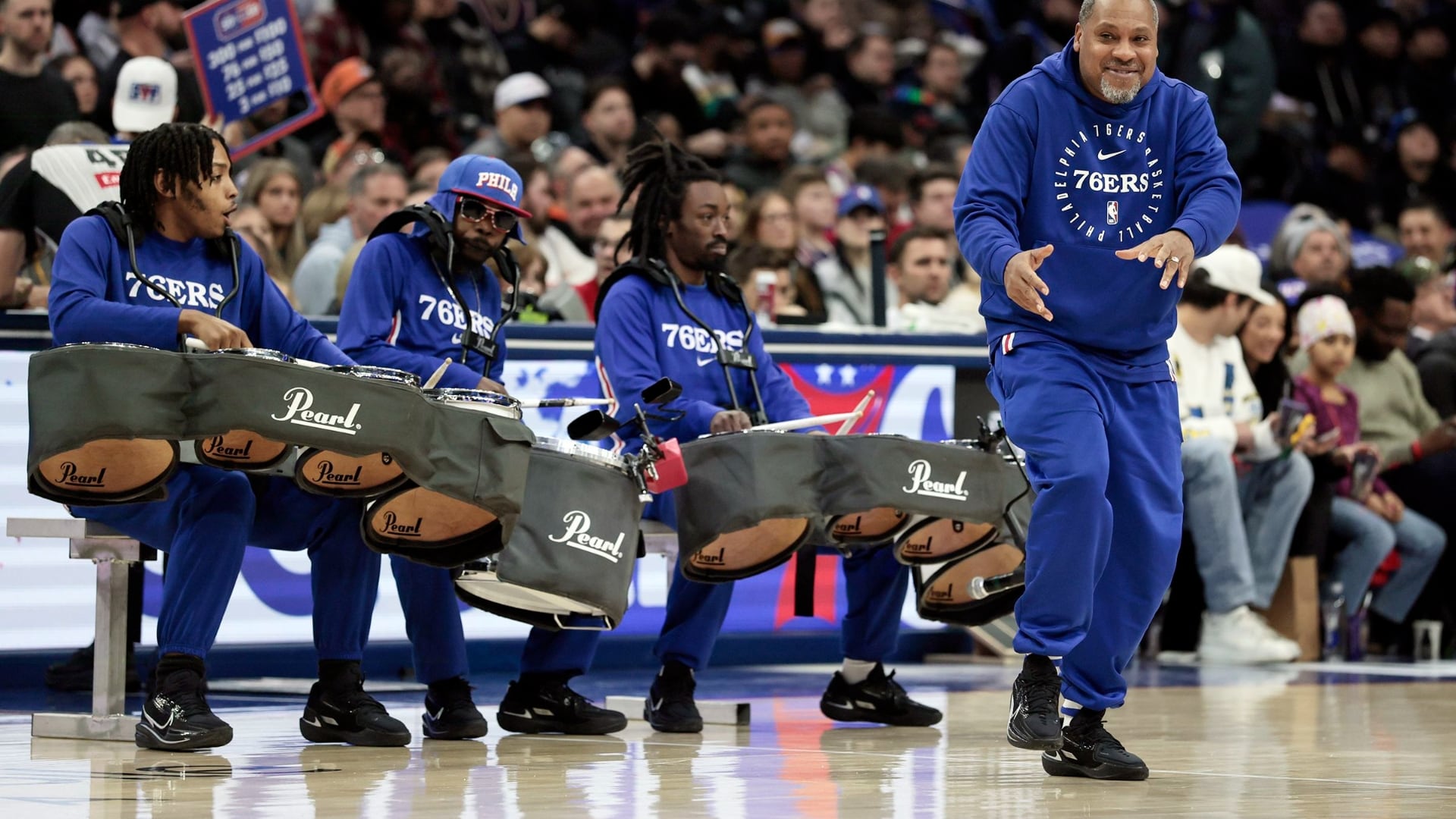
Walking through the main concourse of Xfinity Mobile Arena after a game, fans often hear the faint sounds of drums rattling in the distance. If one follows the high-pitched rhythm of the snare to the melody of the tenor and eventually to the deep pulse of the bass, they’ll find the Sixers Stixers.
The group has been the official drum line of the 76ers dating back to 2013. For over a decade, they’ve performed in perfect cohesion — relying on teamwork, discipline, and unity — building lifelong friendships deeply rooted in brotherhood, and providing life-changing opportunities for inner-city youth through the power of music.
“We have nothing else,” said 46-year-old Antoine Mapp Sr., the director of the Sixers Stixers. “Everyone don’t play sports, everyone don’t play basketball, everyone don’t play football, everyone don’t play baseball, everyone don’t bowl. However, music is universal. Music touches the soul.
“When you’re part of a team, you start feeling accepted. You start feeling like you belong to something, you start feeling important. All kids really need is love and affection. You don’t know what these kids go through at home. You don’t know what they go through in school, but when it comes to being a part of something like this, we all family, and we say before we leave, ‘I love you, bro,’ because I don’t know if he’s going to make it back tomorrow.”
‘Take these drum sticks, jail cell, or graveyard’
In 1991, Mapp was first introduced to drumming by his late grandmother, Elsie Wise. To keep young boys and girls out of trouble in the West Powelton neighborhood, Wise created a drum line and drill team known as the West Powelton Steppers and Drum Squad, which still practices today.
“My grandmom came to me and said, ‘Well, I’ll give you three options: take these drum sticks, jail cell, or graveyard,’” Mapp recalled. “I decided to pick the drumsticks. And I asked her what I’m supposed to do with these drumsticks. She said, ‘Figure it out.’”
“They used to disrespect us, call us names, say vulgar things about our sexuality ... They didn’t understand music and how it touches the soul and how it saves your life.”
At that time drum squads and drill teams weren’t as accepted. At 11 years old, Mapp remembers being called every name in the book.
“In the ’90s, drill team wasn’t accepted,” Mapp said. “They looked at us as being wimps, looked at us as being cowards, looked at us as being punks. They used to disrespect us, call us names, say vulgar things about our sexuality because they didn’t understand drumming, they didn’t understand the culture. They didn’t understand music and how it touches the soul and how it saves your life.”
However, that culture was on full display when Mapp attended Cheyney University, the nation’s first Historically Black College and University. He decided to attend Cheyney, on the border of Chester and Delaware Counties, to stay closer to home — giving him time to continue helping with the West Powelton Steppers and Drum Squad.
In 2001, Mapp became the first person in his family to graduate college, with a major in accounting and minor in computer programming. And as he pursued his degree, he joined the Cheyney drum line.
“The band is the culture of the HBCU,” Mapp said. “The band is the heartbeat. The band is the lifeline. The band is what draws the attention. The sports team being good is a bonus when it comes to an HBCU.”
» READ MORE: HBCU excellence was on display Thursday at the Linc, and the stars were out to witness it
Not only was it the lifeline of the HBCU, but it was the lifeline for Mapp himself. The Philly native credits the drum line for saving his life.
“First of all, making it to 18 years old where I’m from, it’s like making it to 100,” Mapp said. “We used to make it to 18 and say, ‘OK, we have nothing to live for. We made it.’ That’s the mentality we used to have. Drumming saved my life. … The drill team and drum line raised me because the guys on the team became my brothers. The young ladies on the team became my sisters.”
A family affair
“Break down!” Mapp yelled as the Stixers began to choreograph their routine for the halftime show of a recent game against the Wizards.
Listening to the order, the rest of the Stixers changed formation — closing in on one another as they drummed out the melody that was discussed on their ride to the stadium. Wearing matching Sixers gear, their black Nikes moved in perfect harmony — one pair looking rather smaller than the rest.
That pair belonged to 11-year-old Antoine Mapp Jr., the son of Mapp, who joined the Stixers at the start of the season. After their first performance together, Mapp sent out a message to another famous father-son NBA duo.
“When I seen LeBron [James], it was the best feeling in the world,” Mapp Sr. said. “I said to LeBron, ‘Hey Bron, you ain’t the only one on the court playing with your son. It was a beautiful moment. Just to be able to say that, I never thought in a million years that I would be on the Sixers floor in the NBA drumming alongside my son. It’s the best feeling in the world.”
If you would have told Mapp that he was going to be performing alongside his son on the Sixers court in 2014, he would have never believed it.
“I just lost in 2014,” Mapp said. “I just lost my job. My son, Antoine, they told me to abort him. They told me that his stomach and his lungs were growing in his chest. They told me he wasn’t going to walk, talk, run, or do anything. My grandfather, the only father figure that I knew, was in the hospital passing away. I was losing my son and my grandfather.
“On Father’s Day, I lost my grandfather. My son was in the NICU for six months. He was the only baby that survived the NICU.”
I said, ‘Ok, I’ll do it for free.’ ... Drumming was my payment. My life being saved, that was payment enough.
Throughout all the struggles, drumming was one thing that helped him persevere. Mapp remembers sitting in the parking lot and praying for guidance.
“[The Lord] spoke to me,” Mapp said. “That same week, I got a phone call from [76ers director of game presentation] Derrick Hayes. When Derrick called me he said, ‘Well, we’re calling you about being a Sixers drum line.’ I said, ‘OK, I’ll do it for free.’ That’s what I’m used to with the after-school program. Drumming was my payment. My life being saved, that was payment enough.
“When he told me that he was going to pay me for doing the game, a light bulb went off in my head. What is one of the reasons why there’s so much crime in my neighborhood? Lack of funds. That’s one of the reasons. So, I said, ‘OK, if the Sixers are paying us, let me change my program to I pay you to save you.’”
‘Don’t ever stop’
In 2020, Mapp’s 29th season helping with the West Powelton Steppers and Drum Squad, he had his last conversation with his grandmother.
“Before she took her last breath, I asked her, ‘Why am I still here?’” Mapp said. “She said, ‘Because you still love it.’ The last thing she said to me, she said, ‘Don’t ever stop,’ and took her last breath.
“That’s been ingrained in my brain ever since — and I haven’t stopped.”
“I can’t wait to see what my son does with it 20 years down. ... I’m so honored to be a West Powelton drummer and to be a Sixer Stixer.”
Mapp has spent over three decades with the West Powelton Steppers and over a decade with the Sixers Stixers, performing alongside children as young as 4 years old to grown men in their 40s.
“We have no age limit,” Mapp said. “We don’t cap out. We’re in your life for the rest of your life. It’s our 35th year, and we have so many people that are still part of this group and have kids who are part of the group.
“I can’t wait to see what my son does with it 20 years down. I can’t wait to say we’ve been with the Sixers for 50 years, I’ll probably be like 96. But, I’ll still be here. And I’ll still be out there leading my guys. I’m so honored to be a West Powelton drummer and to be a Sixer Stixer.”