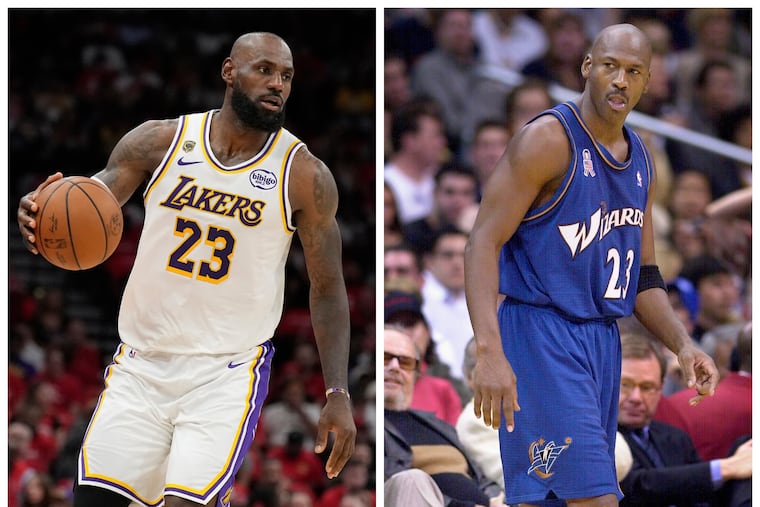
LeBron James-Michael Jordan comps can get tiresome. But here’s one that should matter to the Sixers.
The stakes of Jordan’s return with the Wizards in 2001 weren't nearly as high as James’, but it provides a useful precedent for how the daily drama of LeBron’s time with the Sixers might unfold.
There is no perfect historical analogy for what LeBron James is attempting with the 76ers or for what the Sixers are attempting with him. He will turn 42 in late December. He has appeared in more NBA games than anyone. He will soon begin his 24th season in the league without a pause — no temporary retirements, no full seasons missed because of injury. And he has joined a team that has not won a championship since 1983, was already capable of competing for one next season, and because of his arrival will be expected to win one.
The figure to whom James is most often compared, of course, is Michael Jordan: for records and achievements accumulated, for championships won, for the aesthetics of their styles of play. Now they have another point of relative similarity. Jordan was 38 when he ended his second break from the game and played two seasons with the Washington Wizards. If the collective stakes of his return weren’t nearly so high as James’ decision to sign with the Sixers — the 2001-03 Wizards went 74-90, missed the playoffs both years, and even with an in-his-prime Jordan wouldn’t have had a prayer of winning a title — Jordan still provided a useful precedent for how the daily drama of James’ time with the Sixers might unfold.
» READ MORE: Draymond Green is right about VJ Edgecombe. But he couldn’t be more wrong about LeBron James.
The details of that story were preserved in a book, When Nothing Else Matters: Michael Jordan’s Last Comeback by Michael Leahy, that is as good as anything ever written about any topic related to basketball. Leahy was a staff writer for the Washington Post at the time he immersed himself in Jordan’s world, but he was not a sportswriter; he had nothing to lose, no sources to burn or fans to alienate, by documenting Jordan’s tenure in Washington with remarkable depth and unsparing honesty.
Published in 2004, When Nothing Else Matters has been memory-holed for more than two decades. It didn’t refresh and amplify the mythology around Jordan in the way The Jordan Rules or The Last Dance did, so it doesn’t resonate in the public consciousness much anymore. But it does serve as a cautionary tale about the nature of superstardom — the kind that only the chosen few, Jordan and James among them, enjoy — and its lessons apply just as well to the Sixers and Philadelphia as they did to the Wizards and Washington. Here are five important ones:
Lesson 1: The Wizards’ leadership kowtowed to Jordan. The Sixers’ leadership can acquiesce to James only so much.
One of the recurring themes of When Nothing Else Matters is the control Jordan exerted over the Wizards’ entire organization, starting with his friend and handpicked head coach, Doug Collins.
“Whenever an issue critical to the team’s well-being arose,” Leahy wrote, “Jordan bent Collins to his will — whether it was over Jordan’s playing time, or who among his teammates deserved to start or not start, or what kind of offense or defense to deploy. Collins’s lack of power illustrated the dangers in allowing any team’s Zeus to rule over a coach and franchise.”
Bob Myers has gravitas and four championship rings from his years with the Golden State Warriors. Mike Gansey has a good relationship with James from their time together with the Cleveland Cavaliers. Nick Nurse won a championship in 2019 with the Toronto Raptors — and with a superstar, Kawhi Leonard, who can be a challenge to manage. They have to assert and maintain their authority, or at least some semblance of it, in the face of James’s esteem and power. James won’t necessarily be as controlling and demanding as Jordan, but he can be controlling and demanding enough. He’s accustomed to getting his way all the time, and it would be a lot to expect him to be just along for the ride now.
Lesson 2: Expect tension among the players, especially the best ones.
Jordan’s verbal abuse of rookie Kwame Brown, including calling him a “f—g flaming f—t” during practice, was among the salacious revelations in Leahy’s book. But Jordan’s relationship with Coatesville native Richard “Rip” Hamilton throughout the 2001-02 season is the more relevant one for the 2026-27 Sixers. “There was a lingering tension” between Jordan and Hamilton all season, according to Leahy, in part because Hamilton, in his third season and just emerging as one of the league’s better perimeter scorers, believed it was time for him to assert himself as the team’s centerpiece and that Jordan was holding him back.
» READ MORE: LeBron James and nine other stars who stunned Philly simply by coming here
Just because Jordan and Hamilton clashed doesn’t mean James, Joel Embiid, Jaylen Brown, Tyrese Maxey, and VJ Edgecombe won’t get along. But the Sixers have to prepare for the possibility, even the likelihood, that this team won’t be a smooth-running, ego-free machine. Brown is 29, was the MVP of the 2024 NBA Finals, and — despite the debate around whether he is an analytically efficient player — is regarded as a star. Embiid is a former league MVP. Maxey is approaching his peak years, as is Edgecombe. And James, like Jordan, hasn’t deferred often to anyone in his career.
Lesson 3: Time will take its toll on an older player, even one as great as Jordan or James.
Jordan, remarkably, played all 82 games in his final NBA season, but he struggled with tendinitis throughout 2001-02, missing 22 games. James hasn’t appeared in more than 71 games in any of his last eight seasons; in five of those seasons, he played 60 games or fewer. Never forget: Father Time is Rocky Marciano.
Lesson 4: The honeymoon will end, and victories had better follow.
Jordan’s two years in Washington are not remembered as a great and glorious portion of his career, for the simple reason that the Wizards still stunk with him. The Sixers aren’t likely to fall on their faces with James. But the pressure on them will be immense, and patience with a losing streak or a stretch of subpar play will be thin, if any patience exists at all.
“Sports fans can be a cruel, monomaniacal breed,” Leahy wrote. “Only games and standings matter to the most rabid, which, depending upon how you want to look at it, evinces either an endearing, childlike intensity or a severe case of arrested development.”
Lesson 5: There was more to Jordan’s comeback — and more to James’ joining the Sixers — than winning.
“The truth was this: A sporting god enjoys supreme power only as long as he plays, earns and fills seats,” Leahy wrote. “The moment he ceases to be a team’s principal revenue stream is the moment his dominion ends.”
James said that he considered retiring, that he changed his mind because he still wants “to work … to grind … to compete,” that his desire to win another championship was the reason he came here. Here’s a safe bet: It wasn’t the only one. He will fill more seats in Philadelphia than he might have anywhere else, and you’re naive to think that intoxicating sensation wasn’t on his mind when he made this decision. LeBron James is as much a sporting god as Michael Jordan was, and to be treated as such is the most powerful drug on earth. He doesn’t want to exit the stage as anything less.

Purchase a front page reprint of The Philadelphia Inquirer from Saturday, July 25, 2026, featuring LeBron James following the news that he was joining the 76ers. Buy it here.