The NBA thinks it solved its tanking problem. But some La Salle researchers might have a better fix.
Did the NBA get it right? A La Salle department chair and two of his students have their own solution based on math and data.

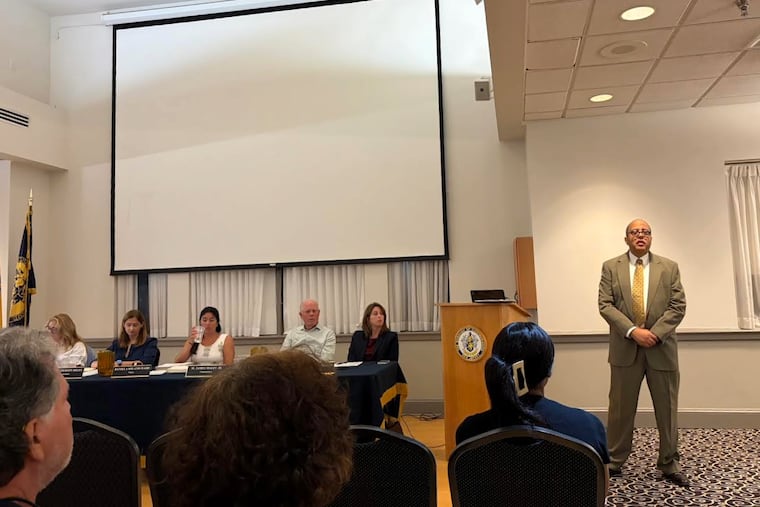
Before he and two of his best students began figuring out how to stop NBA teams from tanking, T.J. Highley, the chair of La Salle University’s math and computer science department, thought they would take on a less challenging problem: the security of American elections.
It seemed a perfect research project for the summer of 2025. But it took Highley, senior Tannah Duncan, and junior Ilia Volkov just a week to learn that there was no new algorithmic or mathematical method they might invent or uncover to make sure voting mechanisms couldn’t be compromised. One country already had secure elections. One country already had figured it out.
“It was disappointing to say, ‘Estonia can do it. Why can’t we?’” Highley said in a recent interview.
So they turned their attention, and their graphing calculators, to the NBA lottery. They came up with a solution. They wrote an academic paper detailing their proposal. They submitted the paper for peer review and publication. And they waited. And they waited. They’re still waiting.
Meanwhile, the NBA’s board of governors voted Thursday to implement an anti-tanking policy of its own, one that expanded the number of lottery teams from 14 to 16 and lowered the odds that the worst teams would get the highest draft picks.
So … did the NBA get it right? Will these new rules actually curb the collective white-flag-waving by some franchises that has plagued pro basketball in recent years and damaged the NBA’s brand? Highley and his students are in as good a position as anyone to know. Let’s see whether the NBA’s process ought to be trusted.
3, 2, 1 ... COLA
Around here, of course, the word tank calls to mind Sam Hinkie and his plan to have the 76ers bottom out for multiple years so he could eventually (in theory, at least) build them back up again.
Highley, for his part, had no issue with Hinkie’s disassembling of the Sixers’ roster and drew a distinction between those measures and the ones used this season by teams such as the Utah Jazz and Washington Wizards, who frequently benched their best and most accomplished players in the middle of games.
“Sam Hinkie’s thing didn’t bother me at all,” Highley said. “He saw the incentives, and he was playing for the incentives. This is exactly what you should do to build a championship team. Whereas this year, you put together a team, and then you’re going to pull players off the court. It doesn’t feel like the general manager is playing for long-term draft help, and the coaches and players agree to go along with it.
» READ MORE: Mike Sielski: Bob Myers and the Sixers’ new player-personnel chief have to … yes … change the team’s culture
“What Sam Hinkie was doing was the right strategy in a bad system. Fix the system so it’s not the right strategy.”
Still, it’s hard to deny that Hinkie’s strategy begat this recent full-on acceptance of tanking — and the NBA’s attempt to curtail it.
In the lottery drawing under the new regulations, 37 balls would be distributed among the 16 eligible teams, with the worst three teams receiving two balls each. To dissuade franchises from trying to be terrible, each of the next seven worst teams would receive three lottery balls. The two clubs that finish ninth and 10th in the play-in tournament would get two balls each, and the two clubs that lose the conferences’ No. 7-No. 8 play-in games will get one ball each.
Highley believes that this system — known as a “3-2-1” format — will eliminate tanking, but it’s unlikely to fulfill one of the primary missions of the lottery and, in turn, the draft: helping a truly bad team improve.
He had also expected the NBA, he said, to include another provision: If a play-in participant advances past a certain round of the playoffs — the 2023 Miami Heat, for instance, so far the only play-in team to reach the NBA Finals — that team would be ineligible to win the lottery. “While unlikely,” he said, “the idea that the NBA champion could also win the No. 1 draft pick with its own pick is pretty alarming.”
In crafting their proposal, Highley, Duncan, and Volkov took the step of ignoring regular-season results altogether, instead focusing on teams’ playoff records and histories. Their system, called COLA — Carry-Over Lottery Allocation — would give each of the 14 teams that missed the playoffs an equal number of “tickets” heading into that year’s draft. So it wouldn’t matter that, say, one team tanked to a 10-72 record and another labored to finish 33-49. The tankers would have no advantage in the lottery over the good-faith competitors.
The key to COLA is this: Every team in the league would maintain its own stockpile of tickets, and that stockpile would grow or shrink based not on a team’s regular-season record but its recent postseason performance and draft-pick results.
“COLA,” the La Salle trio wrote in their paper, “rewards the weakest teams through carry-over: Lottery tickets that do not win a top draft pick are retained for future lotteries, while playoff success or winning a top pick diminishes a team’s accumulated tickets.”
As an example, consider Victor Wembanyama’s team, the San Antonio Spurs, who in 1997 won the lottery and selected Tim Duncan — arguably the greatest power forward in NBA history — with the first pick. From 1989 to 1996, seven straight seasons, the Spurs qualified for the playoffs seven times and reached the conference finals once. Then, because David Robinson suffered various injuries and missed most of the ’96-97 season, they plummeted to 21-61, won the lottery, got Duncan, and were a dynasty for the next 20 years. Because of one down season, a very good team became great.
» READ MORE: Jared McCain has been successful in OKC. What type of return at No. 22 would make the Sixers trade a success?
Under COLA, though, the odds would have been stacked against a team as relatively successful as San Antonio ending up with the No. 1 pick in 1997. Why? Because even though the Spurs were awful that season, they wouldn’t have accumulated enough tickets to give them a better-than-average chance of landing Duncan. Another team that needed Duncan more — perhaps the Sixers, who had missed the playoffs six years running and held the No. 2 pick that year — likely would have nabbed him.
The one drawback
Both the 3-2-1 format and COLA suffer from the same fundamental flaw: For the casual NBA fan, the two systems are fairly complex. Explaining how each one works requires patience and detail, though Highley is happy to take the time.
“I can explain it in 30 seconds or a minute,” he said, “but in 30 seconds or a minute, it sounds like all the other thousand different ways to solve tanking. It takes probably 10 minutes or 10 minutes reading the articles to see, ‘Oh, this does the two things that nobody else can do. We can help the weak teams and get rid of tanking.’ Every other attempt is managing the spectrum, and we’re stepping off the spectrum to do both.”
The NBA opted for managing. We’ll see if the league is sports’ answer to Estonia.