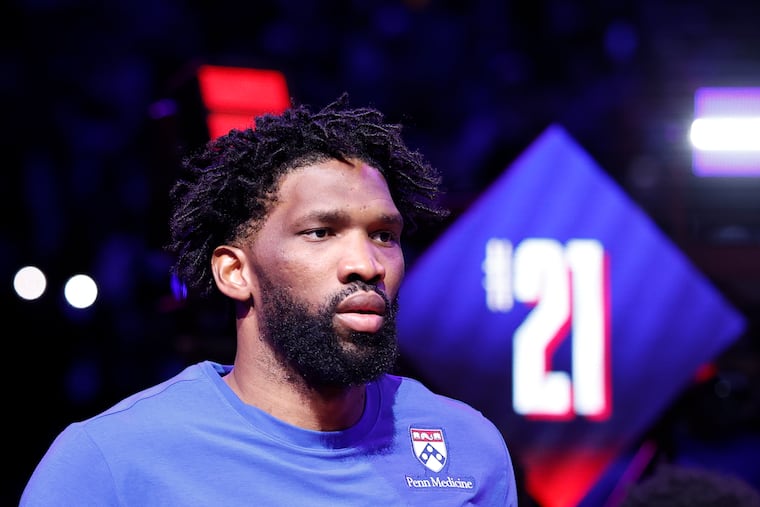
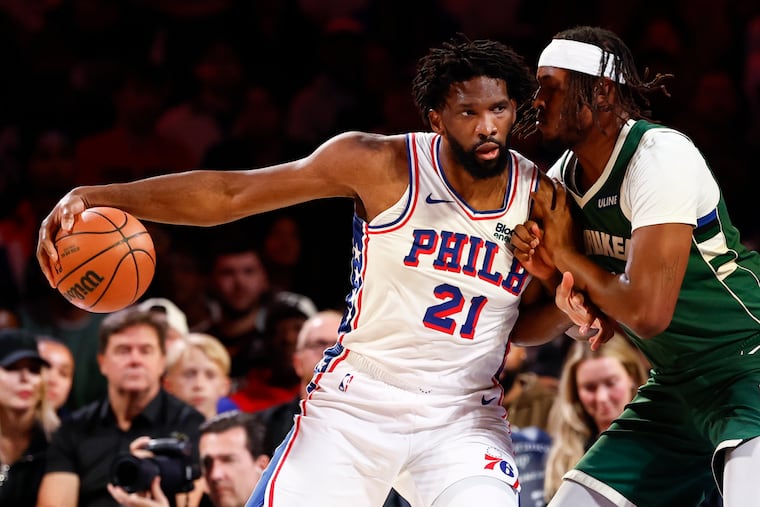
Joel Embiid’s return from a mysterious knee problem finally matured him. He’s playing like an All-Star, snubbed or not.
Once known as "Troell" Embiid, "The Process" lost weight, regained his game, and overcame a knee issue as Tyrese Maxey took over the team. "He's like the fun-loving uncle now,” an insider said.
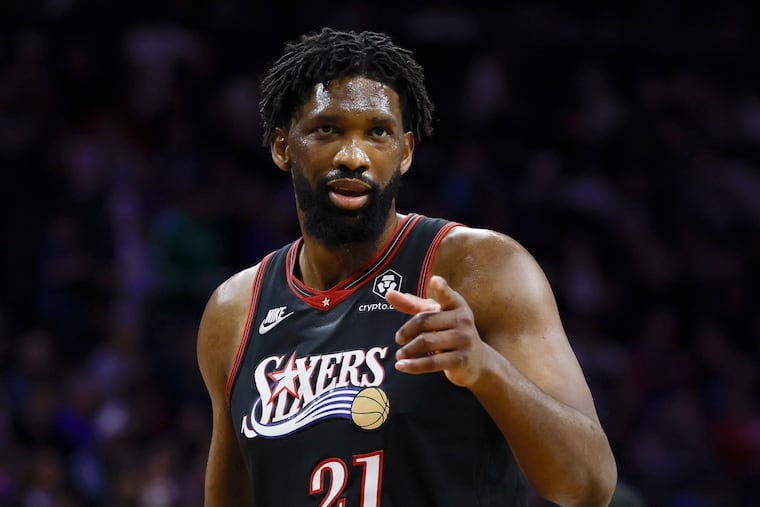
For the first time in a 12-year career that has been as sporadic as it has been incandescent, Joel Embiid is performing to the level of his potential.
If that sounds demeaning for a player who won the NBA MVP award in 2023, then you didn’t appreciate his unprecedented potential then and you don’t appreciate his diminished potential now.
Embiid had a chance to be the best big man in NBA history. However, a lack of professionalism rooted in indifference to discipline both on and off the court, combined with a cascade of injuries rooted in bad conditioning and bad luck, always limited his performance. He has missed almost half of the Sixers’ games in his career. This time last year, a lingering knee injury brought him to the brink of irrelevance.
Now, though, he seems to be the best possible version of himself. His new self. And he’s only getting better.
“I continue to see improvement,” Sixers president Daryl Morey said last week. “He feels like he’s improving still.”
How?
He listened to his doctors. He lost weight. He adjusted his game and is more deferential. He became a better teammate. He might not be going to the All-Star Game this weekend, but he’s playing at an All-Star level.
Embiid said last week he doesn’t care about what would be an eighth All-Star appearance: “I don’t need validation from anybody. I’m just excited to be playing every night.”
Everything is a bonus.
“Coming into this year, I thought it was going to be more of a tryout year,” he said.
He’s played in only 31 games, which is probably why he was not elected as an All-Star by the fans, media, and players, who vote on the starters; nor by the coaches, who vote on the reserves.
After all, Embiid missed 14 of the 76ers’ first 22 games as he grew accustomed to a new body and a new mindset and committed more fully to his rehab regimen.
That commitment has borne fruit. Embiid has played in 23 of the last 30 games, averaging 29.4 points and 8.2 rebounds in 33.8 minutes in that span. The Sixers were 14-9 in those games entering Monday. They held the No. 6 seed in the Eastern Conference, which is vulnerable due to the absence of stars in Boston and Indiana.
» READ MORE: Daryl Morey’s message to Joel Embiid and Sixers fans: Trust the Process
Given the intermittent nature of a playoff schedule, there’s no reason to think that Embiid couldn’t be similarly productive throughout a postseason run. He doesn’t play in back-to-back games, and he probably never will again, but there are no back-to-backs in the postseason. He did not play Monday in Portland due to right knee soreness, another enduring issue, but missing just seven of 30 games on 31-year-old knees that have undergone a total of four procedures has been a best-case scenario.
“We thought that Joel could still get to this level and play to this level,” Morey said. “I think there was a lot of very reasonable skepticism. But all I ever had was talking to our medical staff and doctors, and there was a lot of confidence that he could get to this place if he put in the time.”
That was a big “if.”
“He has,” Morey said.
Clearly.
What, exactly, happened?
Following the timeline of Embiid’s injuries is as convoluted as reading a map to Blackbeard’s treasure.
Embiid underwent meniscus surgery in February 2024. He returned in April for the Sixers’ failed playoff run, then foolishly participated in the Paris Olympics with Team USA (he’s a naturalized citizen).
He showed up for training camp on Sept. 30 both out of shape and far behind on his rehab, and missed the first three weeks of the season. He was hopeless when he returned. The Sixers insisted the knee was fit for play and there was no further injury, but Embiid could not endure the pain and swelling. Doctors said the process of recovery involved strengthening the muscles that surround the knee; weight loss, to reduce the stress on the joint; and overall body strength to better distribute the load. He just got worse.
Embiid played in just 19 games last season, and, after the 16th one, suggested to a television reporter that he needed another surgery. To that end, Embiid eventually visited Dr. Jonathan Glashow, a Manhattan-based orthopedic surgeon and NBA specialist. Glashow performed an arthroscopic procedure on April 9.
This, of course, undermined the medical advice Embiid received from at least six other doctors.
So what, exactly, did Glashow do? Nobody will say. The Sixers, who since 2013 have been cursed by injuries like no other NBA team, are relatively transparent regarding significant medical procedures, at least eventually. Not this time.
Glashow last month posted on social media, but only to offer thanks to a grateful Sixers community and to offer vague praise of Embiid’s “dedication and hard work.”
The surgeon did not, however, reply for comment for this story.
So, the question remains: What did Glashow do? Did he discover an injury other doctors missed?
About a year ago I wrote a column interviewing orthopedic surgeons who detailed options open to Embiid, many of which might have cost Embiid this season. When presented with the options, the Sixers acknowledged that the list was complete.
League sources indicate that Glashow did not perform any of the more radical procedures. According to the sources’ knowledge, Embiid underwent the most minor possible procedure on the list: putting the arthroscope into the knee, making sure there was nothing new causing irritation, and getting out.
After the visit to Glashow, sources say, everything improved. Maybe the big guy got scared straight. Embiid got better rest, he ate smarter, he was even more focused in his rehab sessions. He lost weight. His pain tolerance increased.
Maybe it just took more time than expected. Everybody heals at a different rate. Everybody’s commitment to rehabilitation is different. Doctors can project typical timelines, but returning to play seldom follows a straight line. There are setbacks. There are plateaus. The body has to develop compensatory strength and stability for strength and stability that has been lost forever.
At any rate, less than a calendar year later, Embiid is back — at least, he’s more “back” than anyone expected.
Can it last?
Sustainability
The Sixers will have 28 games left after the Knicks visit Wednesday and the All-Star break begins, with six back-to-backs. Can Embiid play in, say, 22 games? After this season, the Sixers owe Embiid $188 million over the next three years. How much will he be able to give them when he’s 34?
“We do think it’s sustainable,” Morey said.
He’s in good hands. Embiid singled out Simon Rice, the team’s vice president of athlete care, as the main reason for his comeback. But it’s not as if the Sixers hired Rice and then Embiid got better. Rice has been with the Sixers since 2020.
No: This is less about the doctors than it is about the patient. Since last spring, Embiid simply has been more professional. More mature.
Sixers sources say that, after Tyrese Maxey called him out last year for chronic tardiness, Embiid has not been as late as often for the team bus or the team plane. He is more present in the locker room during the team’s downtime. He has been more engaging with young players like rookie VJ Edgecombe, with new players like Dominick Barlow, and with fringe players like Quentin Grimes.
Maybe Maxey’s emergence as the team’s MVP and spokesperson relieved from Embiid the pressure of a role for which he was never equipped.
“He’s like the fun-loving uncle now,” said one Sixers insider.
That’s something.
He’s not MVP-level Embiid, and he never again will be. His defensive movement will never return to the all-defensive levels of his youth, but his positioning is good, and he occasionally blocks a shot. He’s even started dunking again. Gently.
“I think, from now on, every single day … keep stacking them up, it’s only going to get better. With the hope that, whether it’s by the playoffs or next year, I’m really, really back to being myself. I’m on my way there,” Embiid told the Inquirer during the team’s West Coast trip.
That’s a pipe dream, of course. But Embiid is so gifted that this new version certainly should be an annual All-Star contender.
It’s always been hard to quantify Embiid’s intangible value. You can say he’s ninth in “DARKO” or seventh in “PER” or whatever composite metric you like, but the eye test will tell you that Embiid once again is among the NBA’s best players, night in and night out.
That’s the truest test of an All-Star.