Paul George winds back clock with vintage performance against Bucks: ‘I feel like myself again’
George totaled 20 points, five rebounds, and five assists — and propelled the Sixers in the fourth quarter — in Friday's win at the Milwaukee Bucks.
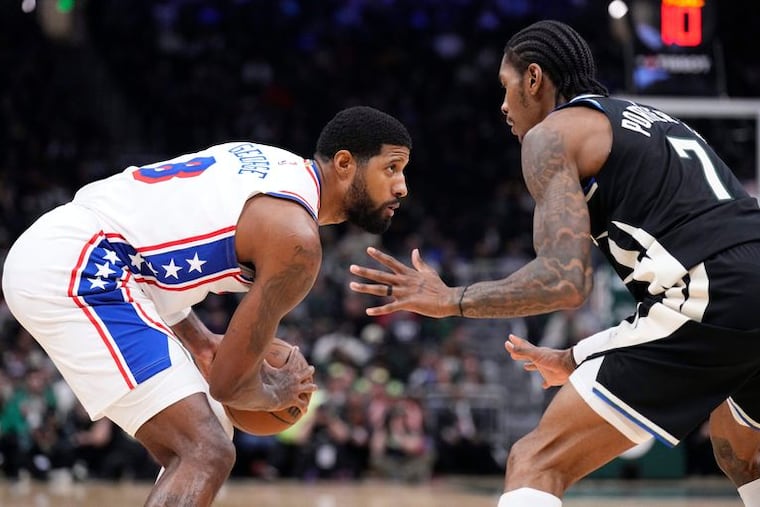
MILWAUKEE — Paul George approached Tyrese Maxey during the fourth quarter of Friday’s tightening matchup at the Bucks, and told the 76ers’ star point guard, “Don’t worry about it. I’m going to finish this for us.”
George more than made good on his promise. His output in that final frame — six points, four rebounds, and two assists — helped push the Sixers to a 116-101 victory at Fiserv Forum. And the well-rounded overall performance (20 points, five rebounds, five assists in 29 minutes, 58 seconds) flashed that, following knee surgery and an injury-riddled first season as a Sixer, George might still have shades of the player who became a perennial All-Star and signed a max contract in the summer of 2024.
“I feel like myself again,” George said from his locker after Friday’s victory. “I believe I’m not done yet. So it was great to kind of [have] everything kind of come back to me and it feel like it was natural. Muscle memory and my rhythm, timing, cadence, flow.”
» READ MORE: Sixers takeaways: Paul George steps up, Tyrese Maxey gets defensive, and more in victory over Bucks
It was a crucial lift for the Sixers (13-9) on a night when Maxey was limited to a season-low 12 points, two weeks after dropping a career-high 54 on these Bucks. The Sixers also were without former MVP center Joel Embiid, who played in Thursday’s chaotic home victory over the Golden State Warriors but sat out the second night of the back-to-back with left knee injury recovery.
George, meanwhile, did not play against the Warriors because of his own recovery path. He entered Friday’s fourth quarter with an already-sharp 14 points and three assists.
The 6-foot-8 wing then began to initiate the Sixers’ offense, a role that typically falls on Maxey. The shift allowed George to be on his “A game,” he said, because of his adept playmaking and smooth shot-making while patiently reacting to the defense.
After multiple correct passing reads yielded missed shots by teammates, George took his defender off the dribble and rose up for a midrange jumper at the 6:18 mark. On the Sixers’ next possession, he nailed another pull-up to put the Sixers up by 14 points. About a minute later, George called for the ball, drew the foul on Kevin Porter Jr., and sank the two free throws.
While holding off the Bucks’ attempted rally from 26 points down, George also got back in transition to help force a Bobby Portis whiff at the rim with 3:53 to play. He then secured a rebound that set up teammate VJ Edgecombe’s three-pointer to give the Sixers a 108-94 lead with 2:34 remaining.
“Coach trusted me in that moment,” George said. “And [that was] me being able to respond to the moment.”
George’s best game of the season was the result of his behind-the-scenes rehab work. That occurred amid outside criticism — “You’re getting old, and you’re washed, and you can’t do it anymore,” George mimicked Friday — that the 35-year-old said he needed to “drown out.”
He also acknowledged the mental challenge of expecting his athleticism and body movements that have been reliable for years and those physical gifts suddenly dissipating. During his disappointing first season as a Sixer, George struggled to burst past defenders while averaging 16.2 points, 5.3 rebounds, and 4.3 assists in 41 games.
“Outside looking in,” George said, “[fans] see us on the court and they’re like, ‘Yo, why aren’t you doing this?’ It’s just like, ‘My body can’t. I’m trying.’”
George missed the Sixers’ first 12 games of 2025-26, before playing in seven of the team’s past 10 matchups.
Following an efficient 14-point outing at the Brooklyn Nets on Nov. 28, George said that he and the Sixers’ staff had discovered the ideal way to fire up his left quadriceps muscle to support his knee. He then asked to play more minutes (28:02) in Sunday’s double-overtime home loss to the Atlanta Hawks, saying he feels like “the bird leaving the nest, getting to fly and flap my wings a little bit more.” But two days later, George felt “a little fatigued” while playing 17:43 in Tuesday’s home blowout vs. the Washington Wizards, a sign that these early games essentially are serving as his training camp.
Sixers coach Nick Nurse reiterated earlier this week that George makes an instant impact as a versatile and communicative defender. His offensive flurries — including scoring the game’s first 11 points in the Nov. 20 overtime win in Milwaukee — also offered some promise. Now, when George drives to his left — when that lead leg must be strong and stable — he said he feels a mental “light popping back on, that I can start to trust it again.”
George also still leans on his vast experience and knowledge of opponents, such as whose jump shot releases take longer and how to attack defensive switches. He has used that expertise to provide vocal mentorship to younger teammates like second-year center Adem Bona, who in Tuesday’s game against Washington missed a pass from George after sealing his defender.
“I’m throwing that over the top, where he can just catch it and finish at the basket,” George said then. “Might be a little different. He’s not used to it. But just letting him know, ‘I see you, and I’m looking for that.’”
It was poetic that, to help ignite George’s excellent fourth quarter, he lofted that style of pass to a cutting Bona for a dunk. And once George’s performance on both ends had all but officially propelled the Sixers double-digit victory, George and Maxey linked for their elaborate handshake as the veteran checked out for the final time.
George had made good on his promise to his point guard. And he looked like vintage PG.
“That’s what he’s here for,” Maxey said.