VJ Edgecombe’s athleticism is electric. But his basketball IQ is driving the Sixers rookie’s early success.
“He could be a guy that just takes off,” Nick Nurse said, “and jumps in the air and figures it out three or four seconds later. But he doesn’t do that. He makes pretty good basketball plays.”
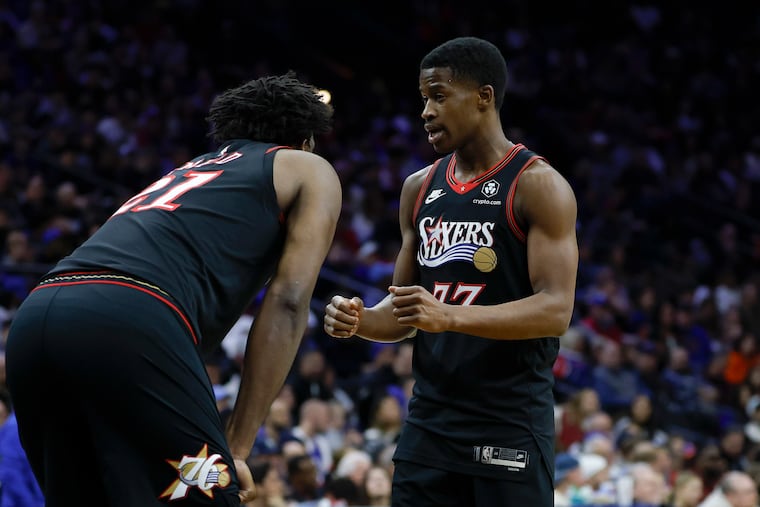
As John Buck watched the final seconds of the Dec. 4 matchup between the 76ers and Golden State Warriors, he was unsurprised by how VJ Edgecombe reacted to teammate Tyrese Maxey’s deep fadeaway jumper with 2.5 seconds remaining.
Edgecombe instantly sensed where the ball might be if the shot fell short, Buck said, then “slithered” into that space, elevated, and grabbed the partially blocked attempt to convert a game-winning putback.
“How many guards just stand there and watch the ball get shot and hope it goes in?” said Buck, who coached Edgecombe at Long Island Lutheran High School in Brookville, N.Y. “VJ was moving into the spot where it may have missed.”
Yes, Edgecombe’s athleticism is electric. Yes, the rookie’s three-point shooting has been a pleasant surprise. But perhaps what Sixers coach Nick Nurse and teammates have raved most about Edgecombe so far is his beyond-his-years basketball IQ.
That natural feel helped put Edgecombe in position to be one of the NBA’s top rookies — on Monday night he was named to the Rising Stars roster for All-Star Weekend — along with an immediate starter for a Sixers team in the thick of the Eastern Conference playoff picture, and a player already with a knack for clutch fourth-quarter moments on both ends of the floor. When asked recently about this aspect of his game, Edgecombe agreed it has “played a lot” into his early NBA success.
“If you watch the game,” Edgecombe told The Inquirer at his locker last week, “you understand the game, understand the flow of the game, the importance of possessions, I rely on my IQ a lot. That’s the most [important part] of the game, the mental part.
“I just try to make sure I’m locked in mentally, to make certain plays and be decisive.”
So what are the origins of such a trait? Matter-of-factly, Edgecombe says, “I watch so much basketball.”
As a child in Bimini, the Bahamas, he initially spent the bulk of his free time playing the sport on dirt courts and makeshift hoops outside. But once his mother bought him a tablet as a middle schooler, YouTube became an endless supply of player highlights and archived games. He could utilize his already “really good memory” while transitioning from watching for entertainment to studying. He even discovered some of Maxey’s film from his time playing for South Garland High School in the Dallas suburbs.
“He didn’t believe me,” Edgecombe said, explaining how he told Maxey after they became Sixers teammates. “And I had to literally tell him my basketball knowledge.”
» READ MORE: What is the Sixers’ biggest need at the NBA trade deadline? Patience.
When Edgecombe moved to the United States and eventually joined Long Island Lutheran’s nationally ranked program, he received access to online scouting reports with full games or clips from opponents. While Buck said he needed to “beg” some players to spend time reviewing that film while walking down the aisle during bus rides to games, Edgecombe’s commitment to that preparation was “elite.”
That gave Edgecombe the confidence to make suggestions about defensive coverages or individual assignments during timeouts, Buck said. And to better leverage his supreme physical gifts.
Buck witnessed it on blocks, when Edgecombe could pin the ball on the glass because he beat the shooter to the spot. Or in his timing on offensive rebounds. Or whenever he got into a shooting rhythm because he picked the correct moments to fire away, later prompting Buck to chuckle when NBA scouts called to ask about his three-point potential as a professional. The early returns vindicate that reaction, with Edgecombe entering Monday 12-of-22 on “clutch” NBA three-pointers, including an overtime game-winner at Memphis in late December.
“There are players who are extremely athletic,” Buck told The Inquirer by phone earlier this month, “but you don’t see it in the flow of a game, or you see it rarely. … With [Edgecombe], it would show up in so many ways.”
Another coach who valued Edgecombe’s IQ: Baylor’s Scott Drew.
During Edgecombe’s lone college season, Drew recognized his “boldness” to speak up during practices, “wisdom” to be accurate with his question or suggestion, and “heart” to keep it centered on the team. Most freshmen in his program, Drew added, only learn one position that first season. Edgecombe could play every spot but center, offering the Bears flexibility to use him as a lead ballhandler or as a power forward in four-guard lineups.
“It allows a coach to have an opportunity to steal a couple baskets by putting in new plays [and] doing things that are harder to guard,” Drew said last week. “And in one-, two-, three-possession games, if you have enough of those plays, you win a lot of those games.”
When Edgecombe first arrived in Philly, Nurse also asked himself, “How did he get like this?”
Nurse quickly recognized Edgecombe had already “absorbed a lot of basketball — and, probably, a little bit obsessively” because of his interest in the game’s history. That is not as common as an outsider might think for a player born in 2005, but was apparent to Nurse when Edgecombe marveled while walking into Chicago’s United Center for the first time.
» READ MORE: How the Sixers’ ‘kids’ bonded, then injected energy into the locker room
Edgecombe’s inquisitive nature during practices also has continued at the NBA level. While still building out schemes throughout the first half of the season, Nurse said, Edgecombe could already identify future wrinkles. Edgecombe said he typically first goes to a teammate to clarify if such additions are possible, then to coaches to get their point of view.
“I just want to make sure my team is in the best possible [situation],” said Edgecombe, who entered Monday averaging 15.6 points, 5.3 rebounds, 4.2 assists, and 1.5 steals.
Added Nurse: “I answer them a lot with, ‘We’re getting to that.’ … Then you kind of quickly explain, ‘Yeah, we can do that, and here’s what happens. That’ll be coming when we need it — and when we see it and when we can polish and can put it in.’”
On the court, that IQ has translated to Edgecombe immediately taking on some ballhandling responsibilities — and committing only two combined turnovers when Maxey missed two games with an illness. Veteran forward Paul George has been most impressed with Edgecombe’s defensive savvy, recognizing when to make sharp rotations or well-timed playmaking risks. Edgecombe’s feel also shows up in how he spaces the floor on offense, clocks when a teammate has not gotten a shot recently, and balances when to be aggressive with the ball in his hands or facilitate.
“He could be a guy that just takes off,” Nurse added, “and jumps in the air and figures it out three or four seconds later. But he doesn’t do that. He makes pretty good basketball plays.”
That is why Nurse has reiterated that he still wants more out of Edgecombe, even as the Sixers’ roster has returned to full strength. Following a Jan. 16 loss to the Cleveland Cavaliers, Maxey told Edgecombe in the locker room that taking only five shots “is not going to cut it for us.” Nurse also has shown Edgecombe film examples of more opportunities to attack the rim or create space for a pull-up jumper.
“He’s just a little too unselfish for me,” Nurse said. “I know that sounds funny, but we need him to use those gifts a little bit more. … I’m like, ‘That was a great move. You only did it once last night. I need like eight of those.’”
Edgecombe acknowledged last week that he is “still learning” but does feel the game slowing down. And he flashed that knack during Saturday’s loss to the New York Knicks. In less than five seconds of the game’s final minute, he buried a three-pointer, forced a jump ball on a tie-up with Jalen Brunson, made two free throws after being fouled to cut the Sixers’ deficit to three points — and nearly drew an off-ball foul on Brunson before the ensuing inbounds pass, but that call was overturned on a coach’s challenge.
» READ MORE: Sixers need to hang on to Kelly Oubre Jr. — at least through the end of the season
Buck is not exactly shocked that such high-IQ play is fueling Edgecombe’s rookie season. He saw it in that heads-up putback against Golden State. And in a game-winning three-pointer in Memphis.
And, behind the scenes, when Edgecombe paid an impromptu visit to a Long Island Lutheran practice just before his rookie season began.
“We’re running a set, and he kind of waves me over,” Buck recalled. “And he’s like, ‘Hey, Coach. I think the spacing for this guy right here should be a little bit different to maximize the play.’ That’s just not normal for a 19-, 20-year-old guy to be coming to practice, not just kind of chilling or being there to be there. But kind of saying, ‘Hey, let me look at this. I think there’s a way to improve that.’”
Now, Edgecombe is applying that as an NBA rookie, to a degree drawing raves from his coach and teammates.
“He’s not out there looking lost or forcing anything,” George said. “He kind of just lets the game come to him. And that right there makes the greats, greats. …
“The game just evolves around them, and that’s kind of what he has.”