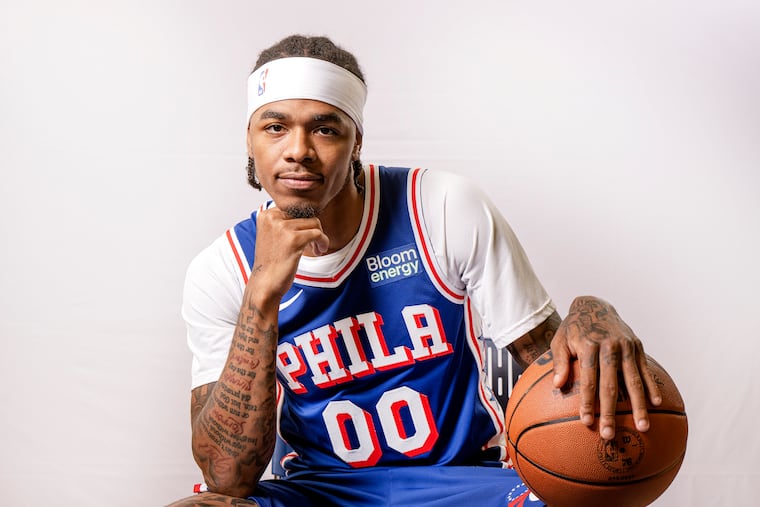
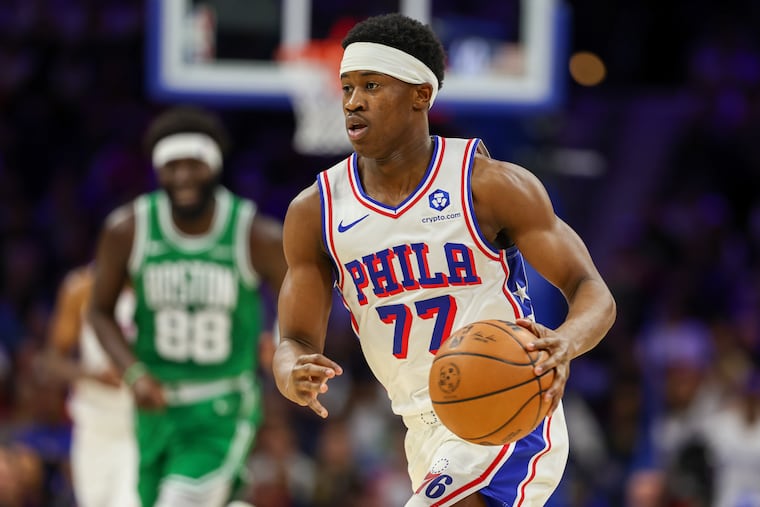
The Jaylen Brown trade benefits VJ Edgecombe, who will now have the time he needs to develop
Edgecombe seems thrilled that the Sixers have landed Brown. The ex-Celtic's presence takes some pressure off the team's young phenom.
Jaylen Brown loves attention, which is why he went on Twitch to talk about his feelings just hours after releasing a statement on social media expressing his feelings about being traded from the Celtics to the Sixers for a PED cheat and four speculative draft picks.
While Twitch-ing, or whatever it’s called, Brown got a phone call from the coworker who probably is happiest to have him aboard: VJ Edgecombe.
It was just 30 seconds of Gen Z acknowledgment and ego stroking, but there was a real vibe of Thank God you’re on my team so now I don’t have to play every minute of every game.
Later, on that Twitch stream, Brown announced:
“‘The Process is back f— on.”
Not really.
Call it Process 2.0, and understand that Edgecombe, properly nurtured, will be as important to its success as anyone.
That nurturing process got a lot smoother when the Celtics gave Brown away on Wednesday.
It could get even smoother if King James arrives.
On Thursday, LeBron James’ camp let it be known that he would consider playing next season in Philadelphia now that Brown has joined Joel Embiid, Tyrese Maxey, and Edgecombe. The King, now 41, is hunting a fifth NBA title, and Philly has become a viable contender within the last few days, even though the Sixers currently can pay him only the veteran minimum, just under $4 million. This would be a $48 million pay cut from last season with the Lakers.
Don’t hold your breath.
As insane as landing LeBron would be, shedding a bad contract and landing a superstar is even nuttier. And fishier.
Something is amiss when the smartest organization in basketball gives away a top-10 player and asks in return for a broken-down PED cheater and two first-round picks that probably aren’t going to be that good anyway.
At any rate, the Celtics on Wednesday traded Brown, a five-time All-Star, who is 29, to the Sixers for Paul George, who is 36, and who has had just one good season since he was 29. The Sixers also sent first-round picks in 2028 and 2031 and two second-round picks to Boston. The most significant aspect of the deal is that it erased the worst contract in the history of the franchise; George has two more seasons left on a four-year, $211 million deal, and he hasn’t been worth one-tenth of it.
The move also made the Sixers an immediate NBA title contender, since Brown is everything the Sixers wanted George to be: a shot-creating athlete at all three levels who can play and defend multiple positions.
The deal also delivers an invaluable byproduct.
It gives Edgecombe time.
Time to develop.
Time to learn.
Time to rest.
Edgecombe not only led rookies at 35 minutes per game, he ranked 11th in the entire league and averaged the eighth-most minutes for a rookie guard in the last 17 seasons. As the Sixers dealt with injury absences of Joel Embiid as well as the early load-management strategies and the late PED suspension of George, Edgecombe proved himself too good to not protect.
“VJ is going to be a lot better in the long run with J.B. around,” said an NBA source who is intimately familiar with the 76ers. “At the end of last season, he was pretty worn out.”
Outside of a diminished three-point shooting percentage, the wear and tear didn’t really show up in his other raw stats. They dipped in the playoffs, but then, Embiid and George were back on the court for much of the late season and postseason. But his decision-making became errant, his shot selection more questionable, and he tended to disappear. He needed help that his big-money vets were not there to provide.
Combined, they missed 89 of 164 games, more than half. This has been the norm for both of them for the past few seasons.
Brown plays about 20 more games a season than Embiid and George.
That means that when Embiid misses his 30 or 35 games this season, Brown will be there to carry the load, whereas George was not.
That also means that when Embiid plays, Edgecombe will not have to serve as the second or third offensive option, using moves he shouldn’t be making and taking shots he shouldn’t be taking for at least another season or two. When the Sixers drafted him third overall, most projections cast him as a superior athlete with unlimited defensive potential but with limited plug-and-play offensive ability. He learned fast, averaged 16 points per game, and made the All-Rookie team, but, man, there were some ugly nights and some ugly shots.
Brown will also help Maxey get off his feet a little more. Maxey led the NBA at 38.0 minutes per game in an MVP-caliber season, but he wore down, too. Both were affected by the early injury absence of Jared McCain, and then by McCain’s exit at the trade deadline, as well as the lack of consistent contributions from guard Quentin Grimes.
Edgecombe and Brown don’t play the same position, exactly, but they will combine with Maxey, and possibly rookie Labaron Philon Jr., to manage the primary backcourt duties.
Brown will arrive motivated to make the best impression possible.
He’s in line for a two-year, $140 million extension that will put him under contract for the next five seasons. He will be a more focused defender and rebounder, play-make with more alacrity, and, inevitably, he will assume the role of mentor to Edgecombe that George served last year.
He said in Thursday‘s social media post that he was “Excited and disappointed at the same time” to be leaving Boston, where he won a title, and coming to the Sixers, who bounced him from the playoffs this spring.
It was delivered with Brown’s typical class and polish.
The Twitch stuff? Less classy, less polished, but just as real.
The Celtics, meanwhile, immediately started planting narratives about how zero-time All-Star guard Derrick White is a more valuable player than Brown. ESPN insider Brian Windhorst also reported that the Celtics, after consulting their analytics, considered it imperative to get backup center Mitchell Robinson off the court when they played the Knicks. Then, on Wednesday, they signed Robinson to a three-year, $47.4 million deal.
No wonder the Sixers knocked them out in the first round.
There is always the possibility that this trade is not as lopsided as it seems. The Celtics certainly didn’t see the value in retaining a guy who can make more than $320 million if he’s offered an extension.
The pocket protector crowd loves to cite and manipulate undependable metrics that diminish Brown’s obvious talent, skill, value, and performance. They insist that his playmaking fluctuates, his defense is overrated, and his shot diet doesn’t regularly generate the most efficient looks for him or his teammates.
Remember, analytics is an industry, and it has to feed itself and convince its consumers of its necessity.
Therein lies an irony. As much as analytics have torpedoed the Sixers’ plans, execution, and hopes over the past 14 years of “The Process,” it appears that analytics now have delivered an unexpected reward — in the form of Jaylen Brown.
Bonus: LeBron James?
Benefit: VJ Edgecombe.