Philly’s path to the World Cup was paved at Newt’s, where playing on cinder was a ‘badge of honor’
The growth of the region’s soccer scene will be celebrated when Philadelphia hosts the World Cup. But for years, the sport seemed to only exist locally in the neighborhoods around the cinder fields.
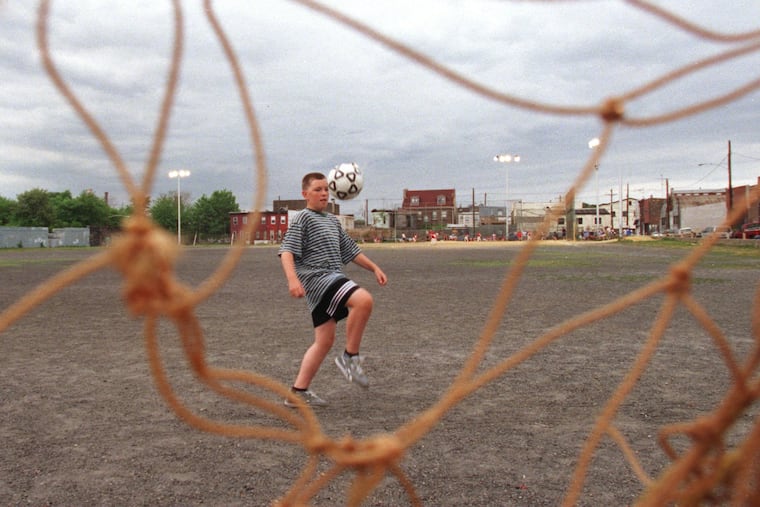
The city was digging up the playground down the street when Joe Beck dug into his refrigerator and grabbed a jar of salsa. They were overhauling Shissler Recreation Center, meaning Fishtown’s famed cinder soccer field would become grass. And that’s why Beck needed a jar.
He washed it out, opened his door on Berks Street, and maneuvered past some construction vehicles that day in September 2010 to scoop up some of the cinders — a playing surface that had scarred the bodies of generations of Philadelphia soccer players.
Beck, like the rest of his neighborhood’s kids, grew up in the 1990s playing at Newt’s, a soccer field just like any other except that the playing surface looked like asphalt. He needed to keep those cinders.
The old story goes that a suburban team once came to Fishtown and asked where the field was. You’re parked on it, they were told. The field tucked away on Blair Street was made of tiny rocklike cinders left from an old coal yard that once neighbored the field. The cinders would rip the side of your leg if you were daring enough to slide.
Walter Bahr and Benny McLaughlin played there. So did Chris Albright, Bobby Convey, Quinn Sullivan, and Brenden Aaronson. If you played soccer in Philly, you played at Newt’s.
Joe Hohenstein, a state representative for parts of Northeast Philadelphia, once wrote that you weren’t a “real Philly soccer player” until you scraped your knee at Newt’s.
» READ MORE: Out of tragedy, Jim Hardy built a program the Kensington community can be proud of
The growth of the region’s soccer scene will be celebrated over the next month when Philadelphia hosts six World Cup matches. Soccer is now played everywhere.
But for years, the sport seemed to exist locally only in the neighborhoods that surrounded the cinder field.
Soccer was the game in places like Fishtown, Kensington, and Juniata Park. The city’s path to the World Cup was paved on the cinder that Beck stuffed into his jar.
“It was a badge of honor to play there,” said Jerry Brindisi, who grew up in Juniata and went to North Catholic High School. “I’m going to be 70 years old, and I’m still talking about it. And so are the guys I went to high school with who were from Fishtown. They absolutely loved it. Why wouldn’t you? You catch a guy slide tackling on that stuff, and they should’ve just put him in the Marine Corps or something.”
We’re the kids from Kensington
The kids who played at Newt’s knew better than to slide on the cinders. But then the game started.
“Here’s a scar,” Jerry Franklin, 71, said last week as he pulled up the leg of his shorts and pointed to his thigh.
Franklin grew up on Frankford Avenue and started playing at Newt’s in the 1960s when he was 7. The gritty field matched the neighborhood of blue-collar workers living in two-story rowhouses. Kids played in the streets and old folk sat on their front steps.
“Everybody knew everybody,” Franklin said.
» READ MORE: To Rob Mac, the devout Eagles fan, there’s only one ‘football.’ To the rest of us, it’s called soccer.
The kids sang a chant about their neighborhood that started with “We’re the kids from Kensington you hear so much about.” They went to school at parishes like St. Michael’s, Holy Name, St. Anne’s, and St. Laurentius; and Newt’s playground — then known as Kensington Recreation Center — was their hub. There were basketball and volleyball courts, a swim team and baseball team, and even talent shows.
“It was people moving all day long from morning to night,” Franklin said. “It was an experience.”
The neighborhood’s pastime was soccer, a game many say was brought to Fishtown in the late 1800s by European factory workers.
Soccer started to grow in America in the 1970s and 1980s. But it took hold long before in Philadelphia’s river wards. Lighthouse Boys Club — considered to be the beacon of Philadelphia’s soccer scene — was formed in 1893 in Kensington. The cinder field next to a Newton Coal Company yard was less than three miles away. It became a place to play, as if no one noticed that it didn’t have grass.
“You just played,” said Dave MacWilliams, who grew up in Kensington and later coached at Temple. “Some of the people now are so spoiled with the facilities. We just needed a ball and a place to play.”
Franklin and his buddies were coached at Newt’s by the guys who ran the playground. The boys played so much on their own that the coaches didn’t have to schedule practice. They all piled into their coaches’ cars to drive to games. Soccer was the world’s game, but the kids from Newt’s rarely left Northeast Philly.
“You weren’t playing all over creation,” Brindisi said. “You weren’t playing like they are now when you go to Rhode Island for a Saturday game. You had a Juniata team, a Kensington team, a Fishtown team, a Lighthouse team. You might have a Wissinoming team. Every neighborhood had a team.”
Those other neighborhoods had grass, which made the dusty and dirty field at Newt’s feel like a home-field advantage. Many games were won before the first tap. The outsiders — especially the ones who came from beyond Northeast Philly — played with a level of tepidness. Can I slide on this stuff? When they did, it burned.
A slide tackle on a field of cinder felt as if you tripped over a curb and scraped your knee on the sidewalk. A cut, Franklin said, would take a week or two to heal. First, you’d have to pick the cinders out.
“My dad had cinders in his kneecaps until the day he died from Newt’s lot,” said Andy McLaughlin, the son of legendary player McLaughlin.
A jar of memories
The city announced in June 2010 that Shissler Rec would get a $1.2 million facelift and that Newt’s would get a field of grass. The construction crews soon arrived and Beck searched for an empty jar.
His dad, Joe Sr., coached his teams at Newt’s, where the games started with the parents walking across the cinders arm-in-arm like a search party scoping out bottle caps or pieces of glass.
“They looked for anything that was a lot more vicious than cinders,” Beck said.
Beck remembers coming home from Newt’s and banging his cleats to free the cinders that were lodged on the spikes. He remembers how the ball zipped along the cinders and how the referee would have to stop a game if someone’s knee was bloody. And you could never get away with not showering after a game.
» READ MORE: You don't need a ticket to experience World Cup fever in Philly
“If you didn’t have scrapes, you had this,” Beck said as he dipped his hand into the jar of cinders to show how the dust stayed on his finger. “That was all over your legs. If you fell forward on your hands or contacted the grounds, everything was dusty. Even if you were wearing high socks, the dust was inside your socks.”
A grass field was long overdue, but there was something about those cinders. It was cinders that Beck put into the jar, but, really, it was memories of his childhood that he was saving.
“It’s nostalgia,” Beck said. “We were a group of kids who loved to play soccer back when soccer wasn’t always popular. We had something unique going on in Fishtown. It felt like it was ours.”
Fishtown has changed since Beck was a kid. His dad was an iron worker, and most of his friends’ parents had blue-collar jobs. Beck’s Fishtown in the 1990s was just like the neighborhood Franklin hung in during the 1960s. But the dynamics shifted as Fishtown — just like Newt’s — saw a revival in the 2000s. It was once dubbed by Forbes as “America’s Hottest New Neighborhood.”
Most of the two-story rowhouses that face Newt’s on Hewson Street have been replaced with bigger homes. From Newt’s, you can still see the giant milk jug that sat above Harbison’s Dairy, but the building is now apartments.
» READ MORE: FIFA Fan Festival guide: Road closures, vendors, and more things to know before you go
The Reach Factory, where they made baseballs on Palmer Street is now condos, just like the abandoned popcorn factory on Memphis Street where Beck and his buddies used to play stickball.
Even with grass, Beck said the field still feels like Newt’s. He is the president of Fishtown Athletic Club, which Dan Shissler — the playground’s namesake — helped save in the early 1990s. The club supports 250 soccer players from the neighborhood who split their time between Newt’s and nearby Hetzell Playground, another old-school soccer haunt.
“I’ve seen so much change in the neighborhood now, and there’s a whole new crop of families and kids coming through the soccer system,” Beck said. “It kind of reminds me of that era of growing up in Fishtown when there were tons of families and kids on the streets interacting and playing. The economics seem different, but if you strip that away, the similarities are still there.”
Franklin still lives nearby and has a piece of Newt’s cinder in his home atop his North Catholic Hall of Fame award. He knows a guy who brought a jar with him when he moved to Florida. Beck keeps his jar in his bedroom, just a few blocks away from where those cinders scraped knees and gave generations a place to play.
“You realize that it was part of your experience,” Franklin said. “But it’s like Veterans Stadium. It was nice for what it was, but it’s just a big old concrete building, and moving onto Citizens Bank Park was good. You know what I mean? It is what it is. Progress moves on. But to be a part of it was pretty special.”

Nine nations will compete in five group stage matches this summer, plus two more in a knockout game on July 4. Here’s what you need to know about those countries — and what those fans need to know about Philly. Click here for more.
