Out of tragedy, Jim Hardy built a program the Kensington community can be proud of
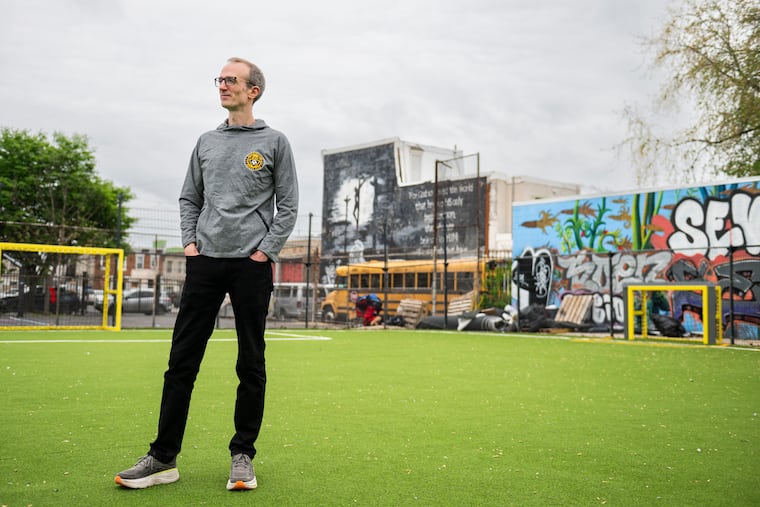
Hardy, the visionary of Kensington Soccer Club, the nonprofit organization impacting over 2,000 participants across 25 different programs, announced plans to step down from the haven he built.
It’s said that trauma builds character.
But what if it’s not directly your trauma?
Well, there are multiple avenues to place it. There’s internalizing it and writing it off as a product of the environment. There’s finding the humor in it, which, despite being an unpopular decision, does help with the healing.
And then there’s the way Jim Hardy used it:
As a force to help thousands of kids and young adults find not just an escape, but for many, their identity.
» READ MORE: City unveils plan to handle FIFA Fan Festival parking and transportation in Lemon Hill
If you’ve never heard Hardy’s name or those of his parents, Dan and Pat, you should know that their impact on the many communities within Kensington is immeasurable. For nearly 20 years, the Hardys have provided a safe outlet for kids in the neighborhood through the Kensington Soccer Club program, a 501(c)(3) nonprofit spawned in 2010. But their vision started two years earlier and was solidified following an event that, even when talking about it 16 years later, still brings Hardy to tears.
‘Really devastated’
Jim Hardy’s story begins in his daytime role as a teacher at Kensington Health Sciences Academy. In 2009, Eric Dixon was a young student in Hardy’s class, and over time Hardy got to learn more about him. Dixon, while hanging with a group of teens in Fairhill Square Park, got into a fistfight with another teen. He was struck, fell, and hit his head on the pavement.
Dixon was rushed to Temple University Hospital, where he later died. He was 16, killed in what was described as “trivial teenage nonsense.”
“I just remember this feeling of helplessness,” said Hardy, through tears as he recalled Dixon’s story. “I was really devastated by that. I went to the funeral, and after that it just became this soul-searching time for me. I didn’t know how to make sense of this.
“I think it was that moment, right there, where I thought, ‘Well, I don’t know what I can do [about Dixon’s situation], but if I could prevent this from happening in the future, I’m going to do everything I can to.’ I loved soccer and I knew that at least some of my kids wanted to play soccer, so I was going to try to make that happen for them.”
In doing so, Hardy gave up his own soccer-playing days; he had consistently played on teams in the CASA adult soccer leagues. He wanted to bring this dream of starting a program to life.
But it wasn’t Dixon’s story that started it; it only galvanized it.
Before he started telling Dixon’s story, Hardy said it was another student of his, a talented player from Mexico named Cristián Chen whom Hardy met during his time as an ESL tutor. If you’ve ever seen the 2005 film, GOAL! The Dream Begins, Hardy described Chen as the living embodiment of the movie’s star, Santiago Muñez, a rare find as a talent who didn’t have the resources to be discovered.
» READ MORE: FIFA promised a $1 million gift to Philly to spur ‘legacy’ initiatives. The city is still waiting.
Hardy took Chen under his wing and got him a tryout with one of the area’s top youth club programs. Chen made the team.
But that was the easy part.
Chen had no way of getting to practices that Hardy estimated would have taken at least an hour and a half by public transportation, with a majority of the games outside of the city limits. Chen’s parents, who both worked, only had one car, Hardy recalled, and were unable to leave work to drive him to practices in the suburbs.
It just wasn’t feasible. And with no outlet in Kensington to go to, Chen’s dreams were dashed before they even began.
“Even the coach of the team joined in to put out the call, asking if there were any parents who could swing by Kensington to pick him up,” Hardy remembered. “No one could. He got his hopes crushed. I just remember him being so excited, and then it all fell apart.
“That really bothered me. I got so excited for this kid just to see him enthusiastic and to feel like I could make this one little thing happen for him, and to see how devastated he was never left me. It’s so much like teaching in many ways, wanting to help, but running up against the limits of what you can do, and what’s available for your students.”
Little did Hardy know what these moments would do, 20 years later.
‘A beacon for these kids’
Kensington Soccer Club has grown from a ragtag group of 18 kids across all age groups to a program that features multiple in-house and travel teams at every age, beginning at age 4. On the adult side, Kensington has full-fledged, high-level amateur teams competing in top leagues on both the men’s and women’s side.
And this doesn’t even touch the scores of in-school and after-school programs, using soccer to focus on not just violence prevention, but literacy and work-ready programs in addition to a host of other community initiatives.
This story has long been a success in the neighborhood, but it becomes relevant now with the news that, after 16 years as founder and executive director, Jim Hardy is stepping down. He is entrusting the continued growth of the organization and its programs to Barbyose Noisette, who has been with the program since 2021. She has led efforts around not just KSC’s many programs, but the acquisition of funding, licensing of coaches, dealing with city and state officials, but mostly making sure Hardy felt good about handing over the keys.
Currently, Noisette oversees programs that impact 2,000 participants a year, in 25 locations featuring schools, parks, playgrounds, and rec centers throughout the neighborhood.
» READ MORE: Black Sheep Pub suffered a devastating fire. Philly’s Man United Fan Club has already raised over $25,000 to help.
“I think what sets us apart from a lot of other organizations and maybe other nonprofits is that we take our program to where it’s needed,” said Noisette. “We don’t ask people to come to us, we go to them, we meet them where they are. That’s part of our model, it’s what’s really important. And that’s just one part.”
Perhaps the biggest part is that KSC programs have a “pay what you can” structure, ensuring that kids and their families aren’t boxed out due to fees. To think how big this program has become, it’s remarkable when the realization sets in that it’s not because parents are being charged large sums to be part of it.
But that makes the onus of fundraising efforts almost entirely on KSC.
“We have the professional staff running all our programs, some of which have been here for years in some cases,” said Noisette. “Now, the need is to continue to invest in raising that money. We have invested in running really professional, consistent programs embedded in the community. Our goal now is to raise more [funding] to really fulfill the potential of what the community needs.”
In terms of potential, this program has already inspired the masses. Hardy prides himself on the number of players who have come through the program and gotten into college. He prides himself on the alumni who never left, alumni like Carlos Acosta, who oversees programs and facilities, and like Brianna Banks, who started out in KSC, went on play professionally in Peru, and then came back to serve as KSC’s intervention and prevention coordinator.
» READ MORE: First stop for the World Cup trophy in Philly? The Palestra.
Or alumni like Jakeema Burton, who says it was Jim Hardy who inspired her to not only stick with the program, but to get her teaching degree and find a job as a teacher in Philly while dually serving as KSC’s director of teen and adult programs.
“If it wasn’t for Jim, I don’t think I’d be doing what I’m doing,” Burton said during a recent Saturday session at Hissey Playground, one of the playgrounds KSC was a partner in having the city transform into two soccer fields. “I wanted to become a teacher and find a way to be important to my community, so I owe him a lot for getting me there and helping me find my purpose.”
‘A place to play’
There’s nothing remarkable about Eric Casiano Field itself. The block-long stretch of green space on Orianna Street, nestled between 4th and Dauphin Streets, was supposed to be a baseball field.
In 2007, community activist and recreation center leader Anthony Washington was looking for someone to take over his rapidly growing and grant-funded Soccer Kick It! program, which he ran from the field, because it was taking him away from the kids who were also showing a large interest in baseball and flag football.
One day, “this tall gentleman” Washington had never seen before walked onto the field during a soccer session. It was Hardy, just inquiring about how he got the program started. Not long after, Hardy ran Soccer Kick It on Washington’s behalf. Mornings could find Hardy out on the field picking up trash, needles, broken bottles, and more, so he could run the program.
Hardy looks at Washington as a visionary and someone who had the model he himself could not just implement but grow into what Kensington Soccer Club is today.
“Anthony Washington built that playground; he built that field,” said Hardy. “He’s a legend in the community. … He had this after-school soccer program that the rec department supported, and so I collaborated with him. I got a bunch more volunteers the summer of 2010; first, it was just middle schoolers and high schoolers, and then I realized we really had something here. By the next year, the summer of 2011, we had [age groups] from 8 to 18.”
» READ MORE: The World Cup may not be a game-changer for the city that hosts the Philly area’s pro soccer team
But to hear Washington tell it, Hardy is his hero.
“You know what I find amazing about Jim? He doesn’t like a pat on the back. I know even reading this story, he’ll think, ‘Why is all of this about me?’” said Washington. “He’s always been comfortable with seeing the successes of these kids because of the program. That’s his motivation. How many kids can he help before he moves on? That’s what’s driven him, that’s what continues to drive him.”
‘It just took its toll’
Looking after the kids of Kensington is what has always driven Hardy. But he also recognized that all of this goodwill was beginning to take its toll on his health, prompting much of his decision to step back. He spent over a decade working two jobs as a full-time teacher and founder of the club. It’s been a ride that has been taxing physically as much as it has emotionally.
“I used to try to do it all,” Hardy recalled. “I would be teaching 40 hours a week and then volunteering another 30 to 40 hours a week at Kensington Soccer Club. My body started to break down after 12 years of doing that, to be perfectly frank. I would try to see if I could stay up late, banging out emails and working on grant proposals, and trying to manage programs, and yeah, it just took its toll.”
Still, this isn’t a goodbye, says Hardy, merely a “How can I help?” as Noisette and her team pick up the ball. Saturdays in Kensington will still find Hardy’s mom, Pat, distributing inspirational books to any kid willing to take them. They’ll still find Jim’s dad, Dan, the former Inquirer education reporter, assisting wherever he can administratively.
It just won’t consistently find Jim roaming the fields, bouncing from activity to activity ... at least that’s the thought.
But he says he doesn’t have any plans of walking away. Especially when the memories remain of how it all began.
“My commitment and enthusiasm is the same as it always was, but adrenaline only gets you so far,” Hardy said. “Eventually, your body can’t do it anymore, so I’m trying to recognize my own limits. But I want to keep serving the community for the rest of my life, but in a way where I don’t risk dying early from a heart attack, the way I was treating my body.
» READ MORE: With the World Cup headed to Philly, Safe-Hub has plans to bring the excitement to Kensington
“But we have a great structure in place, the board, our staff, everyone is committed to growing this even bigger than what we did. That’s the part that makes me happy; this is a real sustainable organization with programs that impact the community. This is what I always hoped it would become. I’m proud that we all stuck with it, and I can’t wait to see where it goes from here.”

Nine nations will compete in five group stage matches this summer, plus two more in a knockout game on July 4. Here’s what you need to know about those countries — and what those fans need to know about Philly. Click here for more.