What is ‘doop’? Only Philadelphia Union fans know.
The ads have started to run on TV and in newspapers, a noticeable campaign based on an undefinable word: Doop.
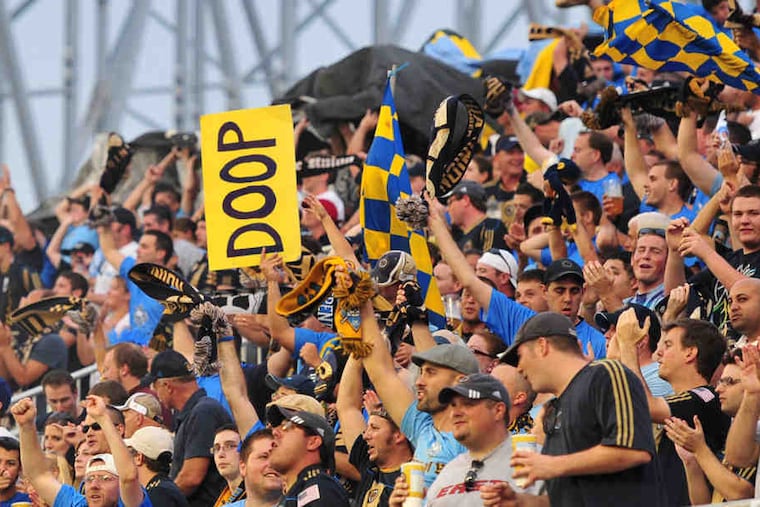
The ads have started to run on TV and in newspapers, a noticeable campaign based on an undefinable word:
Doop.
If you're a Philadelphia Union soccer fan, you know about doop - the rhythmic, repeated syllable in the song supporters sing whenever the home team scores a goal. If you're not a fan, the ads might cause some colloquial confusion.
Either way, get ready, because more doop is headed your way.
As the Union prepares to kick off its second season next month, it has embarked on a high-risk, high-reward ad campaign that promises to spread doop across media platforms in the Philadelphia region.
The team hopes the promotion will bind devoted fans even closer, while pushing casual watchers to investigate the meaning of a word most unheard - and from there to open their wallets and buy tickets.
Unconventional? Sure. But this is a team that intends to emblazon the name Bimbo on the front of its jerseys, having signed a four-year sponsorship with the baked-goods company.
"It's funky enough to beg the question, 'What is doop?' " team CEO Nick Sakiewicz said.
What, indeed.
The word does not appear in Merriam-Webster's dictionary. It has no known definition, other than a couple of crudities suggested in compendiums of urban slang.
Doop shows up in Marvel Comics as the name of a minor character, and on TV's Futurama as an acronym for an interstellar United Nations, the Democratic Order of Planets.
"Doop" is also the title of a 1994 song by a Dutch techno band of the same name. But that song sounds nothing like the pulsing riff of the soccer version, which goes:
Doop, doop, doop, da da doop, doop, doop.
To devout Union fans, said Neal Simpkins, a season-ticket-holder and member of the Sons of Ben supporters group, doop is a noun of renown, invested with multiple uses and meanings.
For instance, on the eve of a game, a fan might say: "Tomorrow, we doop." Any happy, exciting experience can be punctuated by adding, "Doop!" It can even be used to curse: Doop you.
In advertising, one-word campaigns are rare, partly because they hold stark, home-run-or-strikeout potential.
"It is risky, but at the same time, we're in an environment today where there's a great deal of advertising clutter," said Charles Taylor, a marketing professor at the Villanova University School of Business.
He called the use of doop a good strategy, even brilliant, because it helps the Union stand out among the daily barrage of ads. It would be pointless for the team to promote star players - as the Phillies promote Ryan Howard or Roy Halladay - because most people wouldn't know them. Instead, the team is selling the excitement of attending games, he said, and even nonfans might be attracted to that.
"When push comes to shove, this is about whether they get people to come to the stadium or not. That's how they'll know whether this is effective. But they're giving themselves a chance."
Last year, the team averaged 19,254 fans per game at 18,500-seat PPL Park - the first two games were played at larger Lincoln Financial Field - and sold out all 12,000 season tickets. This year, 13,000 season tickets are available, and Union executives are counting on doop to help sell out those as well.
The Union starts the season March 19 in Houston, with the home opener set for March 26 against Vancouver. Between now and then, doop will be seen and heard on the web, radio, and even team merchandise. In fact, the Union has applied for a trademark on the word.
It was Cara Joftis, the team vice president of marketing, who came up with the campaign. She noticed that doop had become part of an internal language among the Sons of Ben. And that, to paraphrase the great linguist Humpty Dumpty, it is a word that means just what the user chooses it to mean.
"We kept listening, and we kept seeing it," Joftis said. "Someone told us their 2-year-old grandchild will do 'doop' in their high chair. That epitomized it."
Canned music isn't part of the PPL Park experience. Instead, songs and chants are led by the Sons of Ben.
The fans are the sound track, Joftis said, and the ads celebrate that, while the accompanying pictures and voice-over alert casual fans that doop is connected to Union soccer.
At the stadium last season, one sign cast coach Peter Nowak in the red, white, and blue hues of the famous Obama campaign poster. At the bottom, instead of Hope, the poster said, Doop.
Nowak had a large hand in developing doop, long before the Union had a player or a place to play. The coach, a former star in the Bundesliga, the top German league, wanted fans to develop a song that could be sung when the Union scored. Foreign clubs often have such songs, and Nowak had heard a version of doop sung by Borussia Mönchengladbach supporters in Germany.
He phoned Bryan James, president of the Sons of Ben, and the two met for several brainstorming sessions. What emerged from those discussions was, well, doop.
"What started out as a small conversation between coach and fans slowly turned into a song that the whole stadium sings," Sakiewicz said. "A lot of times in this business, you've got to let the fans take you where they want to go."
And that, he said, is the straight doop.
