Benny McLaughlin was a Philly soccer pioneer. He couldn’t get off work to play in the World Cup.
McLaughlin didn’t get to play in an epic upset of England in the 1950 World Cup. He chose family and a paycheck. It was part of the legend of a local soccer icon.
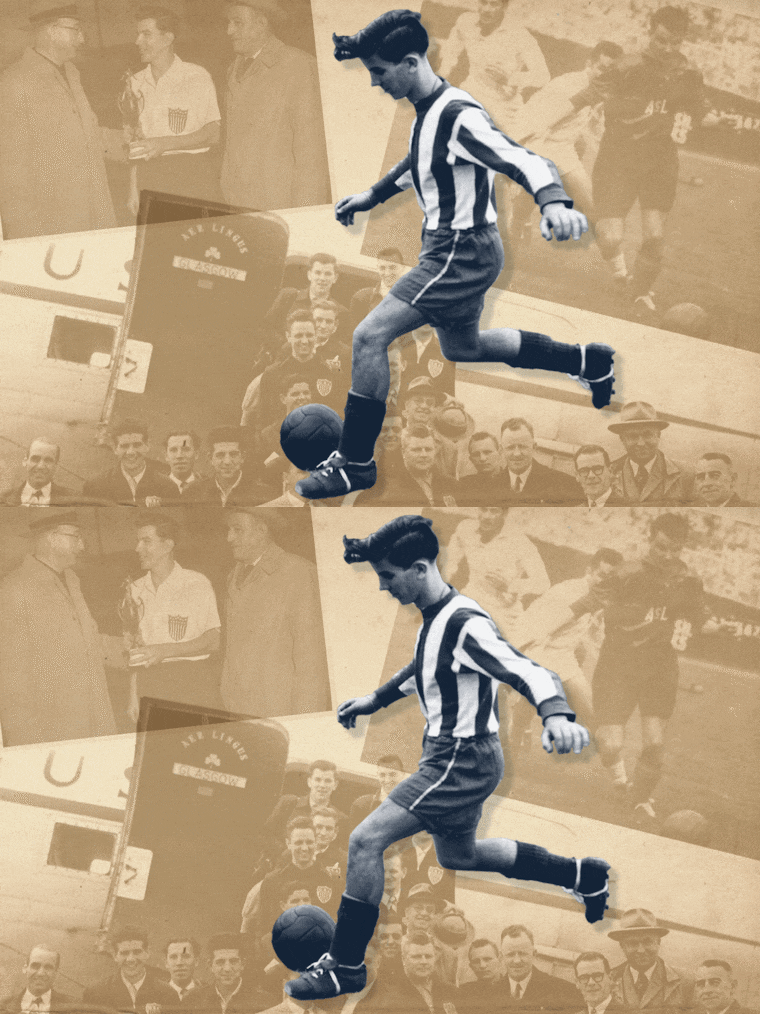
The parking lot was crammed, and the game was already underway when Benny McLaughlin pulled his Impala toward McVeigh Playground, the spot in Kensington where he played as a kid before traveling the world as one of Philadelphia’s true soccer pioneers.
He grew up on Hurley Street in a rowhouse across from the playground where neighbors hung out their windows in the summer of 1948 to fete McLaughlin with a ticker-tape parade after he made the Olympic team.
McLaughlin played professionally as a teenager, was a star at North Catholic, kicked leather balls that felt like cinder blocks in the rain, and helped the U.S. qualify for the 1950 World Cup.
But he had to miss the tournament in Brazil. Why? Because his job refused to give him time off.
McLaughlin, who once played in front of more than 100,000 people in Scotland, was told by a British journalist that he was good enough to play in England’s first division. Considered by one admirer to be the “Babe Ruth” of his neighborhood, in Philadelphia soccer circles, McLaughlin was an icon.
» READ MORE: Philly’s path to the World Cup was paved at Newt’s, where playing on cinder was a ‘badge of honor’
But he still needed a parking spot that Sunday afternoon in the early 1970s at his old playground. Finally, he was spotted behind the wheel.
“Someone goes, ‘Benny’s here,’” said his son, Andy, who sat in the passenger seat. “They waved him in and just said, ‘Park the car anywhere. Leave the keys. Drop it here.’”
Benny McLaughlin already had his cleats and shorts on. He was in his early 40s, there to play in a reunion game of old teams.
Andy, then 12 years old, watched as his dad subbed in. A defender from the Five And One Club — another Kensington watering hole — pointed to McLaughlin and said he had him covered. Good luck.
“He made a move or two around the guy and the guy just fell down,” said Andy, 65. “He took a quick pop shot, and it was in. It was just smooth. I was going crazy. I get goose bumps thinking about it now. And it’s true. I witnessed it. He still had it.”
McLaughlin’s six children would often ask their dad how good he was back in the day. The dad guarded his heroics like state secrets. He was humble. McLaughlin was inducted into the National Soccer Hall of Fame in 1977 and told his kids that it was because he had good teammates.
» READ MORE: Where to watch the World Cup around Philly, from bars open to 4 a.m. to beer gardens in the suburbs
Just once, Andy said, he wished his dad would brag. That wasn’t McLaughlin, who always had a second — or third — job while raising his family on Convent Avenue in the Northeast.
He finally gave his son a glimpse of the life he lived when he blasted that shot into the net at his old playground.
“That was the proof,” Andy said. “I was like, ‘Yeah!’ I was roaring. What would you do? My friends needle me like, ‘What happened to you?’ It’s like being Mickey Mantle’s son. What do you want from me?”
Missing the World Cup
The World Cup will be broadcast worldwide over the next six weeks as players from 48 nations play in sold-out stadiums across three countries. Six games will be in Philadelphia, and the event is now a spectacle after years of planning.
But in 1950, it was anonymous to most Americans. McLaughlin, then 22 years old, was in Mexico the previous September to help the U.S. qualify for the 1950 World Cup. He graduated from North Catholic three years earlier and was an all-American at Temple before dropping out after one year to work.
He was hired in 1949 by Fischer & Porter, a factory in Hatboro that made parts for Navy ships and submarines, where his brother-in-law was an executive. McLaughlin asked the company if he could have a few weeks off to go to Brazil and play in the World Cup.
» READ MORE: Philly hosting the World Cup is just the latest chapter in soccer’s American immigrant story
“They told him, ‘If you go, you no longer have a job,’” Andy said.
Len Oliver, a Hall of Fame soccer writer and Philadelphia native, once wrote that McLaughlin was one of the best American-born players of his era. He was a star. But he couldn’t play in the World Cup.
“Imagine that happening today,” Andy said. “Let’s say you’re a youth player, you make the national team, and you’re going to go represent the U.S. in a foreign country. They would wrap the company’s logo around you. It had to be a real kick in the teeth not to go. But he had to decide. He had a life decision to make. He needed to work. He wanted to get married. If the company said you can’t go, then what do you do?”
That’s Bernie Flanagan
McLaughlin’s father, Bernard, immigrated from Scotland after being recruited by Bethlehem Steel to work at its plant and play on its soccer team. The McLaughlins eventually moved to Kensington, where Benny learned to play soccer in the streets as the boys used the neighborhood’s narrow passages as soccer fields.
His skills blossomed at Lighthouse Boys Club where he played with Walter Bahr, another Kensington kid who became a giant in Philadelphia soccer. They were best friends and played together as teenagers on the Philadelphia Nationals, a professional squad that traveled to New York on the weekends.
McLaughlin was just 15, so he used a false name — Bernie Flanagan — to protect his amateur status while making $15 a game. A tipster wrote to the U.S. Olympic Committee in June 1948, informing them that Bahr and McLaughlin were pros. The USOC passed the information to the U.S. Soccer Federation, which said it would investigate the high schoolers. Nothing to see here, they said.
» READ MORE: Ten years into life as a star, Christian Pulisic arrives at the World Cup he has long dreamed of
“Ben, a young fellow doing a graduate thesis came across these letters,” Bahr wrote to McLaughlin years later after being sent a series of correspondences about their amateur case. “Thought you’d get a kick out of them.”
McLaughlin and Bahr remained amateurs and played together on the U.S. team at the 1948 Olympics in London.
“He looked up and saw 90,000 fans,” said McLaughlin’s son, Bernie, 73. “His cousins from Scotland came over to see him play. He said he was never more proud to be an American.”
Two years later, he was ready for the World Cup. But the company did not budge. McLaughlin, engaged to be married later that year, couldn’t risk losing his job.
“He needed a job, right?” said his son Mark, 59. “All he ever said to us was that it was for personal reasons. What do you do? You choose family. That’s him.”
The U.S. team stunned England that summer in a 1-0 win that still stands as one of the most significant moments in American soccer history. It was so hard to fathom that the Brits back home thought the score was a mistake. They even made a movie about the upset.
Bahr assisted the winning goal, which was scored by the player Andy said replaced his dad on the roster. McLaughlin and Eugene Olaff — who was slated to be the backup goalie but couldn’t get off work as a New Jersey state trooper — read about the win in the newspaper.
“Imagine getting that news,” Andy said. “It had to be bittersweet. You’re thrilled for them but sorry for yourself. When you have time to evaluate it, what’s a few weeks when you’re making history?”
Benny’s legacy
Bernie was a freshman at St. Joseph’s when some teammates who grew up in his dad’s old neighborhood recognized his last name.
“My dad’s picture was hanging up in bars in Kensington,” he said as the taverns all sponsored teams. “They said, ‘Is your dad Benny McLaughlin?’ I said, ‘Yeah.’ They said, ‘Well, if you grew up in our neighborhood, you would’ve never had to buy yourself a beer.’”
About 10 years ago, Andy was sitting at a quiet bar on Torresdale Avenue when he heard a few guys talking about soccer. He joined the conversation.
“I said, ‘Yeah, my dad played one time,’” Andy said. “The guy said, ‘Oh yeah? Who’s your dad?’ I said, ‘Benny McLaughlin.’ He looked stunned. He said, ‘Your dad is Benny McLaughlin? Benny McLaughlin is your dad?’ He was fumbling for words. Finally, he says to the bartender, ‘This guy is on scholarship for the rest of the afternoon.’”
» READ MORE: Duke Lacroix’s soccer career has taken him from Penn to Haiti’s World Cup team
McLaughlin’s name still means something in Philadelphia, but his legacy has dimmed outside the city. Perhaps that would be different if he played in that World Cup and scored that iconic goal. But he never thought about it, his sons said. It didn’t make him bitter or dim his love of the game he learned to play as a kid in Kensington.
He kept a pair of old soccer cleats — “You would’ve thought they were Frankenstein’s boots,” Mark said — under the basement stairs and watched VHS tapes of European highlights, marveling at how they blasted the ball. He cheered the next generation of American players, some of whom grew up near Kensington. The game never left him.
“He always said that soccer is for the new generation,” Mark said. “He had no regrets for what he did. He was grateful for what he was able to accomplish. He never looked back.”
Ed Blaney, who played at St. Joe’s, told the McLaughlins that he credited their dad for his college scholarship. McLaughlin, he told them, helped make soccer relevant in the U.S., which caused more colleges to field teams.
Blaney played at North Catholic and grew up in Kensington, just like McLaughlin. He would not have been able to afford college without the pathway the neighborhood celebrity created. Forget the World Cup. That is McLaughlin’s legacy, Bernie said.
One last reunion
McLaughlin kept his job at Fischer & Porter for more than 20 years before working for the city in the redevelopment authority. He sold carpet at night and delivered kegs on the weekend, doing whatever it took to raise six children with his wife, Joan. McLaughlin made breakfast every Sunday — fried eggs and bacon — and often topped a summer barbecue with a drive to Goodnoe’s Ice Cream in Bucks County.
“I want to stop myself from bragging about him,” Andy said. “But I don’t. As great as a soccer player as he was, he was a great dad, too. He was always looking out for us. He always had a nice word for you. He was just a great, loving dad.”
McLaughlin was starting to fade in 2010 when his family moved him to a senior facility in West Chester. A few weeks later, a new resident named Harry Naughton was complaining about his hips. He told the staff he used to play soccer. They told him they had someone else living there who once was a big soccer player in Philly.
» READ MORE: The USMNT has momentum going into the World Cup, even after a loss
“Don’t tell me it’s Benny McLaughlin,” Naughton said.
The staff asked Naughton how he knew it would be McLaughlin.
“Who doesn’t know Benny McLaughlin?” he said.
Mark soon took his dad to Naughton’s apartment. Benny couldn’t say much, but his son knew he recognized his old teammate. Naughton was a goalie on the Philadelphia Nationals, the team McLaughlin played for under that fake name.
Mark took out his phone, called Bahr, and put him on speakerphone. The three teammates were together again.
Bahr asked Naughton how his back was feeling. He said it was giving him trouble, but how did Bahr know?
“‘Oh, I just figured it would be bad from all the times you had to bend over to pick the damn ball up from the back of the net,’” Bahr said.
Benny McLaughlin, who died two years later in 2012 at age 84, laughed. So did the others as they chatted that afternoon about the old days.
McLaughlin played the game as a kid with wizardry, a skinny kid from Kensington who moved the ball with ease and always seemed to find an open teammate. Eric Charleson, one of America’s earliest soccer experts, once wrote that McLaughlin had “a fire, spirit, and determination that defied the rigors of the sport.” But he was more than that, Charleson wrote, as McLaughlin had “integrity, sportsmanship, and character.” That’s why he didn’t talk much about his career. His game said it all.
» READ MORE: Lapstone & Hammer represents Philly as part of World Cup collaboration with U.S. Soccer
And there he was in his old buddy’s apartment, talking about the game they once mastered. The game they played on the streets in Kensington and the game they toasted in those little neighborhood taprooms. The game that took them around the world and the game that wasn’t yet popular enough to get you off from work. But McLaughlin didn’t mind. The game gave him enough memories. He didn’t need a World Cup.
“You almost saw a youth come into all of them,” Mark said. “They were young again for a minute. The joy and the smile. The eyes were shining. It was just so awesome. It was the best day ever.”

Nine nations will compete in five group stage matches this summer, plus two more in a knockout game on July 4. Here’s what you need to know about those countries — and what those fans need to know about Philly. Click here for more.