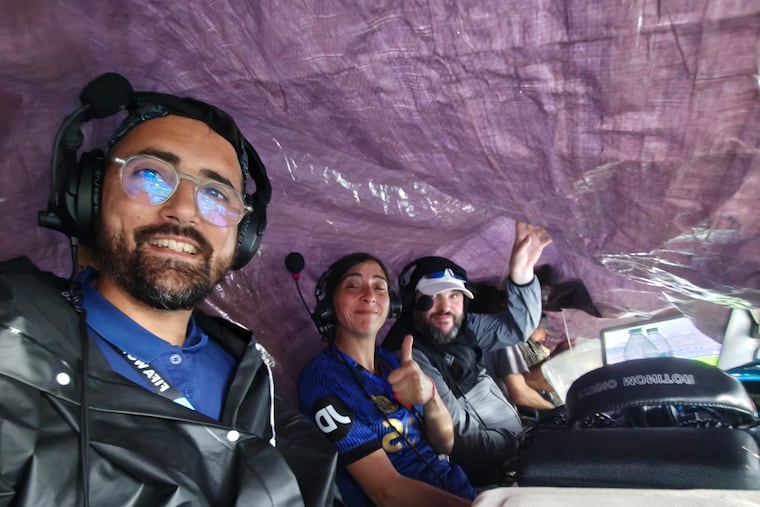
When storms hit the France-Iraq game in Philly, a French radio station stayed on air from under a tarp
France Info's technician went to a Center City hardware store for the move that ended up saving the broadcast. "It was a mix of French and American expertise," broadcaster Julien Froment said.
Everyone knew that there was a risk of thunderstorms in Philadelphia on Monday, and Mother Nature delivered on cue.
But while the players could go to the locker rooms and the fans could go to the concourses, broadcasters calling the action couldn’t just go off air. Even worse, the TV and radio areas are in the upper-deck stands, part of extra media seating FIFA always builds at World Cups. So there was no cover overhead when it was only raining.
While FIFA put plastic covers on the tables, that wasn’t enough to protect all the expensive equipment and the people using it. So the team at France Info, one of the many French radio stations broadcasting the game, had to get creative.
» READ MORE: How a rain delay during the France-Iraq World Cup match turned into a shopping spree at Philadelphia Stadium
Virginie Lorda, the crew’s technician, found a hardware store a few blocks from their hotel in Center City, and bought a tarpaulin and some ropes to tie it onto the table. Then when the rain started falling, the tarp came out.
Broadcaster Julien Froment documented it all on his social media feeds, adding to the spectacle of a night with a two-hour delay in the game. The next morning, he talked with The Inquirer about it as the crew headed back to France’s base camp in Boston.
“I have to give the credit to Virginie,” Froment said. “She had the idea to set this up, a little bit at the last minute, to protect us. … It was a mix of French and American expertise.”
Summers can get very hot in France — the country recorded its hottest day ever on Tuesday, and highs are expected to top 100 degrees multiple times this week. But the sky doesn’t explode like it does here, even if that feels normal to Americans.
» READ MORE: Four Frenchmen skipped work to go to the World Cup in Philly. They’re already planning to return for an Eagles game
“You all are used to this,” Froment said. “For us Europeans, to have to deal with a thunderstorm, it’s a bit new. This one was a grand premiere.”
It’s worth noting that when Philadelphia hosted the Club World Cup last year, the city got pretty lucky. There were big storms on nongame days, and multiple games in other cities got hit. But no action here got delayed or postponed.
So maybe we were due, and unfortunately it happened during an especially star-studded game. France’s Kylian Mbappé scored two of Les Bleus’ goals in the 3-0 win, including a viral sensation of a hit for the opener, and reigning world player of the year Ousmane Dembélé capped things off with his first World Cup tally.
To the city’s credit, the stands were almost totally full when the game resumed. No one went home even with the long delay, wanting to make the most of a rare chance to see these players in person.
» READ MORE: Philadelphia’s World Cup love affair shows just how far we’ve come
Though it’s unusual for American stadiums to have media seating in the middle of the stands, it’s the norm in Europe and elsewhere. There aren’t broadcast booths the way there are at American football, baseball, and soccer stadiums.
The locations of the “media tribune,” to use the world’s game’s phrase, can vary. At Chelsea’s famed Stamford Bridge in London, you can almost touch the team benches. At Lyon’s modern Groupama Stadium in France, which hosted the 2019 women’s World Cup final, you’re up in the heavens.
But no matter the distance from the field, there’s almost always a roof over the stands in some form.
“We’re in the open air to capture the atmosphere — it’s the tradition," Froment said. “We’re used to being outside. But the big difference between European and American stadiums is we aren’t protected here. There’s no roof, there’s nothing to protect us from the elements.”
» READ MORE: Can the USMNT really win this World Cup? Probably not, but the players are allowed to believe it.
That is especially the case at the stadiums Froment’s crew has been to so far in New England and the Meadowlands. France isn’t playing at the indoor venues in Atlanta, Houston, or Dallas; or in Seattle or Los Angeles, where the stadiums are open-air but the stands are covered.
But Froment has enjoyed the experience overall, marveling at America’s modern stadiums that are palatial compared to European soccer cathedrals with decades of history but fewer amenities.
“Here, you get the feeling that everything is almost at extremes,” he said. “The stadiums are huge, built specifically for the fans. I’m kind of shocked by how many snack bars and concession stands there are. … It really represents a different kind of consumerism — a different sports culture — compared to what we’re used to in Europe.”
They’re also a lot bigger than most stadiums in France. The biggest, the Stade de France in suburban Paris, seats 80,000; the second, Marseille’s Vélodrome, seats just over 67,000; and the venues in Lyon and Lille are the only others nationwide over 50,000.
» READ MORE: Philly has been called the ‘Paris of America.’ Here’s what French fans in town for the World Cup think.
Asked his opinion of Lincoln Financial Field, Froment called it “the best stadium I’ve been to at this World Cup,” helped by location, architecture, and the vibe of the broader Sports Complex.
“It’s a little different,” he said. “At MetLife Stadium [in North Jersey], it doesn’t have personality. It feels like it could be any stadium in the world. In Philadelphia, you feel like there’s a story there.”
(We couldn’t help responding that he’s far from alone in those opinions.)
He had some time to explore as well. There were a few trips to Reading Terminal Market, and walks to the Liberty Bell and the Rocky Steps — documenting France fans’ night-before pep rally at the latter.
It’s playing the hits, sure. But it’s also a reminder of how warm a welcome Philadelphia has put on for its international guests this summer, and that Center City being easy to walk around is another of its great assets.
» READ MORE: The joy the World Cup has brought to Philadelphia feels like the escape we didn’t know we needed
There might be a second chance to welcome France, too, if Les Bleus win their group and the round of 32 game afterward.
“I find the city really nice,” Froment said. “It’s less oppressive than New York. You can breathe more easily.”

In this World Cup, underdogs have stolen the spotlight, the U.S. men made a notable run and Philadelphia not only welcomed the world but gave visitors a crash course on just how real the curse of the Rocky Statue can be.
Join Jonathan Tannenwald, the Inquirer's soccer writer, and host Lisa Carlin, analyst for CBS Sports Golazo, as they dissect the matches, the moments, and more as Philly has its moment in soccer's brightest spotlight. Watch our latest episode right here.
Watch previous episodes:
Episode 1: The Wait is Over!
Episode 2: Groups, Goals, and Glory
Episode 3: Electric Action in Philly
Episode 4: The Knockout Rounds Begin!