Can the USMNT really win this World Cup? Probably not, but the players are allowed to believe it.
The hype generated from the U.S. team's wins at the World Cup has caused people to start asking if they can win it all. The truth is the games to come will be much harder than the ones so far.
IRVINE, Calif. — On any given day in Seattle, there are a lot of things in the air: the breeze off Puget Sound, the seagulls that steal your french fries, and other substances for which the city is well-known.
It wouldn’t be fair for an outsider to ask if the last of those factored into the sudden outbreak of hype around the U.S. men’s soccer team. The atmosphere at Friday’s U.S.-Australia game needed no enhancement, with that crowd showing the nation and the world why Seattle’s soccer culture is the real deal.
But something has caused people to start asking if the U.S. men can win this World Cup. So let’s answer it.
No, this team is a long way from such a … height, let’s say.
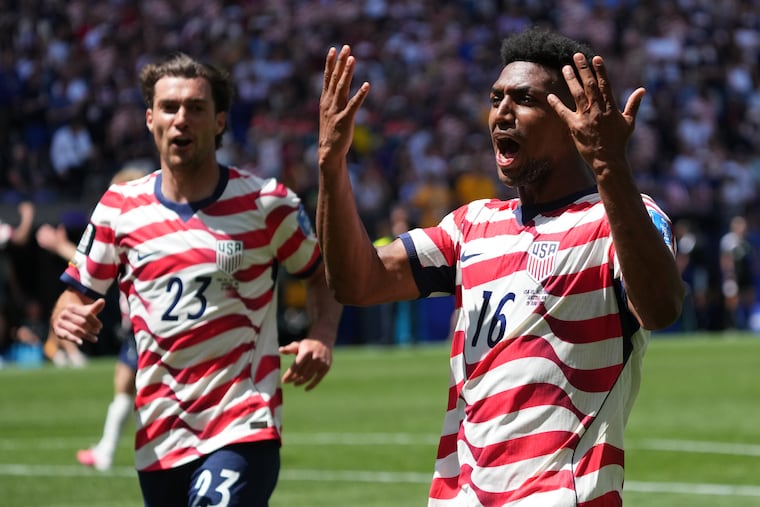
Yes, the Americans have won two games in a men’s World Cup group stage for the first time since 1930. Yes, they have won their group for the first time since 2010, and clinched qualification for the knockout rounds with a game to spare for the first time in the program’s modern era, which started in 1990.
But the teams they’ve beaten so far, Paraguay and Australia, looked the part of the 41st- and 27th-ranked teams in FIFA’s global standings, which they were when the tournament kicked off. The U.S., meanwhile, has done something that should be within reach for a No. 17 team with home-field advantage on the world’s biggest stage.
» READ MORE: ‘Two Delco-heads,’ Matt Freese and Auston Trusty, helped the USMNT make World Cup history
When the U.S. faces Turkey in the group stage finale on Thursday in Inglewood, Calif. (10 p.m. Fox29, Telemundo 62), the hosts will again face a team ranked below them. Turkey is No. 22. How much will that actually prove, compared to a potential matchup with Belgium in the round of 16 or Spain in the quarterfinals?
Even the first knockout game in the round of 32 could be a trap. Though the U.S. is already set to head to the Bay Area for a game on July 1, the team across the field won’t be known until the group stage ends. It will be the third-place team from group B, E, F, I, or J, depending on which eight of the 12 third-place finishers in the tournament advance.
The Athletic has a forecasting formula that projects Bosnia & Herzegovina, ranked No. 64, as the most likely candidate right now. As they’d say on “Let’s Make A Deal,” you take the offer right there. Upcoming games could put Ivory Coast, Ecuador, Japan, Sweden, Norway, or Senegal behind the other doors.
But if it is Bosnia, it would still be a measuring stick, and not just because the U.S. men have won just one knockout-round game in their history (against Mexico in 2002).
» READ MORE: The joy the World Cup has brought to Philadelphia feels like the escape we didn’t know we needed | Kerith Gabriel
The Americans’ all-time record against European teams in World Cups is 3-14-7, and the only win of the modern era was against Portugal in 2002. The other two were against England in 1950 and Belgium in 1930. (Coincidentally, both games had heroes from Philadelphia, Walter Bahr and Bart McGhee.)
Sometimes, the insistence on measuring American soccer against Europe is just a thing in the heads of fans and media. But the results record is still long and one-sided, even compared to other continents. The U.S. is 3-2-0 against teams from South America, 2-2-0 against teams from Africa, and 2-1-1 against teams from Asia.
Why it’s different for the players
If reading this makes you feel like it’s spoiling the party, sometimes that’s the job of a professional cynic. So we’ll balance it by saying the warning only applies to outsiders. It’s perfectly fine for the players and coaches to believe they can go all the way, because they need that belief along with everything else to win games on the biggest stage.
“Obviously, we take it one game at a time, but every game, every tournament that we play, we want to win,” centerback Chris Richards said. “So I don’t think it’s ridiculous to say that we want to win it.”
» READ MORE: For Haiti, a lopsided World Cup loss to Brazil didn’t matter much. Just being here meant everything. | Mike Sielski
Nor was it outrageous, even if it was certainly headline-grabbing, when manager Mauricio Pochettino told The Athletic last week that “we should dream without limits.”
“If I dream of touching the moon, of being up on the moon, maybe I can get close to the moon,” he said. “If I only dream of getting close to it, I’ll stay on Earth. It’s so powerful, isn’t it? Believing that you can do it.”
It had to help Friday. The players found out that morning, just a few hours before kickoff, that its catalyst, Christian Pulisic, wasn’t healthy enough to play.
“We were all ready to prepare for this game, and whenever we heard that the coach gave us the lineup, the next player, the next man up was ready,” said Ricardo Pepi, who was that next man.
“I think that we built the victory in our attitude,” Pochettino said after the Australia game. “I told the player: the first action when we started the game, did you see how Pepi and Balogun go to press?”
We sure did, and it set the tone that led to the game’s first goal in just 11 minutes. Australia had to boot the ball out to beat it, and one of those clearances led to the throw-in that started the scoring play. The U.S. worked the ball around the back line, Antonee Robinson sprung Balogun down the left wing, Pepi charged up the middle, and Cameron Burgess put the ball in his own net.
They didn’t let up, either, as physical as the game got. After winning the first game with style, the U.S. won the second with grit, as the teams combined for 28 called fouls and plenty more uncalled.
How the Turkey game will go is impossible to know right now, with the U.S. already group winners and Turkey already eliminated. It’s the first game without qualification stakes for the Americans since 1998, when they lost their first two games and were eliminated before the third.
» READ MORE: Rob Stone has spent half his life broadcasting World Cups. This summer, he leads what could be Fox’s last.
Will Pochettino rotate his lineup a lot? It makes sense at first, but there are caveats. There’s a history of teams that rest players in their third game ending up rusty in their first knockout game, and this time there are six days between the second and third group contests — then another six between the round of 32.
There’s a clear case to rest Pulisic and players on yellow cards: Tyler Adams, Robinson, Richards, and Balogun. If they get another booking in this game, they’re out of the round of 32 contest. But beyond them (and it’s a lot, for sure), Pochettino might want to keep the rest in a good rhythm.
At least it’s a good problem to have. The results so far and the manner of earning them signal that the U.S. can make a run in this World Cup. But winning the title is a different question. That still feels too high of a task, and it will eventually become clear.

In this World Cup, underdogs have stolen the spotlight, the U.S. men made a notable run and Philadelphia not only welcomed the world but gave visitors a crash course on just how real the curse of the Rocky Statue can be.
Join Jonathan Tannenwald, the Inquirer's soccer writer, and host Lisa Carlin, analyst for CBS Sports Golazo, as they dissect the matches, the moments, and more as Philly has its moment in soccer's brightest spotlight. Watch our latest episode right here.
Watch previous episodes:
Episode 1: The Wait is Over!
Episode 2: Groups, Goals, and Glory
Episode 3: Electric Action in Philly
Episode 4: The Knockout Rounds Begin!