The first Broad Street Run had cigarettes at the start and a bandit runner. It’s come a long way.
Philly has races nearly every weekend but no race better defines the city than Broad Street. The first run in 1980 was marketed for “the everyman.” Years later, it's still the same.
Chris Tatreau stood at the starting line, ready to fire the gun to begin the inaugural Broad Street Run in June 1980 when he saw a few runners puffing cigarettes. The race — which has since grown to become the nation’s largest 10-miler — was thrown together with a $2 entry fee and a registration form in the newspaper. And it looked to be up in smoke before it even started.
“They were from South Philadelphia, for sure,” said Tatreau, who grew up in North Philly and was working for the city when he was tapped to direct the first Broad Street Run. “I said, ‘Fellas, this is just a bad image. I don’t want a picture in the paper with someone blowing smoke out.’”
The guys put out their cigs, Tatreau fired his starter’s pistol, and the runners were off.
» READ MORE: Everything you need to know ahead of the 2026 Broad Street Run
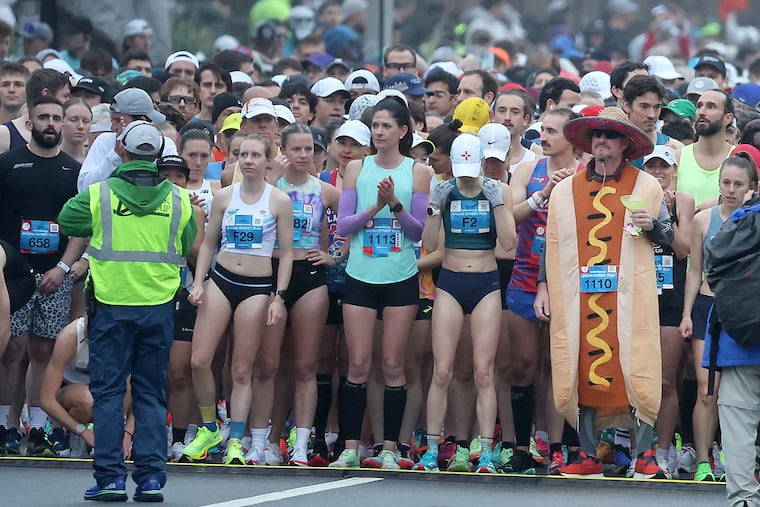
Sunday’s Broad Street Run will have more than 40,000 participants. The route is still mostly the same as 1980, but the race that started with 1,500 runners squeezed into the southbound lanes of Broad Street has grown into a spectacle.
Philly has races nearly every weekend, but no race better defines the city than Broad Street, where the distance is long enough to be an accomplishment yet short enough to be doable. It starts in North Philly, sprints through Center City, and finishes in South Philly.
There are elite runners in the front, neighborhood joggers in the middle, and people dressed like Allen Iverson somewhere in the pack. The first run, Tatreau said, was marketed for “the everyman.” Years later, Broad Street is still the same.
“We priced it so nobody could say, ‘I couldn’t afford it,’” Tatreau said.
‘I got no money’
Tatreau was at the finish line inside JFK Stadium when John Jennings finished in second place but was not wearing a race bib. Tatreau taught at Cardinal Dougherty High School when Jennings went there and asked his former student why he didn’t sign up.
“I said, ‘I got no money,’” Jennings said as the race priced for the “everyman” wasn’t priced for him.
Jennings was a Catholic League champion at Dougherty before graduating in 1973, and he competed in the 1976 NCAA championships with Seton Hall University. But he didn’t pay for Broad Street, so his second-place finish — “53 flat,” Jennings said — did not count.
Jennings took the bus that morning from Rising Sun and Godfrey to Broad and Olney, left his change of clothes behind a bush, and hopped into the crowd. The first Broad Street Run was nearly won by a bandit.
“People were mad at me because I didn’t enter,” Jennings said. “But if you have no money, what are you going to do?”
Jennings grew up in the Lawncrest section and went to Dougherty to play football before getting cut from the freshman team. The track coach was his homeroom teacher and urged Jennings to join the cross-country team. Jennings gave it a shot and won his first race by 20 seconds. He found his sport.
“That school saved my life,” Jennings said. “If it wasn’t for Cardinal Dougherty, I would’ve been a regular kid in the neighborhood working at Sears and Roebuck on the Boulevard, you know what I’m saying? I came from nothing. That’s how it all started. Dougherty, baby.”
Growth of Broad Street
It will take nearly an hour on Sunday to begin the race, as the 40,000 runners are split into “corrals” for a staggered start. There’s so much more now than just firing a pistol. That was hard to imagine in 1980 when jogging was just becoming a trend.
“It’s unbelievable how much it’s grown,” said Dave Thomas, who ran that first race with Jennings but paid for his entry. “I started running in 1971, and you couldn’t see in the future how much it would take off. It’s the kind of event where people may only run that one race and they’re like, ‘Hey, I’m training for Broad Street.’ It’s the type of race that draws regular jogger types. It’s a great event.”
The first race was in June, making the weather much warmer than what’s projected on Sunday. The runners all took off at the same time, confusing the North Philly residents who watched a group of runners dashing down one side of Broad Street.
“The kids came up and asked how much we were getting paid,” Jennings said. “They didn’t understand it, either. All these white guys in front of Central High running down Broad Street, and they’re like, ‘What the hell is going on here?’”
There were races in the city back then, but most of them were small runs strictly for competition and not the parade-like events they’ve become. The small group of Philly runners met regularly for five-mile races on Kelly Drive, starting near Boathouse Row.
The 100 or so runners — nearly all of whom were men — all knew one another, and the races were put on by Browning Ross, a former Olympian who ran at Villanova University.
“The awards were like stuff he had in his trunk,” said Thomas, who grew up in Olney and ran at La Salle High and Temple University. “It might be a book or something. It wasn’t organized the way it is these days, but it was a really close-knit community. They were serious runners.”
» READ MORE: WWF at the Spectrum felt like a Phillies playoff game. And there was no doubt the wrestling was ‘real.’
The first Broad Street Run came as everything was about to change. Jogging was becoming more common. Running would soon become a thing. The race’s idea came from Bob Crawford, who was the city’s recreation commissioner. Crawford’s son saw San Francisco’s Bay to Breakers race and urged his father to try something similar in Philly.
They picked JFK Stadium as their finish line and then rode a bike up Broad Street to measure 10 miles. The start was marked at Broad Street and Fisher Avenue. The finish line is now in the Navy Yard, but the starting line is still roughly the same.
Runners now cover both sides of Broad Street, but in 1980 cars zipped up the northbound lanes as the pack moved south.
“It was pretty dangerous,” Tatreau said. “The police, as always, did a great job, but there were a lot of hairy times. ‘Well, all I wanted to do is make a left turn. I live to the left.’”
The race partnered with the Daily News, which printed the registration form in the paper and regularly had stories in the weeks leading up to the race. The tabloid promised to run the results of everyone who finished. Only the finishers who paid, of course. Tatreau credits The People Paper for the strong turnout and the cigarettes.
“We got the Daily News clientele,” Tatreau said. “My two smokers, obviously, bought the Daily News every day.”
Spur of the moment
Broad Street took off in the late 1980s under the guidance of Joe Cook. Jim Marino took over the race in 1997, directed it for more than 20 years and made the race even bigger. They installed a lottery in 2013, and thousands are now shut out every year. The 1980 race allowed runners to sign up at the starting line. Jennings had some money with him, but that wasn’t for a race bib.
“I think I put a dollar in my sock to take the subway home,” Jennings said.
Jennings met Thomas at the finish line and they headed back up Broad Street. Mike Bradley, who ran at Bishop McDevitt High, took first place. The clothes Jennings stashed behind the bush near Central High were still there.
They hopped into Thomas’ Volkswagen and boarded a Greyhound bus the next day for California. The bandit moved to Lake Tahoe and didn’t return to Philly for a few years. He worked in the casino industry and now lives in Arizona.
Thomas paid for his entry fee in 1980, so his finish counted. He coaches cross-country and track at Jefferson University and will be posted Sunday at the finish line. Jennings was two bucks short of being able to say he finished second in the first Broad Street Run. All these years later, he has no regrets about missing out on a little piece of history.
“It was just a spur of the moment thing,” Jennings said. “I never knew this race was going to grow.”