WWF at the Spectrum felt like a Phillies playoff game. And there was no doubt the wrestling was ‘real.’
WWE is now a billion-dollar business, with its signature event, WrestleMania, this weekend in Las Vegas. But for fans at the Spectrum in the '70s and '80s, it wasn’t just “sports entertainment.”
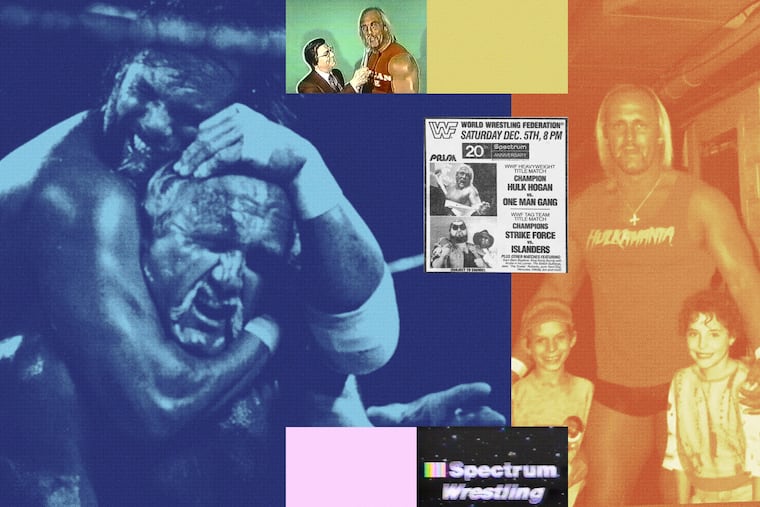
The villains they watched on TV — snarling beasts who promised to inflict pain on the heroes — suddenly were right there, walking to the ring as the Spectrum crowd jeered. There was no doubt for the middle school kids from Delaware County that what they were watching was real. It was professional wrestling in the 1980s. Of course, it was real.
As easy as it was to buy in, it was even harder to maintain control. Chris, an 11-year-old from Springfield, had no chance.
“We’re up against the metal guardrail and Chris is just yelling ‘F— you!’ at the bad guys,” said his buddy, Adam Roosevelt. “My dad looked at him, and it was like he was having an out-of-body experience. He had to grab him and shake him. ‘Chris, hey, man. Hey, man. Take it easy, buddy.’”
WWE is now a publicly traded company with TV contracts worth billions of dollars. WrestleMania, the company’s Super Bowl, is held at football stadiums over two nights. This year’s iteration — WrestleMania 42 — begins Saturday in Las Vegas. And it’s no longer a secret that the show is scripted and the results are predetermined. So much so that Netflix, which pays $5 billion to televise WWE programs, has a show about the people who write WWE’s storylines.
» READ MORE: John Cena’s grandfather played for the Phillies and protested when they traded him away
But it was still “real” back at the Spectrum, where WWE — then known as the World Wrestling Federation — came monthly during the 1970s and 1980s just as the company was growing from a regional enterprise to a global entity.
The wrestlers protected the business, refusing to admit that they were pulling punches. Some even roughed up reporters who asked if it was “fake.”
The crowd at the Spectrum — like those kids from Delco — bought in. They cheered for Hulk Hogan and Jimmy Snuka and booed Nikolai Volkoff and King Kong Bundy. There were characters like the Honky Tonk Man and the Million Dollar Man. The arena was sold out, and the matches were televised.
The pro wrestling business soon changed, becoming far bigger than anyone could imagine. Back at the Spectrum, it was still real.
“It was so different,” Roosevelt said. “It truly was a time where we still kind of were able to separate reality and believe that it was real. It was the suspension of disbelief. Nowadays, I think everyone gets it. Everyone is in on the joke. Back then, it was still something. You caught the matches on TV once a week, maybe you’d see the guy a couple times a month, and then to see it live was just an explosion of ‘Holy crap. This is crazy.’ It was an experience.”
Spectrum Wrestling
Eric Gargiulo didn’t have cable TV in the 1980s, but that was not enough to stop him from watching Spectrum Wrestling on Sunday afternoons. His neighbors didn’t have kids, but they had PRISM, the Philadelphia cable network owned by Ed Snider that televised the Spectrum matches.
So he knocked on their door and asked if he could sit on their couch for a few hours to watch guys like Rowdy Roddy Piper and the Hart Foundation.
“I found any way I could to watch those PRISM shows,” said Gargiulo, who later worked for independent promotions and wrote a popular wrestling blog.
» READ MORE: Veterans Stadium had a secret lounge where stars became normal people and hoped to leave their mark
Those PRISM telecasts were the closest thing to being in the arena. They were taped on Saturday nights in South Philly and televised the following day. There was no Raw or Smackdown to watch. Spectrum Wrestling was the show. Dick Graham was the announcer, Kal Rudman interviewed the stars, and Gorilla Monsoon was the color commentator.
“What a beautiful man,” said Randy Seidman, the show’s producer. “I didn’t know what to call him. Do I call him Mr. Monsoon? Do I say, ‘Hey, Gorilla?’ It turns out his name is Gino Marella. He was a great guy.”
Monsoon lived in Willingboro and ran WWF’s Spectrum operation, since Vince McMahon, the company’s owner, usually was in New York. Seidman would tell Monsoon during intermission how many more minutes of action he needed to fill the next day’s TV slot. No problem, Monsoon said.
“Monsoon would then act like a baseball coach,” Seidman said. “He would be giving signals from where he’s announcing at ringside to tell the guys to wrap it up. He ran a tight ship. He paid the guys in cash that night after they were done.”
Graham was a local broadcaster, and Rudman was a pop music power broker who went to Central High School and often dictated what songs became hits on FM radio. The wrestlers called him “Killer Kal” as they hyped up their matches backstage.
Rudman became friends with McMahon in the 1980s and started working shows at Madison Square Garden, where a wrestler once toppled out of the ring and landed on him. He showed up at the Spectrum a week later on crutches.
“I’m thinking ‘This poor guy,’” Seidman said.
The PRISM crew members were hanging backstage during an intermission when they suddenly heard music playing in the arena. The show was starting early. Seidman yelled for everyone to get in position.
“And here comes Killer Kal with the crutches up in the air running down the hallway,” Seidman said, as even the announcers tried to keep it real.
Keeping it real
PRISM did not pay the WWF to televise the matches, as McMahon saw the Sunday afternoon TV block as a way to build his company. In the early 1980s, the WWF still was a small outfit competing with a slew of other promotions. By the end of the decade, WWF was king, thanks to Hulkamania. PRISM — along with similar cable shows in New York and a weekly show on the USA Network — played a part.
The WWF asked PRISM for little oversight on the show except to not shoot tight shots of clinches or finishing moves. They had to help keep it real. The wrestlers mostly were easy to work with, though sometimes “Macho Man” Randy Savage dictated how they filmed his manager (and real-life wife) Miss Elizabeth. Bob Backlund — “What a boring champ,” Seidman said — did exercises in the hallway, and some — like Virgil, the manager of the Million Dollar Man — even hung in the TV control room.
“He would have his sleeves ripped off his tuxedo jacket,” said J.R. Aguila, who worked as the show’s director. “I remember turning to him once and saying, ‘You know, you work for that guy and with all the money he’s flashing, you think he’d buy you a coat with sleeves?’ He looked at me like he was going to eat me for dinner. I shut my mouth and made it a point moving forward of ‘Do not feed the animals.’”
The guys filming the show knew what was going on, but that didn’t always keep them safe. Kamala the Ugandan Giant — “A rather large man,” Aguila said — was thrown out of the ring one night and landed on cameraman Jim Duva. The feed went black. It suddenly felt real.
“We’re bummed because we lost the camera but more importantly, ‘Did he kill one of my friends?’” Aguila said. “We eventually got the camera back up, and he’s laughing his rear end off, at least what was left of it, because he just got splatted by Kamala the Ugandan Giant.”
‘My body was shaking’
Gargiulo was at a Duke basketball game a few years ago when the Cameron Crazies reminded him of the people he used to sit with at the Spectrum.
He was in South Philly in February 1984 when Hogan wrestled the Masked Superstar just two weeks after winning the WWF title at Madison Square Garden against the Iron Sheik. That match in New York marked the dawn of Hulkamania, a movement that soon pushed wrestling onto MTV and Saturday Night Live. Wrestling became a spectacle.
Everything became bigger after that, even the roars at the Spectrum.
“[Hogan] came out, and I’ll never forget it,” Gargiulo said. “I was up in the nosebleeds, and the whole place was just shaking. It was electric. My body was shaking. It was such a level of excitement, even more so than a Duke basketball game. It was insane. I had been there for Backlund’s title reign, but this was such a different level. It was off-the-wall chaos. People going crazy like a Phillies playoff game.”
Stars like Hogan and Piper were the attractions, but the Philly crowd became its own character. It turned Hogan that night into a hero. The PRISM crew filmed him leaving his locker room like a gladiator, walking to the ring while “Eye of the Tiger” blared on the speakers and the crowd came unglued.
» READ MORE: Ranking the Top 10 WWE moments in Philadelphia
“The Spectrum was so loud,” Hogan said in 2018. “It used to make my jaws water. It’s kind of like I’d smell good food or something, my jaws would water. It would get so loud in the middle of that ring with that rumble in the building that it would make my jaws water. And then if I was getting beat up by the bad guy, I would reach out for help, the fans would try to come toward the ring.”
The crowd cheered that night for Hogan, but the Philly fans didn’t always follow WWF’s plan. They often loved the bad guys. Philly cheered for Snuka when Superfly was still a “heel” and booed Backlund when he was a “baby face.” They even booed Hogan once when he was still champion. The crowd was real.
“The Philly audience was always known as its own entity,” Gargiulo said. “I can’t tell you why it’s like that here and not in New York or Atlanta, but Philly is its own entity.”
Roosevelt’s mother, Carol, worked for PRISM, which is how he and his buddy landed those seats against the guardrail as the “Fan of the Month.” Even the promotional contests — which Seidman oversaw — sometimes were fixed.
Roosevelt was often backstage and saw the wrestlers eating dinner, comparing it to going to Disney World and watching Mickey Mouse take off his head. It was strange. But then he reminded himself how he saw Flyers enforcer Dave Brown leave the Spectrum one night in jeans and a collared shirt.
“Dave Brown was just out there kicking somebody’s [butt] on the ice for the Flyers and then you see him and it’s like when you see a teacher in town: ‘Woah, they’re human,’” Roosevelt said. “It’s like, ‘Hulk Hogan isn’t in his yellow and red. He’s in jeans and a shirt.’ Their work was done for the day, and they were off for home. It didn’t impact the belief in the reality.”
“The tricky one was I remember George ‘The Animal’ Steele came out and signed an autograph for me. I’m like, ‘What is going on? This guy was just eating turnbuckles. How the hell does he come out here and smell like aftershave?’ That was kind of tough, but I just rolled with it. I didn’t know what to think, but I survived, so I was just moving on.”
Still real to me
The crowds came to the Spectrum to see the stars. But those Saturday night cards also had guys like Special Delivery Jones, who was billed as being from Philadelphia, and Ron Shaw, who actually was from Philly.
Shaw grew up in Torresdale and went to Lincoln High School before attending a wrestling school in Massachusetts run by Killer Kowalski. He signed with the WWF in 1980 and worked mostly as an “enhancement talent.” It was Shaw’s job to make others look good, meaning he usually lost.
So something seemed off in November 1985 when Shaw won by submission against David Sammartino, who regularly won his matches and was the son of a legendary champion. Shaw’s match with Sammartino lasted just two minutes, and Sammartino didn’t perform a single maneuver before dramatically quitting as soon as Shaw locked him in a bear hug.
The crowd was stunned, and Monsoon — who was on commentary — muttered, “I can’t believe that” before claiming the referee didn’t signal for the bell, which had just rung to finish the match. It appeared that Sammartino went off script and decided to lose.
“I got into the ring, and we were staring at each other,” Shaw said last month. “As soon as we locked up, I threw two hard stiff punches right behind his neck. If anyone is going to tell me those were pulled, you look at that again because I whacked him hard in the back of his head. That stunned him.”
Shaw said he was warned backstage that something might happen in his match against Sammartino, who was frustrated with the way he was being used by the WWF. Shaw said he thought that meant Sammartino might try to hurt him in the ring. Instead, Sammartino went limp when the match started as Shaw repeatedly body slammed him and whipped him into the corner before Sammartino gave up. He did nothing.
» READ MORE: Mike Chioda was one of WWE’s all-time refs. First, he had to score booze for Andre the Giant in Wildwood.
“You can take some body slams during a match, but when you take seven, eight, or nine body slams in a row, that’s going to do something to your body,” Shaw said. “Even though the ring has some give to it, that will shock your back. I knew his back was hurting. I could hear him breathing.”
The match is known in wrestling lore as “The Phantom Submission,” and Sammartino left the WWF after that match. He has said in interviews that he was angry and told Shaw before the match that he was going to change the result, a cardinal sin in wrestling. Shaw said he didn’t see Sammartino that night until they were in the ring.
Sammartino stayed on his back after the bell rang and grimaced in pain. The referee paced around the ring, seemingly unsure what to do. The crowd — the crazies who lost themselves in the action — started chanting “[B.S.]” as the ring announcer came to make Shaw’s unlikely win official.
“Let’s find out. I’m a little bit in the dark here,” said Monsoon, who posted a sheet of paper in the locker room every night with the plan for the show.
It’s been more than 40 years since that night, and WrestleMania this weekend will look hardly anything like what they showed on PRISM. It’s no longer a sport, but “sports entertainment” as McMahon told lawmakers in 1989 that the sport was predetermined as a way to no longer have it regulated by state athletic commissions.
A steroid trial in the early 1990s shadowed the company and touched many of the stars who performed at the Spectrum. The wrestling in South Philly no longer seemed as real as it once did. Back then, the fans bought it and lost themselves in the results that were scripted out long before. For one match, the result was not predetermined.
“I put a legitimate hard bear hug on him, and he gave up,” said Shaw, who declines to say the result was anything but real. “I heard I broke a rib on him that night. He didn’t even take a shower. He got in his car with his wife, drove back to Atlanta, and pretty much quit that night.”