Curling is back at the Olympics. What are the rules? Why do people love it? And how can I watch it?
Here’s everything you need to know about one of the most popular sports every four years at the Winter Olympics.
The opening ceremony of the 2026 Winter Olympics doesn’t take place until Friday at Milan’s San Siro Stadium, but some of the world’s top athletes are already competing in Italy. That includes in the sport of curling, which always seems to shine on the global stage.
“I love exposing people to something that’s so special,” said Carolyn Lloyd, who’s been a member of the Philadelphia Curling Club for 20 years. “People don’t realize just how special it is. It’s different from a lot of sports, certainly in its culture. This sport captures my whole heart.”
Curling is one of the first sports to start, with mixed doubles beginning Wednesday. Team USA made its debut early Thursday against Norway and Switzerland in mixed doubles. However, men’s and women’s curling will begin on Feb. 12 and will feature a local athlete: Marple Newtown High School graduate Taylor Anderson-Heide, who attended the University of Minnesota and is making her Olympic debut.
Anderson-Heide, 30, is a five-time national champion. She trained at the Philadelphia Curling Club in Paoli with her identical twin Sarah Anderson.
“What I saw watching these kids grow up, was the dedication of coming and continuing to work through adversity,” Lloyd, who lives in Collegeville, said of the Anderson sisters. “Any sport you’re going to lose a lot while you’re learning and you have to be resilient. That’s one thing that I’m always the most impressed at when I think about them. And I cheer their successes. And when they struggle, I feel it too because you know how hard they work.”
Here’s everything you need to know about curling before it once again captures the world’s attention at the Winter Olympics …
What are the rules of curling?
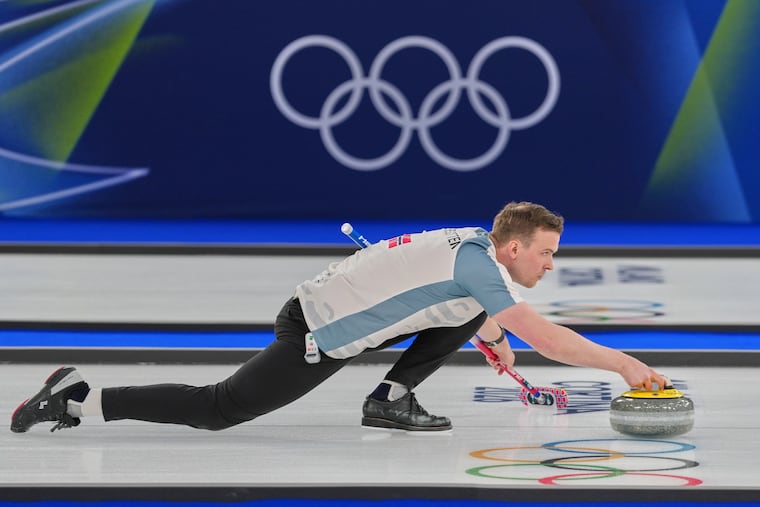
Curling, which officially became an Olympic sport in 1998, involves two teams sliding granite stones across a long strip of ice known as a sheet. Players take turns sliding a 44-pound stone toward a round target, known as a house, that sits at each end of the 150-foot long sheet. Each house consists of four rings and a center, known as the button.
Two teams of four players take turns delivering one stone at a time. When delivering a stone, a player uses one of the hacks, or fixed rubber blocks, to push off and must release it before what is known as “the hog line” for it to be considered in play.
Games are typically 10 rounds (or ends), and only one team is awarded points after each. The team with the stone closest to the button after all 16 are thrown (eight per team) receives one point — and one additional point for each stone that is both inside or touching the house and closer to the button than opposing team’s closest stone. The team that goes last has what is called “the hammer,” a distinct advantage that passes to the other team after the team that possess it scores.
A traditional team consists of a lead, second, third, and fourth — and players throw stones, two each, in that order. A fifth player serves as an alternate. Each team also appoints a captain, known as the skip, and a vice skip. The skip is in charge of directing play for the team and typically stands in the house at the scoring end of the sheet. The vice-skip takes over their duties when the skip, who typically goes last, is delivering stones.
Then there’s sweeping. In addition to the rotation of the stone helping guide its trajectory, a pair of sweepers can brush the ice, creating friction and influencing how the stone moves. You’ll often see the skip yelling out orders to these players as they quickly move down the sheet and stay ahead of the stone.
And the ice? It’s not the same as what the Flyers play on.
“You can’t curl on a skating or ice hockey rink,” former Olympic curler and current Great Britain’s chef de mission (or non-playing captain) Eve Muirhead recently told the Athletic. “The stone wouldn’t go anywhere. So you put millions of tiny water droplets on the sheet to cause less friction between the ice and stone. The droplets freeze into what we call ‘pebble’ — if you run your hand over the ice, it’s rough.”
In mixed doubles, which joined the Olympics in 2018, the rules are slightly different. The game includes just two players — one male and one female — as well as pre-placed stones, a “power play,” and fewer ends.
You can find more in-depth rules here.
» READ MORE: Travis Kelce helps pay for family of hockey star Laila Edwards to see her play in Olympics
How did curling start and why is it so popular?
Curling is considered one of the oldest team sports. According to World Curling, a 16th century Flemish artist known as Pieter Bruegel painted an activity similar to curling being played on frozen ponds. Written evidence dates to the mid-1500s in Scotland, where the first recognized curling clubs were formed — and where the majority of granite for the stones is produced.
The game eventually spread across the globe, but the first official international competition didn’t take place until the 1924 Winter Games in Chamonix, France, where curling made its Olympic debut as a men’s competition. While curling made a couple more appearances over the next 60 years as a demonstration event — at the 1932 Olympic Winter Games (Lake Placid), the 1988 Olympic Winter Games (Calgary), and the 1992 Olympic Games (Albertville) — it wasn’t until 1998 in Nagano that curling was included as a full medal sport for both men and women.
Since then, Lloyd, 49, has seen the growth in the sport on a local level.
“We went from having like a couple 50 to 75 people coming to open house to having hundreds of people outside,” Lloyd said. “The police were here and there was a line down the block. It got so crazy so fast.”
Every four years, curling again captivates the fans around the world. But why? Part of that is likely how different it is from many of the fast-paced Olympic sports. That slower pace allows for more strategy and real-time analysis, like baseball. And it doesn’t look that hard — although looks are deceiving in this case.
It can also be very satisfying to watch heavy stones effortlessly glide across ice, especially when they do it like this …
Another reason people enjoy curling is the etiquette and sportsmanship associated with the sport.
During the week the Philadelphia Curling Club will host league nights where members compete in games. After the competition, it’s tradition to stay after and socialize, with the winning team buying the losing team the first round of drinks.
The postgame ritual is known as “broomstacking,” and has become a deeply rooted tradition that focuses on the camaraderie of the sport.
“Broomstacking is usually in the more fun tournaments,” said former Philadelphia Curling Club member, and Olympic curler Taylor Anderson-Heide in a YouTube video on the spirit of curling. “Or we call them bonspiels. You can decide to stack your brooms on the house and then go have a drink inside at the bar.”
There are other unspoken rules. For instance, similar to golf, the crowd never cheers for missed shots — and you always shake your opponents hand before and after a game. There’s also no talking during an opponent’s shot, and players call their own fouls. And like in chess, you must know when to concede when there’s no way to mathematically win.
» READ MORE: The action at the Winter Olympics has started. Here's what to watch, and how.
What is the curling schedule for the Olympics?
If this got you excited to watch, good news: There is curling every day of the Olympics, until Feb. 22, when the women’s gold medal will be decided. There are far too many games to list here, but you can check out the official Olympic schedule here.
The mixed doubles medal matches will take place first, on Feb. 10 at 8:05 a.m. ET (bronze medal match) and 12:05 p.m. (gold).
The men’s bronze medal match is Feb. 20 at 1:05 p.m. ET, with the gold medal match the following day at the same time. The women’s bronze medal will be decided on Feb. 21 at 8:05 a.m. ET, with the women’s gold medal match concluding the event on Feb. 22 at 5:05 a.m. ET.
How can I watch Olympic curling?
Select matches will air on CNBC and USA Network, with the women’s gold medal match on Feb. 22 scheduled to air on NBC. All of the matches will be available to stream on Peacock and NBCOlympics.com. You can get the full TV schedule here.
» READ MORE: After striking gold in Paris in 2024, can NBC do it again at the Winter Olympics in Milan?