‘Something special’ in Philly, the Danny Rumph Classic marks its 20th anniversary this week
The tournament continues to grow. It was created in 2005 in honor of Rumph, a promising basketball player who, at age 21, died of sudden cardiac arrest while playing at the Mallery Recreation Center.

The standing-room crowd filled in around the court of Germantown’s Mallery Recreation Center, knowing this would be the game’s final possession.
And when Sharif Bray drove baseline and lofted a game-winning bucket over Dionte Christmas to give the home team the championship victory in the 2011 Danny Rumph Classic, pandemonium ensued.
“My favorite memory,” said Justin Scott, who was coaching that game and cofounded the tournament, “and I don’t know if it’ll ever be topped.”
“That was the seed that was planted,” added Marcus Owens, Danny’s uncle, “that the city was aware of it, we loved it, and we needed more space.”
That is a prime example of the signature Philly basketball moments created by “The Rumph,” a five-day summer pro-am holding its 20th tournament beginning Thursday at Drexel. The rowdy, competitive environment now draws local talent and NBA stars, generating a “who’s going to show up?” mystique that spreads across basketball circles and social media.
But its impact during the last two decades extends far beyond the court. The tournament was created in 2005 in honor of Rumph, a promising basketball player who, at age 21, died of sudden cardiac arrest while playing inside the Mallery Recreation Center. The same friends and family still spearhead the event — and the companion Daniel E. Rumph II Foundation — as a way to raise money for youth heart screenings, and to place defibrillators in gyms where kids like Danny play today.
“We started off as a tragedy,” said Owens, who also is the president of the foundation. “… and to see how it has grown from filling up a recreation center that is now in his name, to filling up college arenas ... [From] being known up in Germantown, to being known all around Philadelphia and now [nationwide], from East Coast to West Coast, of what it’s about, who we are. It’s just absolutely amazing.
“It’s a vision that I don’t think any of us saw. But as it grew and kept growing, we said, ‘Well, this thing could really become something special.’”
» READ MORE: NBA stars put on a show at the Rumph Classic, and Isaiah Wong is the main attraction
Sharif Hanford, another Danny Rumph Classic cofounder, once witnessed his friend literally give somebody the hoodie off his back. That embodied Danny’s “caring nature,” and “calm, cool demeanor,” Hanford said.
“Danny meant a lot, to a lot of people,” added Michael Morak, another Danny Rumph Classic cofounder.
‘Save the next bright star’
Several of Rumph’s friends witnessed his sudden death. They came up with the idea for the foundation and tournament as a way to collectively mourn and heal — and celebrate Rumph’s life and the game he loved. Their tangible goal was to raise enough money to place one defibrillator in a recreation center, which was not available when Rumph collapsed.
It was the first step in the foundation’s overall mission to “save the next bright star.”
AND1, the sneaker company where Morak was interning at the time, offered to donate T-shirts for the first tournament. (This year’s version will be an homage to that original design, Morak said.) Local coaching staples Calvin Lewis and Philadelphia Sports Hall of Famer Bill Ellerbee helped sponsor teams. The Mallery Recreation Center, which has since been renamed for Rumph, blocked out the court time.
About 500 spectators packed into the building for the first Classic, and Hanford said one could not even see the out-of-bounds lines. Hakim Warrick is credited as the first hometown NBA player to partake, but local players spanned multiple generations during those initial years. Maurice Speights also was an early participant when he was a 76er, matching up against former Temple player and Philly native Wayne Marshall.
Perhaps most significant: the decade-plus involvement of North Philly’s NBA twins, Marcus and Markeiff Morris, whose team FOE (Family Over Everything) has won the tournament five times.
“Their loyalty and the commitment to the event have made the other guys take notice and want to participate,” said Skip Robinson, who coaches the Morris twins’ team. “… because [they say], ‘OK, they’re playing in it, it’s got to be good enough for me to play in it.’ That says a lot that they put their stamp on the event.”
Added Morak: “For them to always say, ‘I want to put Philly on my back. I want to put the Rumph Classic on my back and want to make sure that the event is supported at a really high level,’ has probably been the biggest moment.”
Following Bray’s memorable game-winner, the Classic moved to Arcadia University, where Scott was coaching at the time (he is now an assistant at the University of Oklahoma). It also has been played at La Salle and the Community College of Philadelphia. Morak praised those venues for “letting us be us,” complete with trash-talking and one-on-one highlights. The crowds still populated the larger venues.
Then James Harden showed up in 2016. When the news hit social media, the line out the south door at La Salle’s Tom Gola Arena reached Wister Street, Owens recalled.
“That’s when it just started going to the stratosphere,” Owens said. “That it was like, ‘OK, we are now nationally known.’ Everyone’s talking about it across the country, not just in the city.”
Cue appearances by Allen Iverson, who once tracked down a surprised Jalen Brunson when he played in the event. And Jayson Tatum, who put the “too small” celebration move on a defender while dropping 30 points. And Tyrese Maxey, Lou Williams, Collin Gillespie, and Bones Hyland, a collection of NBA players with local ties who became more accessible to fans than during their seasons.
“It embodies everything Philadelphia is,” Robinson said. “We want to see greatness. We want to see what that looks like. And to have it for $10 for an hour-and-a-half to two hours is special.”
Remembering the mission
That Philly platform stretches further than the players on the court. Each tournament features locally custom-designed basketball shorts, which have become an unofficial collector’s item. It offers opportunities for aspiring photographers, announcers, and referees. There is a Sunday barbecue to swap stories and enjoy food and company.
Yet Morak vows to ensure that the original purpose never becomes lost in the Classic’s immense growth.
Morak believes it is not an exaggeration to say their efforts to raise awareness — and provide resources — about youth heart health have saved lives. He can point to a player on his son’s under-9 team who had a previously undiagnosed condition detected during a Rumph screening. She underwent surgery and is now healthy again, Morak said.
» READ MORE: The Danny Rumph Classic shows Philadelphia basketball’s true flavor
“The basketball’s cool. It’s the shiny toy,” Morak said. “But it’s also really important [to remember] the mission and the cause for it.”
Those kids are part of the next generation already being raised in The Rumph.
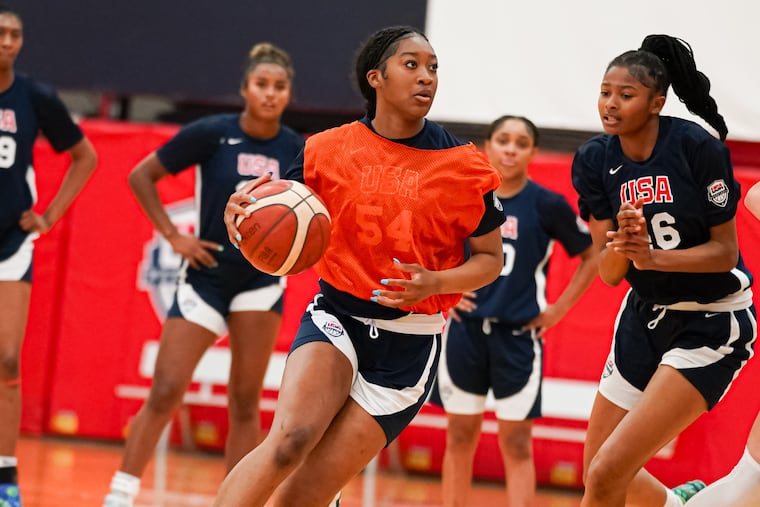
That next wave also includes Xzayvier Brown, Scott’s stepson, who recently transferred from St. Joseph’s to Oklahoma. His tournament responsibilities as a kid ranged from keeping stats, collecting jerseys to be washed after games, and cleaning up at the end of the day. Or Jessie Moses, one of the top girls’ basketball recruits in the 2027 class, who got hooked on the event when she got to sit on the Morris twins’ team bench as an elementary schooler and “they accepted me like it was nothing,” she said. Moses also helped launch a middle school game, which is played before Monday’s championship game, and was inspired by the Classic to start her own basketball camp.
“Once you’re in that close-knit community that The Rumph always provides, I feel like everybody has each other’s back,” Moses said.
Added Morak: “We all look at Jessie as our niece. We look at Xzayvier as our nephew … but they’ve still got to move boxes and help like everybody else.”
Those up-and-comers are why Owens believes the Danny Rumph Classic will be “impossible to stop” for the upcoming 20 years. They join the loved ones who have been around since the beginning. The founders. And Danny’s mother, Viola “Candy” Owens. And Ms. Janet, who has long managed the tournament’s registration. And the volunteers.
Together, they have built a premier summer tournament, where signature Philly basketball moments happen. They have placed defibrillators in gyms all over the city.
And, for the next two decades, they want to continue to do right by Danny.
“Sometimes, you’re just speechless,” Owens said. “... We miss and love Danny every day. But we’re Christians, and we just can’t help but believe that he’s looking down on all of us with a big smile.
“That’s his legacy. He was 21 when he died, but his legacy is going to be way longer than that.”