Before she helped negotiate the WNBA’s ‘life-changing’ CBA, this Philly lawyer hooped at Lower Merion and Penn
The Women's National Basketball Players Association made history last month, and athletes in the room say it wouldn't have happened without Deb Willig.
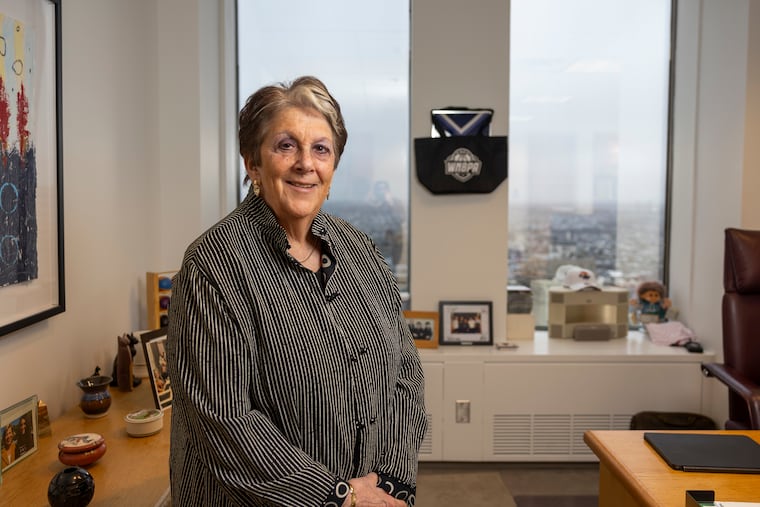
Basketball looked different when Deb Willig was playing it in the 1960s. Teams had six players on the court at a time. At Lower Merion High School, Willig was a “rover” who would cover the entire length of the court. She did so wearing a skirt, not shorts.
But some injustices endured. The future labor lawyer continued her athletic career at Penn in 1968 and quickly realized her team would be treated as an afterthought.
There were wide disparities in resources. Willig said the men traveled in motor coaches while she and her teammates were in a school bus without heat. The men played at the Palestra; the women were relegated to an “old, run-down gym that probably doesn’t exist anymore.”
Even still, the Bala Cynwyd native, who was hired as the WNBA players association’s outside special counsel in 2024, was surprised by the conditions the women faced. What seemed to her like basic amenities — security at practices and games, for example — was not universally provided. The Inquirer reached out to the WNBA for comment on this article, but did not get a response.
Some of the gyms WNBA players practiced in didn’t have private locker rooms or even a full-sized basketball court. There was no standard for how many physical therapists, massage therapists, or athletic trainers a team should have.
“I just kept going, ‘SMFH,’ in my head,” Willig said. “It was really astonishing.”
Willig, 76, played a big role in changing that. With her leading collective bargaining agreement negotiations, the women gained a 367% increase in salary when a new agreement was ratified on March 24, the biggest jump from CBA to CBA in professional sports history.
But figures around the union say her impact went beyond the numbers. Vice president Alysha Clark, who recently signed with the Dallas Wings, described Willig as a no-nonsense negotiator, unafraid to confront a room full of WNBA staff, many of whom also worked for the NBA.
Her bluntness rubbed off on the players, who insist that a deal couldn’t have been struck without Willig.
“For her to come in and just be like, ‘I’m not scared. What you guys are doing is undervaluing these women, and you know it, and I’m gonna make sure that you know it,’” Clark said. “It gave us a boost of confidence. It was like, ‘Hell yeah, Deb. Tell her. Hell yeah, Deb!’”
‘She’s that girl’
In the fall of 2023, Terri Carmichael Jackson, the executive director of the WNBPA, began assessing her organization’s resources. Throughout previous CBA negotiations, they’d leaned on the legal team of the National Basketball Players Association because the group didn’t have dedicated staffing in place.
But this fight would be different. The league was growing at a rapid pace, giving the union as good an opportunity as ever to improve the livelihoods of its athletes. For the first time, they had the funding to retain outside counsel, one dedicated to them.
So, that’s what Jackson set out to do. She began consulting fellow player associations to see what law firms they liked. Willig, Williams & Davidson, a union-side labor law firm based in Philadelphia, made the short list.
» READ MORE: Philly’s WNBA team has been approved by WNBA and NBA Board of Governors
Meghann Burke, the executive director of the NWSL’s union, recommended Willig specifically. The Penn graduate had worked with the soccer players throughout their CBA negotiations in 2021 and 2022 and had endearingly become known as “their badass lawyer.”
It didn’t take long for WNBA players to feel the same way. Union leadership began to jump on Zooms with different firms to get a sense of how they’d approach the upcoming negotiations with the league.
Willig quickly separated herself. She and her firm’s partner, Jessica Caggiano, pointed out obvious areas to focus on — like salary and facilities — but also suggested provisions around parental leave, retirement benefits, and family planning.
And then there was Willig’s tone, which Jackson described as “straightforward” and “no [expletive].”
“She was their person,” Jackson said. “I think they appreciated the fire she brought. And particularly for those that were in the room, they could see how we played off of each other and how it was a good balance.
“[The players] knew me for years. Terri doesn’t take any [expletive]. and she’s gonna let you know she doesn’t take any [expletive]. And then there’s Deb, who just slices right through it with an ax.”
Added Clark: “She was very matter-of-fact. And was just like, ‘You guys deserve more. This is B.S. But I’m gonna be here, 10 toes down.’ The confidence she exuded was palatable. You were just like, ‘Oh, she means business. We aight. She’s that girl.’”
Willig joined as outside special counsel in December 2024. She immediately was struck by the “condescending and disrespectful” tone with which the WNBA spoke to the union.
“Tone-deaf,” Willig said. “I mean, I have negotiated contracts for the white-collar workers of the city since 1978, for the Philadelphia Federation of Teachers since 1983. I’ve negotiated contracts for steelworkers at Merck for 15 years. For Teamsters. Lots of stuff.
“The people on the other side were tone-deaf and very condescending. ‘You don’t understand the business,’ we heard.”
“I think the league seriously underestimated the intelligence and resolve of the players,” she added. “No question in my mind about that. Never thought they’d go on strike. Thought they would cave.”
» READ MORE: Kahleah Copper shares North Philly with Unrivaled teammates
In player-leadership meetings over Zoom after the bargaining sessions, Willig would relay the league’s proposals. The WNBA wanted to share net revenue, and the players wanted gross revenue (which would include a cut of merchandise, a media deal, and more).
The league also proposed shaving 80% or 70% off the top for expenses but wouldn’t let the union fully audit them. It proposed splitting the remaining cut; so if the expense fee was 70%, for example, the players would receive 15% gross revenue.
It didn’t fly (they ended up settling on 20% of gross revenue, with more transparent accounting).
Another big issue was housing. Since the league’s first CBA in 1999, teams had provided housing for players, or at minimum, a housing stipend. But on Day 1, Willig said the WNBA proposed eliminating it immediately and held that stance for 14 months.
Their argument, according to Willig, was that with increased salaries, players could afford their own housing. But to many, this was a benefit that transcended money. It helped players — especially those on the periphery — navigate uncertainties like roster cuts and trades.
Jackson said that it became a rallying cry for the union. More and more players started showing up to meetings. Many viewed the WNBA’s approach as “callous.”
“That didn’t feel good, I will tell you,” Jackson said. “Most of the players did recognize how negotiations go. On that issue? It did not feel good. It felt like they had no consideration for their safety and security.
“And for developmental players? You’re actually putting them in a position where they are paying to be in this league. Why would we agree to that? Who would agree to that?”
(The parties decided on providing housing for all players over the first three years of the agreement, after which the benefit is phased out, depending on how much a player made.)
There were other squabbles. The league historically left it to the teams to decide whether they’d have security at games and practices; some teams simply used a member of the traveling party to fill this role.
Jackson and Willig proposed mandating two; they settled on one per team.
The union made significant gains for future and current retirees, getting a 401(k) match of up to 140% of a player’s deferral (it was a 25% match under the 2020 CBA). They also asked for $1,500 in a Health Reimbursement Arrangement for retired players without health insurance to use for routine exams.
The league instead proposed running medical testing in a tent at the All-Star Game. This, too, was deemed unacceptable.
“A union staff member [Jayne Appel Marinelli] who is a former player asked, ‘How do you propose they get there? Will you pay for their travel?’” Willig said. “And the league was speechless.”
(Retired players will now get $1,250 toward medical testing and needs via an HRA.)
» READ MORE: Takeaways from the WNBA draft
The players appreciated Willig’s advocacy but also her candor. She would clearly relay the WNBA’s messaging — without the legalese — and would give her unabashed opinion.
“I think for us, it was more affirming,” Clark said. “Because, as players, we know and we feel that they think we’re dumb. They think we don’t know or understand, just in the way that they were talking, to Deb’s point, being very patronizing.
“So, for her to come in and be like, ‘They don’t respect you guys.’ It was like, ‘OK, boom. That affirms what we’re feeling.’ Because we felt that.”
‘This is life-changing’
A tentative deal finally was struck on March 18. The new document covered territory it hadn’t in the past.
There would be family rooms, family planning benefits, and parental leave. Players would be reimbursed for mental health services, as well as a second opinion of a team doctor’s diagnosis.
There now were minimum standards around the number of physical therapists, massage therapists, and athletic trainers. Players no longer would be practicing in community centers with public gyms and locker rooms.
A veteran thinking about the next stage of their career could now access a player program fund to pursue it. A rookie supporting their extended family on less than $70,000 in 2025 would now be making at least $200,000 more.
» READ MORE: Our favorite looks from the WNBA draft
After the agreement was reached, the players held a meeting.
They were about to vote to ratify the CBA, and Willig and Jackson wanted to make sure they knew exactly what was in it.
The final tally was unanimous. The groundbreaking agreement was passed.
“And one younger player [wrote], ‘This is life-changing,’” the lawyer said, as she motioned to her heart. “And I just …”