‘Don’t take the easy way out.’ A.J. Brown’s plea to struggling NFL players reveals compassion, maturity.
Two days after the death of a troubled player, the Eagles receiver spoke on social media, urging those with problems to seek counseling. "Don't end it like that, bro. Don't end it like that."
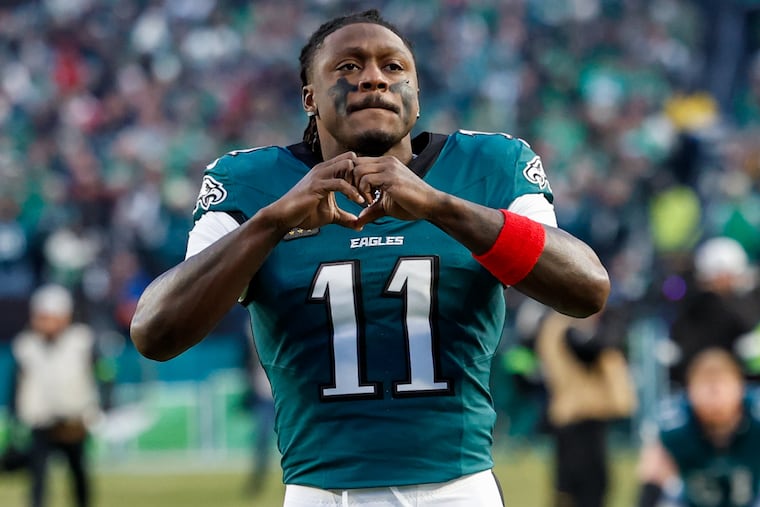
In the wake of the untimely deaths of three young players, A.J. Brown on Monday posted a 9-minute, 8-second testimonial on Instagram encouraging NFL athletes struggling with mental health issues to seek counseling and God rather than taking their own lives. It was poignant and it was beautiful.
It was a revealing glimpse into how Brown deals with his own demons. It also was an example of how the exceptional culture in the Eagles’ locker room emboldens this sort of leadership in the most important of ways.
“Don’t take the easy way out,” Brown said. “I once thought that was the way. I was 23 years old and I thought the same thing.”
Brown spoke two days after Vikings receiver Rondale Moore, 25, was found in his garage dead of a suspected self-inflicted gunshot wound. Moore had seen his last two NFL seasons ruined by preseason injuries. It was the third such incident in just 10 months.
In November, Cowboys defensive end Marshawn Kneeland, 24, also was suspected of taking his own life with a gun after a high-speed chase and crash.
Similarly, in April, LSU receiver and NFL prospect Kyren Lacy, also 24, shot and killed himself after a high-speed chase two days before his criminal trial in an unrelated incident.
Tragedy upon tragedy upon tragedy compelled Brown to speak out.
“Don’t end it like that, bro,” he begged. “Don’t end it like that.”
Advocacy
This wasn’t the first time Brown has spoken about his own struggles, but it is the most intense and impassioned message he has delivered.
He recorded Monday’s message on his phone while sitting in his parked car. Most of it centered on Brown’s reliance on his Christian faith, but Brown also stressed the role that counseling performs in people whose worlds seem to be closing in.
“Go talk to [God], first and foremost, before you even go talk to a therapist. But go talk to a therapist,” Brown said. “Reach out to your loved ones. Go talk to somebody, bro. Get it off your chest. You’re not too tough to talk to someone.”
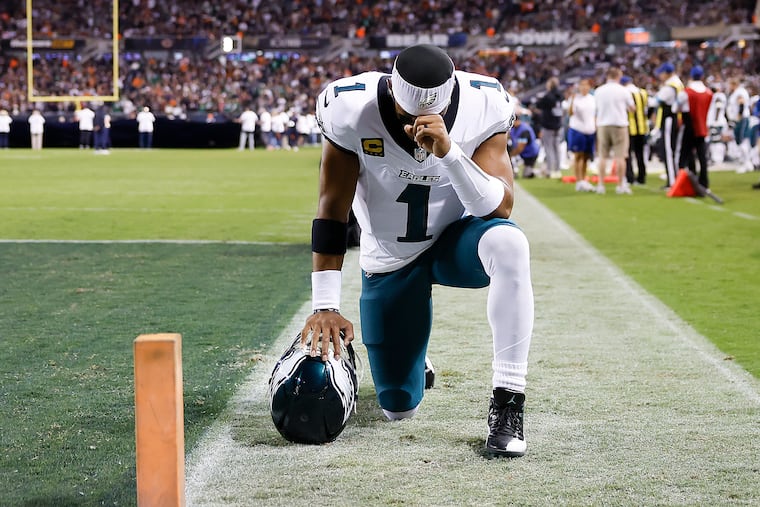
Much has been made of Brown’s unconventional behavior in his four seasons with the Eagles. He often has been publicly critical of the Eagles offense both in media availabilities and on social media. He has sparred with head coach Nick Sirianni during games. He continually hints in public that he would like to be traded, and a report last month said he submitted a trade request three times during the 2025 season. Brown also has boycotted the media twice in the last two seasons.
Among the reasons the Eagles are patient with Brown, and among the reasons the media squawks so little about his boycotts, are Brown’s mental health struggles. He is afforded a larger measure of grace from teammates, coaches, administrators, and the press than athletes who struggle less.
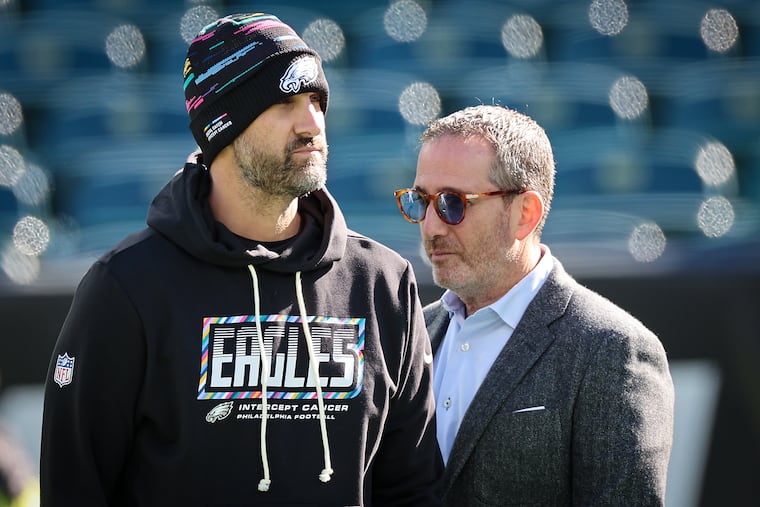
This grace begins with Sirianni, whose inclusive, empathetic management style built on the foundation laid by Doug Pederson. One of the reasons Eagles owner Jeffrey Lurie hired Pederson in 2016 was Pederson’s “emotional intelligence,” which created an environment of understanding and acceptance unmatched by any locker room in the NFL. This environment, Lurie says, helped the Eagles reach three Super Bowls and win two.
» READ MORE: All this talk about trading A.J. Brown is madness. Anyway, you’re talking about trading the wrong Eagle.
Evidence?
In 2017, Pederson’s second season, Eagles guard Brandon Brooks opened up about treating his debilitating anxieties with therapy and medication, taboo subjects in the world’s most testosterone-charged league. The Eagles won their first Super Bowl after that season.
In 2021, Sirianni’s first season, Eagles right tackle Lane Johnson, who’d helped Brooks deal with his issues, missed three games dealing with his own mental health issues. The Eagles went to the Super Bowl after the 2022 season and won it after the 2024 season.
Johnson was, by far, the team’s best player in that span.
Brown was not far behind. That’s because, in part, the Eagles accepted him for him.
For instance, When Brown was caught on camera reading a self-help book on the sideline during a playoff game after the 2024 season, Sirianni told a local radio station, “Some guys pray in between, some guys meditate in between. A.J. reads in between.”
Sirianni also said, “A.J. Brown, is a great, great, great person.”
That’s generally the consensus in the Eagles’ organization: Brown might be a diva, and he occasionally might be insubordinate, but his heart is always in the right place.
That was never more evident than in Monday’s post.
His own experience
The mission statement of the A.J. Brown Foundation reads, in part, “Our vision is to cultivate a generation of resilient and confident young individuals.”
“I take pride in my mental health,” Brown said Monday. “Something I practice each and every day.”
Brown then offered what might be a glimpse into his own struggle and the methods he uses to cope.
“Stay in that fight,” Brown said. “Be strong. Do whatever you need to do. Get on your phone. Record videos of yourself talking to yourself. Say affirmations around the crib. Sticky notes. ... Talk in third-person to yourself.”
» READ MORE: Can the return of Eagles OLs Lane Johnson and Landon Dickerson save Nick Sirianni and Jalen Hurts?
Don’t worry about it if people think you’re strange:
“Let them call you crazy.”
With so many voices eager for attention, and with so much non-credible disparagement targeted at you, just accept your failures and ignore the critics as best you can:
“I want you to understand, in the NFL community, things aren’t always going to go your way. You may not get everything that you desire. Sometimes this game is not friendly. People are going to say nasty things about you. Call you this call you that. ...
“But none of those things, in that moment, define you. You just have to understand that this is just a short moment in your life that’s just going to go, just like that,” he said, and snapped his fingers to illustrate.
Frustration is constant; satisfaction, unattainable:
“I understand what it feels like when you’re trying to take care of your family. None of that stuff is fulfilling. The only thing that’s fulfilling in this world is our Lord and savior, Jesus Christ.”
Even now, Brown clearly struggles with issues. He said he focuses on his family, especially his two young children, when the darkness begins to descend, and looks within.
“Nobody cares about you, bro. Especially as a man. You have to do what makes you happy,” Brown said. “I don’t care what they call you. I don’t care whatever ... whatever you think you failed at. ... Whenever you have a negative thought, say 10 positive things about yourself.”
Just hold on, get help, and have faith in something.
God. Yourself. Anything.
“That sun is gonna shine,” Brown said. “It ain’t gonna stay rainy forever, bro.”

The news keeps getting worse. Eagles quarterback Jalen Hurts will likely miss the rest of the 2026 season with a deep vein thrombosis blood clot, as well as bilateral pulmonary emboli. Moments after the story broke, The Inquirer’s Jeff McLane and Marcus Hayes reacted to the news, looking at what the diagnosis means for the Super Bowl MVP, how the Eagles handled the situation dating back to their trip to London, and whether backup Tanner McKee is ready to take the helm on a full-time basis. Listen here.
Listen to all episodes here or wherever you get your podcasts.