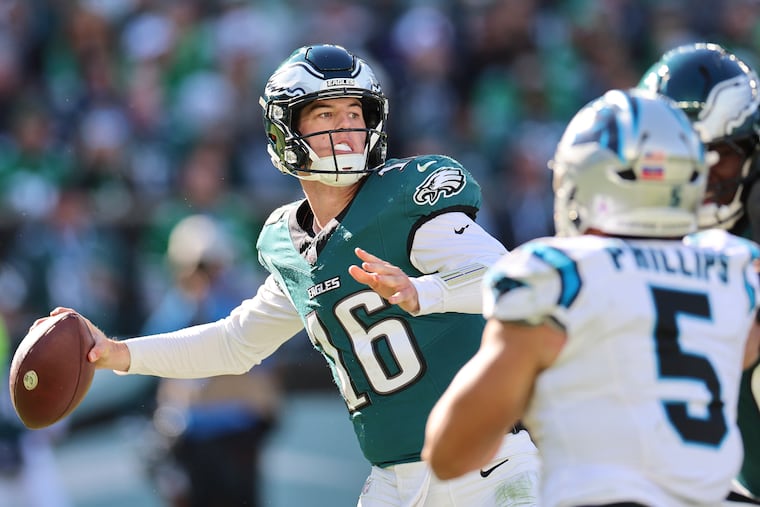
Nick Sirianni may have figured out how to last as the Eagles’ head coach. Here’s his secret.
If one of Sirianni’s greatest weaknesses as an NFL head coach is that he’s often too impulsive and emotional, his background might also be one of his greatest strengths.
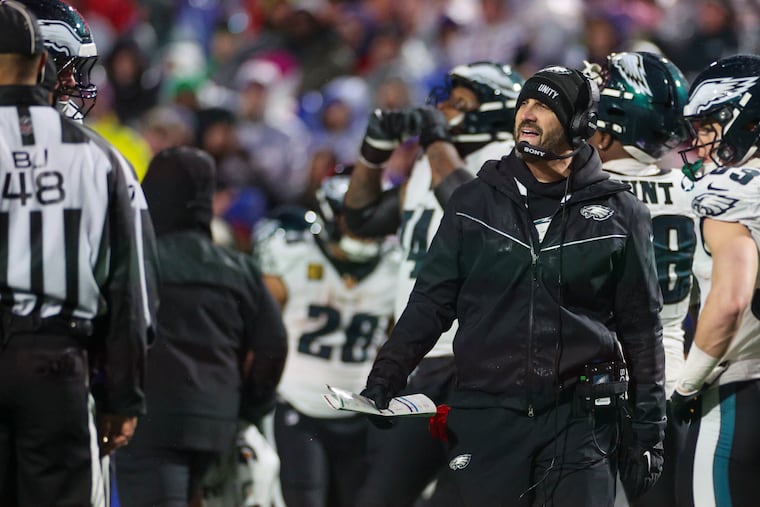
Nick Sirianni is the son of a high school football coach and a mentee of a Division III football coach. Everyone knows this about him.
When he speaks publicly, he frequently sprinkles in references to his father, Fran, and his nine years in charge of the program at Southwest Central High School in western New York. He talks of lessons learned from his years as a player and assistant under Larry Kehres at the University of Mount Union (it was Mount Union College when Sirianni was there) in northeast Ohio.
If one of Sirianni’s greatest weaknesses as an NFL head coach is that he’s often too impulsive and emotional, maybe it’s because there’s a fine line between small town and small-time, and he can’t help himself from crossing it. Still, he ain’t changin’ now, and in an honest appraisal of Sirianni’s five years with the Eagles, one can make the case that his background might be one of his greatest strengths.
If nothing else, it might be one of the reasons that he’s still in this position and, if Howie Roseman was to be believed Thursday, will be for more than a minute.
“Obviously,” Roseman said, “I sit here, and I feel incredibly grateful that I’m working with someone who … is elite at being a head coach, elite at building connections with our team, elite talking about fundamentals, game management, situational awareness, bringing the team together, holding people accountable. When you’re looking for a head coach, those are really the job descriptions.”
» READ MORE: What does Nick Sirianni do? A lot, says Howie Roseman, despite Eagles’ frequent offensive resets.
They’re not much different from the job descriptions of a head coach at any level of football, and for all the suggestions that Sirianni is nothing but an empty hoodie, those qualities still matter at the sport’s highest level.
What’s more — and this is the important part as far as Sirianni’s future is concerned — they allow him to be flexible, to contour himself both to what the team needs in a given season … and what he needs to do to survive.
Think about Sirianni for a moment in contrast to his predecessor, Doug Pederson. It’s no secret that Roseman and Eagles chairman Jeffrey Lurie want a head coach who aligns with their thinking on how to win games. Boiled down, a head coach here doesn’t have much independence or power relative to others around the NFL. (The last time Lurie gave a coach such freedom, Chip Kelly started making holiday party-related demands, and Pat Shurmur ended up coaching the 2015 season finale.)

Mike Sielski alerts
Pederson had been hired as an offensive guy, and he accepted that label and that arrangement right up until he and his team won Super Bowl LII in February 2018. Six months later, his memoir hit stores. At the end of the 2019 season, he asserted in a news conference that embattled assistants Mike Groh and Carson Walch would return — only to have Lurie say, Not so fast, Dougie.
One day after Pederson endorsed them, Groh and Walch were gone. A year later, after a 4-11-1 season, so was Pederson. So much for assertiveness, and so much for the notion that Pederson’s status as the orchestrator and often the lead play-caller for the Eagles’ offense would preserve his job. Once Carson Wentz and the offense collapsed, what reason was there to keep Pederson?
Because Sirianni’s personality is more tempestuous than Pederson’s, it was always fair to wonder whether, if he ever found himself in the same post-championship situation, he might try to flex a little bit, too. But he did the opposite Thursday, explaining why his close friend Kevin Patullo was no longer the offensive coordinator, suggesting that he would be open to having the new OC have the kind of say-so over the unit that Vic Fangio has over the defense.
“You’re looking to continue to evolve as an offense,” he said, “and I’m looking to bring in the guy [who is] going to best help us do that. I think that there are many different ways to be successful on offense, and everybody has different styles. Everybody has different players. And there’s many different ways to be successful.”
The cynical way to look at this, of course, is that A) Sirianni is acting out of self-preservation; and B) his presence acts as a Kevlar vest for Roseman, protecting him from any public-relations damage if he messes up the assembling of the Eagles’ roster. As great a general manager as Roseman has been, he still makes mistakes. And on those rare occasions when he makes more than his share, the perception that Sirianni is handed an outstanding team every year and that all he can do is screw it up sure takes a lot of heat off the guy who is calling the player-personnel shots.
There’s another prism through which to view Sirianni, though: that he doesn’t have to control every aspect of a team, or even one specific aspect of a team, to do his job and do it well. He doesn’t need to pick the players, design the offense, call the plays.
He’ll delegate responsibility, trust his people, fill in the gaps where he can and should. He’ll take the guys who happen to be on his team that particular year and play that particular hand. Sounds like what a high school or small-college coach does. Sounds like a formula to last a while with this particular franchise.

The Eagles seem reluctant to address the handling of the Jalen Hurts blood clots saga, but the key questions involved in the story aren’t going anywhere. Throughout the week, in the absence of remarks from general manager Howie Roseman or team medical personnel, head coach Nick Sirianni was peppered by reporters. He’s offered few details in return. After speaking with high-ranking medical officials currently or previously employed by NFL teams, The Inquirer’s Jeff McLane frames four central issues that remain unanswered, while also looking at what this situation means for Hurts’ future in Philadelphia. Listen here.
Listen to all episodes here or wherever you get your podcasts.