Donald Ross’ ‘masterpiece’ at Aronimink will again challenge the best at the PGA Championship
The course, designed and redesign over a century, will be its truest self ever when the best golfers in the world descend for the 2026 PGA Championship.
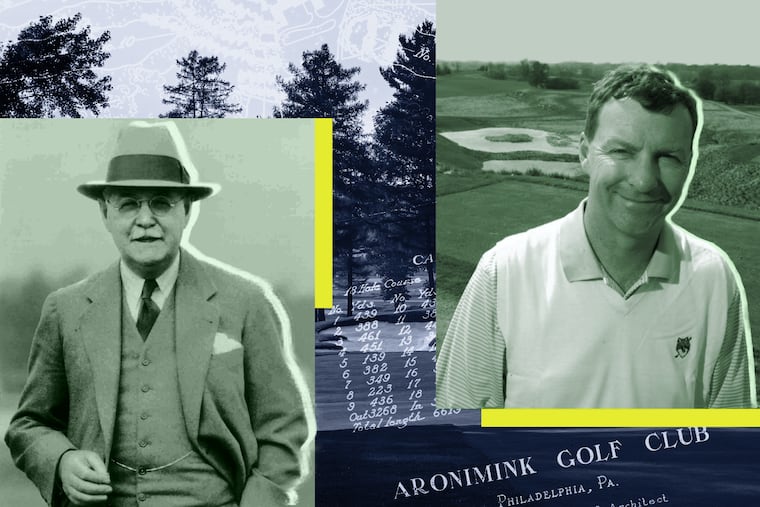
Like most regal golf courses in the northeast sector of the United States, Aronimink Golf Club, as a body of golf enthusiasts, was less designed than it was evolved.
Unlike most regal courses, Aronimink, in its present iteration, is very nearly as its original designer intended. This was sort of true in 1962, when Gary Player won the PGA Championship there; the greens hadn’t receded as much as they would, and the bunkers were more proliferated than they would become. It was least true in 2010 and 2011, when the AT&T National visited. It was made to be truest in 2018, when Keegan Bradley won the BMW Championship, and in 2020, when the LPGA held its PGA Championship there.
“I love Aronimink,” Bradley said.
» READ MORE: A very Philly guide to the 2026 PGA Championship at Aronimink Golf Club
What’s not to love?
He shot 20-under and won a playoff, but that was on a course softened and weakened by continual rain. The rough will be higher and, optimally, the surfaces will be dryer and the course will be its truest self ever this week, when the best golfers in the world descend for the 2026 PGA Championship.
» READ MORE: PGA Championship Range Show Powered by T-Mobile
“Honestly, it was so wet and underwater that I don’t think it was a very fair representation of what the course is,” said Justin Thomas, who finished at 15-under, tied for 12th.
Wet or dry, they again will play a course that essentially is what Donald Ross — an elite golfer and one of the best architects in history — meant for them to play.
Origin story
Like Philadelphia Cricket Club, which hosted the Truist Championship last year, Aronimink was birthed from the golfing passion of a handful of members of the Belmont Cricket Club. In 1895, at 52nd Street and Chester Avenue, they built a quirky, nine-hole course (they were all quirky back then) that now is a residential area with a colorful corner bodega.
Two years later, the Belmont Cricket Club joined the Philadelphia Cricket Club, Merion Golf Club, and Philadelphia Country Club as the four founding members of the Golf Association of Philadelphia. In 1900, Belmont incorporated as Aronimink (originally spelled “Arronimink) Country Club, a Lenape Indian word that can mean “by the beaver dam,” “where the fish cease,” or “place of the water;” it’s about a mile from the Schuylkill River.
The club began to float.
In 1907, the club moved a half-mile northwest to 54th and Whitby Avenue. In 1913, it moved six miles west to Drexel Hill, where an unaffiliated swim club, like other businesses, still bears the Aronimink name.
It changed its name from “Aronimink Country Club” to “Aronimink Golf Club” in 1920, and, by 1926, decided to move 10 miles west, to a 300-acre plot in Newtown Square, its current address. In the wake of his recent successes at Lulu Country Club, Gulph Mills, and Torresdale-Frankford (now the Union League Golf Club at Torresdale), Aronimink’s members decided to hire Ross as their architect.
Their timing was perfect. Ross had recently been passed over for another local design, and he was determined to make those potential clients regret their decision.
The result: His best work.
Donald Ross
Ross was born in 1872 in Dornoch, Scotland, and grew up playing Royal Dornoch, which opened in 1877 and had golf history dating to the 1600s. A carpenter’s apprentice at the age of 14, he worked for a while at Royal Dornoch, then traveled south and spent 1893 as an apprentice under “Old” Tom Morris at St. Andrews. He worked at Carnoustie Golf Links the following year, then returned to Royal Dornoch to serve as head professional.
It was there at the age of 27 he met Harvard astronomy professor Robert Wheeler Wilson, a voracious golfer who traveled with his clubs. He convinced young Donald that a better life lay in America, where Ross’s father, Murdoch, had spent many years away from his family working as a stonemason. Ross hopped a steamer and took a job at Wilson’s home grounds, the Oakley Country Club in Watertown, Mass., in 1899. Within a year, he’d redesigned the course.
» READ MORE: Going to the PGA Championship at Aronimink? Here’s what to know, including transit, parking, food options, and more
An affable, bright-eyed Scot with a trim mustache who always wore a Jeff cap, Ross was more than a designer. He also was a professional golfer, like his brother, Alec, who won the 1907 U.S. Open at Cricket’s original course, St. Martin’s. Donald was the inferior golfer, though he won the Massachusetts Open twice. But he was a superior businessman.
In 1891, Ross became the head pro at the Pinehurst resort in North Carolina. He redesigned No. 1 the year he was hired. In short order, he had designed four courses, including the iconic Pinehurst No. 2.
A star was born.
Legacy
Ross died of a heart attack in 1948 at the age of 75 in Pinehurst, which he’d help mold into the cradle of American golf. He lived most of the winter in a cottage behind the third green on No. 2. He had satellite offices in Rhode Island, Massachusetts, and Wynnewood, about 10 miles east of Aronimink. From the cottage, Ross created most of his designs, received clients, and conducted turf experiments on the resort courses that revolutionized golf course maintenance in Southern states.
He fathered a daughter, buried a wife, buried a fiancé, remarried, and survived a throat ulcer. More than anything, though, he created beauty from whatever landscape served as his palette.
» READ MORE: Everything you need to know about the PGA Championship — from how to watch to how to get merch without a ticket
By the time Aronimink hired Ross, he had designed or redesigned almost 250 courses, including:
Woodland Golf Club in Newton, Mass., where Francis Ouimet was a junior member before he won the 1913 U.S. Open.
Essex Fells Country Club in New Jersey, birthplace of the term “mulligan,” defined as a second opening tee shot without penalty.
The first nine holes of Pocono Manor Golf Club, his first job in Pennsylvania.
The Bay Course at Seaview resort near Atlantic City, home of the ShopRite LPGA Classic, the only regular stop in the region for either the men’s or women’s tours.
Oakland Hills Country Club in Michigan, which has hosted nine majors and the 2004 Ryder Cup.
The current site of Oak Hill Country Club near Rochester, N.Y., which has hosted seven majors and the 1995 Ryder Cup.
If 250 courses by 1926 sounds like a lot, that’s because course architects get credit for design, even if they aren’t on site. That Ross wasn’t manning bulldozers on site in the spirit of, say, contemporary A.W. Tillinghast, whose genius peaked at the current Cricket Club site, is not entirely accurate. Ross visited about two-thirds of the 400 or so clubs with which he is associated, leaving much of the real work to partners and subordinates.
Ross designed his most acclaimed course, Seminole Golf Club in South Florida, in 1929. Long a haven for the ultra-rich and mega-powerful, Seminole is synonymous with exclusivity.
While Ross often redesigned existing clubs, Seminole, like Aronimink, was his baby from conception to completion.
‘Masterpiece’
Inscribed on a plaque near Aronimink’s first tee are these words:
“I intended to make this my masterpiece, but not until today did I realize that I build better than I know.”
Those were Ross’s words. Ross visited the course shortly before his death in 1948, two decades after he’d completed the project. He took his own breath away.
It will take yours away, too.
At Aronimink, as with most of his designs, Ross incorporated the existing features of the land. He integrated existing swells and valleys. He created distinct lines of approach from tee to green that rewarded strategy, accuracy, and distance control, with well-protected greens that penalized golfers who hit shots beyond the putting surface. The design was so strong that it held up to the PGA Tour’s best in 2018, when the BMW Championship visited. It assuredly will hold up this week, too.
A lot of that has to do with Gil Hanse, who works out of Malvern and is this generation’s most esteemed practitioner of classic course restoration. He has worked on an astounding number of venerated courses, among them The Olympic Club in San Francisco, Merion Golf Club in Havertown ahead of it hosting the 2030 U.S. Open, Ross’ Oakland Hills, and, of course, Aronimink.
Using aerial pictures of the course from 1929, Hanse restored about 100 bunkers; there now are about 175. He returned greens to their original, generally larger, sizes. He stretched the course so it can now play at about 7,400 yards.
» READ MORE: Top pros like Justin Thomas, Keegan Bradley, and Brooks Koepka can’t wait for Philly fans at PGA at Aronimink
“We are incredibly proud of the course and the work that we’ve done,” Hanse told his website after the BMW.
Thirteen tee boxes were reconstructed then. Eight years later, players are averaging about 8 yards more off the tee, so to modulate the tour’s bombers, players will be hitting from deeper tees on Nos. 5, 7, 10, 15, and 18 onto narrower fairways on Nos. 3, 4, 9, 16, and 18.
Trees were removed before 2018, and more are gone now (denuding courses is all the rage), which will bring the wind more into play but also will bring more of the course into view. Spectators on the No. 2 fairway, for example, will be able to turn around and see Nos. 10 and 18.
What will they see?
They will see what Ross envisioned in 1926, what took his breath away in 1948, and what will take your breath away a century after its conception.

The 108th PGA Championship returns to Aronimink Golf Club in Newtown Square for the first time in over six decades.
You can watch Marcus Hayes and Jeff Neiburg preview the tournament on Gameday Central from Aronimink, and be sure to check out the PGA Championship Range Show from 12-2 p.m daily, starting Wednesday.
Whether you're going, watching from home, or just curious about what all the fuss is about, we've got you covered with our PGA guide and stories on everything from Aronimink's history and design, to what the players have to say about returning to the Philly area. We even made a golf video game so you can play the course and learn its secrets.
Get it all with our full PGA Championship preview. And follow the latest news and action from the course, right here.