Kyle Schwarber is too good to bat cleanup. That, and other conclusions from last year’s lineups.
A question of correlation versus causation remains. Were the Phillies better as a team because Harper’s numbers were better behind Schwarber?
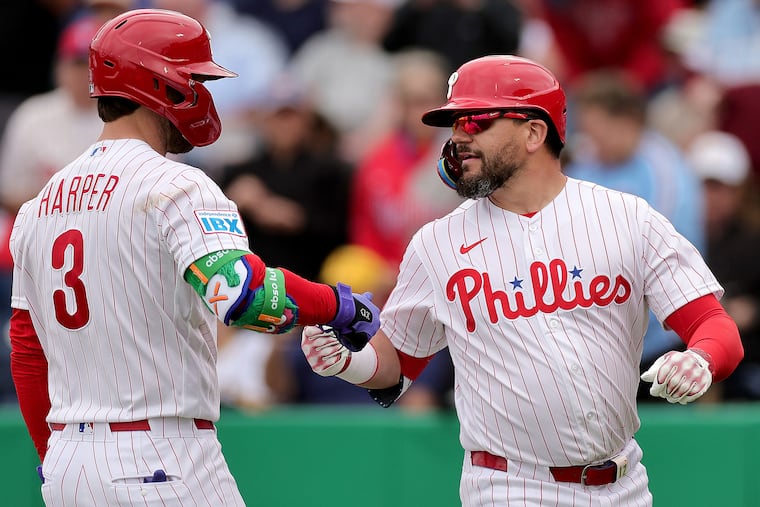
What if I told you that Alec Bohm offered more protection to Bryce Harper than Kyle Schwarber?
What if I told you the Phillies’ best batting order is the one they rode to the NL East title, and that Rob Thomson shouldn’t change a thing?
I can’t say either of these things with any degree of certainty. All I can tell you is what the numbers added up to last season. If you don’t like numbers, what you are about to read probably isn’t for you. But a surprising number of people emailed me after Tuesday’s column and suggested that I compare Harper and Schwarber’s numbers when hitting back-to-back in the lineup.
» READ MORE: Bryce Harper and Scott Boras are right. Here’s a wild stat that makes their point.
As a refresher, the topic du jour — or however you say the topic of that day in French — was Harper’s struggles to score runs after reaching base. It was a pertinent topic, given that it sat at the intersection of issues people rightfully have with the Phillies’ odd-fitting and top-heavy batting orders.
But the ramifications of Dave Dombrowski’s roster construction are much broader than the infrequent sound of Harper’s cleats clacking on home plate. The weight is disproportionately borne by Thomson. The dam has more holes than he has fingers. Baseball would be a lot more fun if he could use Harper and Schwarber twice each time through the batting order. Until he can, the lineup will always leak somewhere.
The question remains. What is the optimal (legal) combination? Specifically, at the top of the order, seeing that Thomson has used a number of different combinations of Harper, Schwarber, and Trea Turner, with or without another hitter mixed in.
I used Retrosheet’s play-by-play data and borrowed Will Hunting’s chalkboard and did some figurin’. Harper behind Schwarber, Schwarber behind Harper, neither behind the other. The sample sizes are too small to render any definitive judgments, especially given other confounding variables in play.
There were some surprises.
How do you like these apples:
Observation 1: Harper didn’t get any benefit from batting in front of Schwarber.
In fact, he was his least productive self with Schwarber behind him in the order. The splits are pretty drastic. Harper’s OPS was nearly 100 points higher when batting in front of Bohm vs. Schwarber. And it wasn’t just because he walked more. His extra-base hit percentage was higher, thanks in part to five home runs in 126 plate appearances in front of Bohm compared with seven in 200 in front of Schwarber.
The numbers, please.
Harper in front of …
Schwarber: .796 OPS, .355 OBP, 18.0 K%, 12.5 BB%, 9.0 XBH%, 7 HR, 200 PA
J.T. Realmuto: .810 OPS, .332 OBP, 20.9 K%, 10.2 BB%, 8.6 XBH%, 11 HR, 187 PA
Bohm: .881 OPS, .381 OBP, 23.8 K%, 13.5 BB%, 11.1 XBH%, 5 HR, 126 PA
Observation 2: Harper was at his best when hitting behind Schwarber.
He also was pretty good when hitting behind Turner.
The numbers:
Harper, when hitting behind …
Schwarber: .858 OPS, .352 OBP, 22.0 K%, 11.1 BB%, 10.8 XBH%, 17 HR, 332 PA
Turner: .831 OPS, .373 OBP, 18.8 K%, 14.8 BB%, 9.4 XBH%, 9 HR, 244 PA
Here’s the interesting part: Harper was much better hitting behind Turner when Schwarber wasn’t hitting directly behind him, specifically when Bohm split the lefties in the No. 3 spot, with Harper batting second and Schwarber fourth. In fact, Harper and Schwarber were both pretty darn good in those situations — again, in tiny sample sizes.
Harper behind Turner, and nonconsecutively with Schwarber: 9-for-37, five extra-base hits, two home runs, 11 walks, .903 OPS.
Schwarber in those situations: 9-for-38, six extra-base hits, four homers, eight walks, 1.014 OPS.
All of Harper’s plate appearances in front of Schwarber came in the first three months of the season. The last time Thomson used a Harper-Schwarber lineup was those back-to-back losses in Toronto when the Blue Jays outscored them, 11-2.
After Harper returned from the injured list in late June, Thomson switched to the lineup that carried the Phillies through the rest of the season. Schwarber in the two-hole, followed by Harper. Only twice did he deviate from that batting order when both players were in the lineup. Understandably so. The Phillies averaged five runs per game in their last 79 games, putting together a team OPS of .789.
There is a question of correlation vs. causation here. Were the Phillies better as a team because Harper’s numbers were better behind Schwarber? Or were Harper’s numbers better behind Schwarber because that’s where he was hitting when he and the rest of the team found its stride?
All sorts of variables could be in play: the quality of pitching the Phillies faced in the last three months vs. the first three months, the weather, etc.
That being said …
Observation 3: Schwarber should not bat cleanup. The optimal lineup is either Turner-Schwarber-Harper or Schwarber-Turner-Harper.
The Phillies were at their best when Schwarber and Harper were batting in the top three. This is obvious. Schwarber may look like the prototypical table-clearer until you see what happens when Bryson Stott and Turner are getting it set.
No offense to either player. But the goal is to get your elite players the most at-bats. It doesn’t get more prototypical than Aaron Judge, and the Yankees bat him leadoff.
» READ MORE: Inside the Phillies: Shane Victorino’s advice for Justin Crawford, a changing rotation, and more
It comes down to this, really: Down by one in the bottom of the ninth with the top of the order due up, you want a lineup that guarantees Harper and Schwarber a chance at tying the game. The data from last season doesn’t prove anything, but it is always smarter to err on the side of what the data suggests when what it suggests is the same as one’s intuition.
We can argue about Bohm vs. Adolis García vs. Realmuto. Hopefully, we’ll end up arguing about Aidan Miller. But there isn’t much of an argument for batting Schwarber or Harper lower than third.
Just ask any opposing pitcher what he would prefer.

Tim Mayza was among the best, most under-the-radar Phillies stories this year. And he's coming back for more after signing a new contract last week. The Lancaster County native joined Phillies Extra, The Inquirer's baseball podcast, to discuss his solid season, building a culture in the bullpen, the origin of his "Sheriff" nickname, and more. Watch here.
You can also subscribe to the podcast version of Phillies Extra on Spotify or Apple Podcasts.
Previous episodes: Aidan Miller | Scott Franzke | Larry Andersen | Matt Klentak | Jeff Francoeur | Luke Murton | Mike Hazen | Tony Gwynn Jr. | Kevin Stocker | Bobby Dickerson