Philly skateboarders saved Muni and the new park could provide a blueprint for other cities
“We really think that what Philly is doing is pioneering,” said Justin Villano of the work at the spot outside the Municipal Services building.
Justin Villano found his way to Philadelphia in the late 1990s, pooling together gas money and piling into a buddy’s car to skateboard at the iconic spots they saw on VHS tapes.
Love Park. Muni. Dilworth Plaza.
The concrete around City Hall was home to Philly’s premier skaters: guys like Ricky Oyola, Matt Reason, Kerry Getz, and Stevie Williams. Villano and his friends from New York had to be there.
“The city was a bit raw and rough around the edges but there was this certain welcoming feeling when you were at Love or Muni,” Villano said. “Everyone was there doing their own thing, but we were all there at the same time. There were so many characters, and it became so vibrant. That’s what makes it so special.”
» READ MORE: New skate plaza in Center City uses repurposed granite from original LOVE Park
So Villano, who is now the global marketing director of action sports at Vans, didn’t need much convincing when it came to supporting the grassroots movement to save skateboarding at the spot known as Muni, since it’s outside the Municipal Services Building at 15th Street and JFK Boulevard.
Vans provided $300,000 toward the project, which was spearheaded by Pat Heid, a Philly skater who works in sales for Vans and is involved with the nonprofit SkatePhilly.
“We know how important it is to preserve these places and spaces like Muni,” Villano said. “Because we were a part of the culture and experienced it firsthand. That’s when the key members of SkatePhilly come in. They’re born and raised in that community and know what it means to the bigger global skate community. We all have this obligation to give back to skating.”
The project to save Muni started in May 2023, when skaters saw fences go up around the Municipal Services Building and knew the city had plans to renovate the area. Heid worked to secure the concrete benches that were removed and then went to an Art Commission meeting in July about the redesign of the plaza. The city had no plans to include skating in the new plaza.
He read a prepared statement and convinced them to include a place for skateboarding in the renovations. Heid told them about the history of skating in Center City and how the three plazas planned by Edmund Bacon in the 1960s became “a trifecta of some of the world’s most famous and iconic areas for street skateboarding from the late 1980s until 2023.”
“It allowed many of our city’s youth to become professionals within the global skateboarding industry, as athletes, marketers, sales people, photographers, and videographers,” Heid wrote. “The influence of these spaces and extended community has reached millions and millions of people globally through print, digital, and social media, extending into the fashion and art landscapes. Specifically, the community over the past seven to 10 years has been some of the most influential. We are hoping to preserve our community and this history, allowing future generations of our city’s youth to engage this area positively through the active, physical and creative expression of skateboarding.”
» READ MORE: WWF at the Spectrum felt like a Phillies playoff game. And there was no doubt the wrestling was ‘real.’
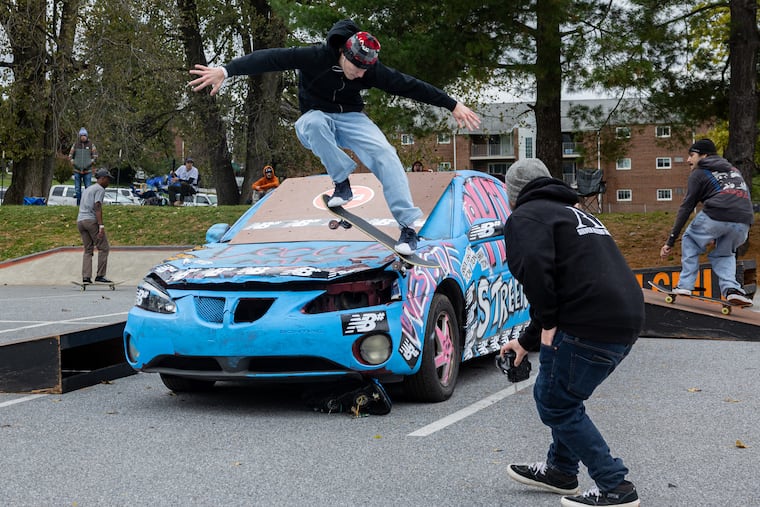
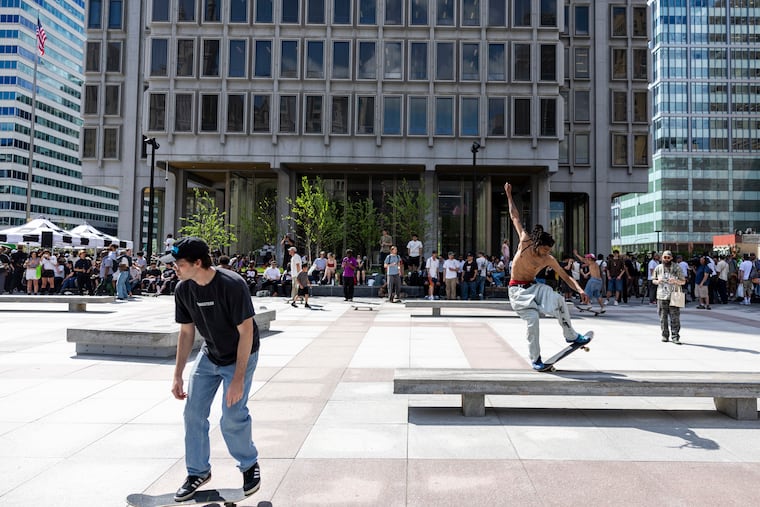
Heid went to more meetings, made more presentations, and the city agreed to save Muni. A portion of the park — which opened Friday — is designated for skateboarding, and the concrete benches he salvaged were reused. The skaters won.
“There’s a certain sense of obligation that a lot of us have as we get more senior to give back to skateboarding and leave it better than we found it,” Villano said. “I think a lot of us carry that mantra and a lot of us feel obligated to pay tribute to the culture because it gave us so much. Skateboarding shaped a lot of us as characters and professionals. It teaches you independence and problem solving and basically provides you with all your friends. It’s great to see that the folks of the community came together to do this. All the credit is due to SkatePhilly. We’re just happy to support them.”
The fight for Muni is not unique to Philly as swaths of skate spots across the country are disappearing. Renovations stopped skating in Love
Park and Dilworth Plaza. New York has lost iconic skate spots, but a similar grassroots campaign saved Brooklyn Banks, a spot in Manhattan under the Brooklyn Bridge.
The work at Muni — which was saved by a partnership by the city, community, and Vans — could be duplicated elsewhere.
“I think it’s great for the cities to create this infrastructure that isn’t a typical skate park and build it into their city footprint,” Villano said. “These places are already originally recognized as skate spots and now the cities are embracing skateboard culture and seeing how it’s such a positive output.
“We hope that other cities will take note of this. We really think that what Philly is doing is pioneering this on the big picture of things. My hope is that other cities will see this, take interest, and want to do the same.”
It didn’t cost much for Villano to get to Philly in 1998 — “Gas was like 99 cents back then,” he said — so he and his buddies kept coming back. The Philly guys then would trek up to New York and skate with Villano’s crew.
“Everyone brought something to the table,” Villano said. “Whether it’s the style of skateboarding, their approach to tricks, the way they carry themselves, the way they dress. Philly has such a unique aesthetic. You know when you’re watching footage in Philly that it’s from Philly. The people who are woven into the fabric of Philadelphia skateboarding are amazing.”
The Philly skate spots were more than just asphalt, benches, and stairs. They were a community. Vans helped make sure the asphalt at the new Muni was leveled the way it was at the old Muni and added the brand’s checkerboard pattern on the ground as a subtle nod. But Villano hopes the new spot is more than a design.
“I’m now 42, and I think I started skating when I was 11 or 12,” Villano said. “I hope for the next generation, they get to experience that same feeling that I had when you first roll up to a spot that you saw on film or in photos or in the magazines, and you say, ‘I can’t believe this is it.’
“There’s a certain level of excitement that I hope we can pass on to future generations. I hope these iconic skate landmarks get preserved for the long run and that this — along with the Brooklyn Banks — is another shining example of what cities can do to cultivate skateboarding and to cultivate positive outlets for their youth.”