South Korea’s esports powerhouse has local roots — and even its own Gritty: ‘It all started here in Philly’
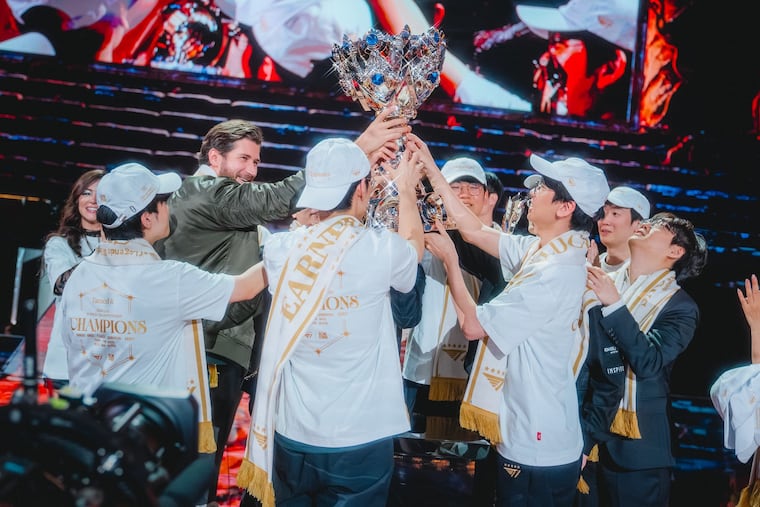
Comcast Spectacor’s T1, led by “the LeBron James” of esports, won its sixth League of Legends World Championship and became the first team to three-peat.
When Joe Marsh started as an intern at Comcast Spectacor more than 20 years ago, he never expected he’d become the chief executive officer of an esports powerhouse in Korea.
T1 Entertainment & Sports, a joint venture between Comcast Spectacor and South Korea’s SK Telecom, is one of the most successful esports organizations in the world. The team won its sixth League of Legends World Championship earlier this month over its rival KT Rolster in China. It was T1’s third straight League of Legends title, marking the first three-peat in the event’s history.
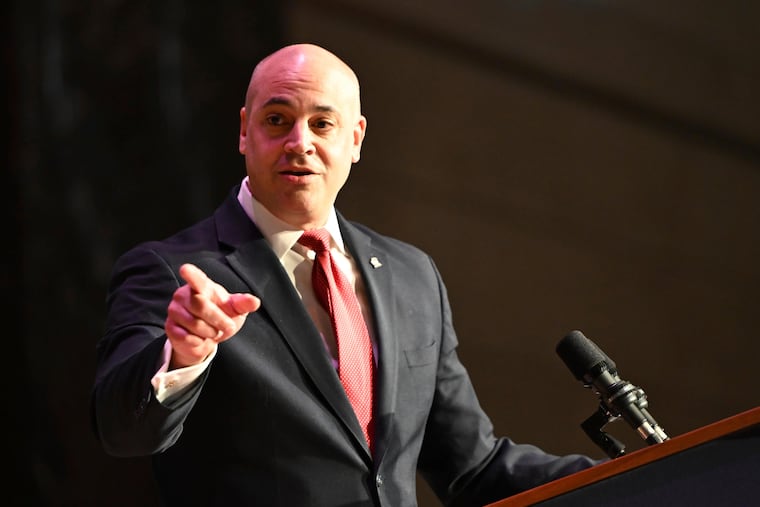
At the center of the team’s success is a 29-year-old who calls himself Faker who was recently referred to as “the LeBron James” of esports for his combination of skill and longevity. There also are two big contributors from the Philadelphia area: Marsh and Tucker Roberts. Marsh, a Villanova and Millersville graduate, is the CEO of the team. Roberts, a Penn graduate, is the chief innovation officer and president of gaming & emerging technology for Comcast Spectacor.
As CEO, Marsh has recruited team members, built a new office space in Korea, partnered with major brands like Disney, and collaborated with K-pop superstars BTS. T1 has even created its own gaming cafe, a popular pastime in Korea, with player-themed food, drinks, and computers.
Of course, the journey to all the team’s success took time — but it got its start right here in Philadelphia. And the man behind it all loves to showcase his Philly roots whenever he gets the chance.
“It all started here in Philly, which is a great connection, great for the city,” Marsh said. “We wanted our own version of Gritty. His name’s ATI. He’s supposed to be a Phoenix, but it looks like a giant chicken with a flame on his head. He’s gigantic and he’s awesome. But that’s our version of Gritty. Again, another thing that we took from our time in Philadelphia.”
One thing the team didn’t need to borrow — or even attempt to replicate — was a rabid fan base, the kind Marsh grew up a part of in Philly.
“[Korean] fans are very passionate, just as passionate as Philly fans,” Marsh said. “And they don’t accept anything less than greatness — and they’ll support you through thick and thin. But they want to make sure the players are giving their 100%, just like Philly.
“I mean, that’s why I think Tucker [Roberts] and I have done so well in Korea. Because we grew up in Philadelphia in a town that took their sports seriously. And yeah, it’s esports and it’s different in terms of medium, but it’s the same concept. It just happens to be played online. And I think the level of fandom that they have in Korea, it’s crazy.”
Forming T1: ‘Going to Asia was the best way to do it’
Marsh was hired at Comcast Spectacor full-time in 2006. While the Langhorne native fulfilled the duties of his position, he worked toward his MBA in finance analytics and strategic management at Villanova, graduating in 2016 — right around the time Comcast wanted to get into the gaming industry.
Together, Marsh and Roberts eventually developed Comcast’s first esports team, the Philadelphia Fusion, which was part of the Overwatch League. The Fusion competed in the team-based, multiplayer first-person shooter game Overwatch, making the finals in their first year.
In 2021, the Fusion moved to South Korea, where they rebranded as Seoul Infernal, putting an end to Comcast’s plans of building the nation’s first video gaming arena in the South Philadelphia Sports Complex. An arena solely for gaming may be considered an anomaly in the United States, but it’s the norm in Asia. Fans have regularly been filling arenas to attend esports events. It’s why the move to Asia seemed like a necessary one for Marsh.
And although the Overwatch League folded after the pandemic, the former Philly team was the blueprint for what Marsh and Roberts wanted T1 to be.
“I think they had the right business model, wrong game, and wrong region,” Marsh said. “I think what we’re doing now in Korea is basically what the Overwatch League was trying to do. We realized pretty early on that the best gamers are in Korea. And, you know, if we’re going to make a splash for Comcast, going over to Asia was the best way to do it.”
In 2019, Comcast Spectacor partnered with Korea’s SK Telecom to launch T1 Entertainment & Sports. With the partnership, SK Telecom T1’s League of Legends team rebranded to T1 and Marsh was named the CEO, put in charge of the growth and optimization of T1’s global presence.
T1 Entertainment & Sports competes in a number of competitive gaming segments, including Valorant, PUBG: Battlegrounds, and Tekken 8. However, League of Legends is the most popular. The game is a five-on-five online video game in which each player selects one of 171 characters and attempts to destroy the opposing team’s base.
While T1 has become something of a dynasty, it’s not always smooth sailing.
“I think there’s times throughout the year where everyone wants to kill each other and then there’s times of the year where everything’s going great,” Marsh said. “And, you know, a lot of people see the duck on top of the water gliding. What I see is the feet below paddling 100 miles an hour. And my job is to make sure people only see the duck and not the feet because people don’t care how the sauce is made, right?
“They just want to know if the trophy is getting lifted. And for me, I’ve learned over the years to enjoy the journey as much as the result. Because it’s not, it’s almost an empty feeling. Like, you win and you’re like, wow, that was really hard. And then I’m already like, OK, like, how do we re-sign this roster? How do we do that? Like, I think we enjoyed it for like a half a day. And then it’s back to business as usual.”
Recruiting the right team
If LeBron James was walking down the street, he would get stopped and asked for a bunch of photos. The same thing can be said about top gamers when they’re walking around the streets of South Korea.
That’s how popular gaming is in Asia. And the T1 brand has grown beyond the competitive scene. The players are treated as celebrities — even Marsh has been stopped for photos and autographs.
But no one gets stopped more than Lee Sang-Hyeok, known to millions as Faker. Whether your G.O.A.T. is Michael Jordan or LeBron, T1 has that guy — and he’s been delivering for over a decade, earning millions in salary and endorsements.
Faker has been on the top of the gaming world dating back to his debut in 2013, when he was just 17 years old. Now, he’s still considered one of the best players. Not many believed he could have such longevity — especially when 21 is considered ancient in the gaming world.
However, instead of slowing down with age, Faker has adapted his gaming style to stay on top.
“I didn’t expect to be active for this long when I first started,” Faker said in an email through a translator. “Back then, I just loved the game and wanted to get better. As I kept challenging myself year after year, I found myself continuing this journey. Having new goals each season has helped me stay motivated.”
This is wild--I profiled Faker for ESPN Mag *ten years ago* and at the time was told by everyone there's no way to stay on top in an esport past your early 20s. Dude really is the LeBron of League of Legends.
— Mina Kimes (@minakimes.bsky.social) November 7, 2025 at 3:36 PM
[image or embed]
When it comes to recruiting players, it’s not always about creating a super team with the best of the best. It’s about building a group that can work cohesively together.
“It’s a mix of not just signing the best players,” Marsh said. “We did that in 2019 before I got there and we didn’t win the championship. It’s about finding the best five people that can play together to win. In the game League of Legends, we’re most known for communication. And that’s what separates the champions from the teams that are falling short. And, you know, we’re fortunate to have Faker, obviously the greatest gamer of all time. But he’s a guy who has evolved over the years from superstar to veteran leader and facilitator.
“We’ve done a good job putting kids around him that can thrive off of what he’s able to do. Because a lot of times if you watch our games, especially against lesser competition, they’re just chasing Faker around the map to kill him for a clip for YouTube. Meanwhile, my guys are winning games, right? They’re doing the objective.”
However, the recruiting process can be challenging. Not only is it difficult with the language barrier, but when Marsh started in 2019, most players didn’t even have agents. Marsh would either have to speak directly to the players or to their family members. Despite the challenges, he managed to create a family-first culture with the team.
“I try to make sure that the families are a big part of what we’re doing at T1 because part of the reason why the players stay in Korea is to have that safety net — whether it’s family or their friends,” Marsh said. “It’s a long, grinding year. Most of my guys are in their early 20s. Imagine being a pro, making tons of money, having the weight of the world on your shoulders from not only your country but fans around the world. You need that support system. And we try to do that.”
Added Faker: “T1 is a very special team to me. I’ve been with the organization since my debut, and even through many changes and difficult moments, we’ve always grown together by trusting one another. Our success comes from the combined effort of players, coaches, staff, and the fans who support us.”
And it all started in Philly.