SEPTA seeks apartment development near its stations to boost ridership and revenue
The transit agency looks to recruit development partners near Regional Rail stations, aiming to help create walkable communities and grow ridership.
SEPTA runs buses and trains. It doesn’t build homes.
But the mass transit agency does own land and is looking to strike deals with private developers to turn underused property into apartments and retail space. It’s targeting areas — so far at Regional Rail stations — with pent-up housing demand and a desire for walkable communities.
With the Transit Oriented Communities program, SEPTA is betting that it can generate steady income over generations, helping cushion it from frequent financial crises.
Leasing land to developers will bring millions over time, of course, but cultivating more riders is crucial to SEPTA’s sustainability.
“We can’t expect to grow ridership if people cannot live and work near our services,” said Jennifer Dougherty, manager of real estate planning and development for SEPTA.
Already, about 2 million people live on 10% of the region’s land that is within a half-mile of high-frequency transit and Regional Rail stations. There is room for more density.
“We’re just so lucky to live in a region that grew around transit. We’re not retrofitting,“ Dougherty said. ”We’re reinforcing the existing character and built environment of Southeastern Pennsylvania.”
The strategy of late has been building momentum:
In Ambler, Korman Communities Inc. and Benchmark Real Estate LLC will build luxury apartments and retail multiuse development on 3.4 acres of parking lot at the train station under a contract SEPTA awarded Feb. 26. The developers have agreed to pay SEPTA $402,500 a year, with annual 3% increases, for a 99-year ground lease, with total income for the transit agency estimated at $236 million over the life of the deal.
Alterra Property Group is planning a 300-apartment building in Conshohocken on land owned by SEPTA that had been slated for a 528-space parking garage.
And SEPTA has begun working with local government and residents to craft a development concept for 1.7 acres of land at Langhorne Station in Lower Bucks County.
The Ambler and Conshohocken projects are furthest along, but both still need a final design and will need to wind through the zoning approval and other processes of the two boroughs before ground can be broken.
“They are both hot housing markets, and there was a high degree of confidence that we would be able to attract a good partner on good terms,” said Kenny Starr, SEPTA’s manager of joint real estate development.
While development announcements grab attention, SEPTA sees its role as a partner with the municipal and county governments in the region. A proposal won’t work if it doesn’t fit into the context of a town or neighborhood.
“It’s a lot different from if a developer was coming in cold to say, Hey, I own this property, and now I want to put X, Y, or Z on it,” Starr said. SEPTA wants to have open conversations “so we can all figure out what works best, if anything, and then go out and get it.”
Here’s how two Philadelphia suburbs are grappling with SEPTA transit-oriented housing proposals.
Built-out Ambler wants housing options
The Reading Co. brought the railroad to Ambler in 1855, and the place took off from there.
By the 1980s, industry had shut down, and shopping malls ruled. Abandoned buildings were decaying along the rail corridor at the edge of Ambler’s downtown, with polluted land underneath from manufacturing. Empty storefronts haunted Butler Avenue.
So Ambler rallied around the railroad.
“We started revitalizing those brown fields because we were looking to take that ghost downtown a leap forward,” Mayor Jeanne Sorg said. The borough tapped state and federal money for cleanup in the early 2000s.
With no open developable land in the borough, Ambler’s planning has centered on SEPTA’s Lansdale/Doylestown Line.
The borough created a zoning overlay for transit-oriented development. In 2013, the Boiler House, an old asbestos factory repurposed as offices, opened adjacent to Ambler Station, along SEPTA’s Lansdale/Doylestown Line.
Meanwhile, back in the early 1990s, partners Michael Sloane and Mike Fink of Rebound Properties bought up a couple dozen downtown retail buildings and filled them with restaurants, boutiques, and coffee shops. Town leaders refurbished the old Ambler Theater.
“We were able to rise again because we kept those great bones,” Sorg said. “Rail built Ambler once, and it’s helping us rebuild it again.”
Demand for housing is intense, especially for multifamily homes. Rents in Ambler have doubled in the last 10 years, and 12% of households spend more than half their income on housing, SEPTA’s research says.
“When a rowhouse or a condo or a small home comes up for sale in the borough, they fly off the market,” said Mark Korman, president of the commercial division of Korman Communities.
Local officials have been talking with SEPTA for at least eight years about transit-oriented development.
Korman Communities plans to build four stories, with its AVE brand of luxury apartments (10% of which will be affordable) and street-facing retail space on the ground floor. It will also have a public park.
Korman considers Ambler his hometown. It’s where he went with his brothers for shoes and prom tuxedos and to listen to Tommy Conwell and the Hooters.
The project will help link the station area, an island in a sea of asphalt, to the rest of downtown.
“We love walkability,” Korman said. “Ambler’s train station is right in the heart of the borough. … You get off the train. You’re walking to restaurants, coffee shops, the theater, all kinds of things.”
Seeking a spark to revive Langhorne Station area
Old Lincoln Highway runs through the center of Penndel, lined with used car lots, auto repair shops, Big Marty’s Carpets and a couple of competitors, a parking lot for tractor trailers, and some vacancies.
They’re going concerns, but downtown could use a project to spark a revitalization, said Mark B. Moffa and some other community leaders.
SEPTA’s Langhorne Station, tucked amid Penndel, Middletown, Langhorne Manor, and Langhorne Borough, could be the beginning.
“That corridor really looks run down, has a feeling of a place that used to be something, but isn’t anymore,” Moffa said.
He is the acting county treasurer, a former Penndel Council member, and a leader in the borough’s revitalization task force, which worked with the Bucks County Planning Commission to update zoning, including a transit-oriented overlay.
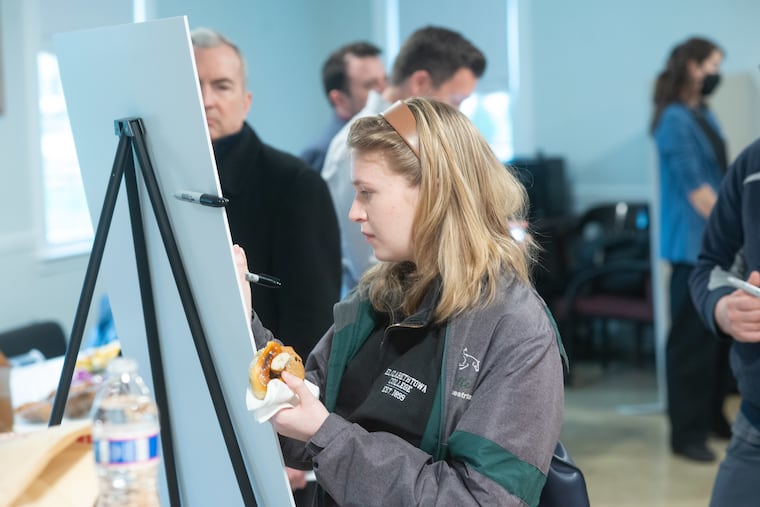
On March 23, about 90 people crowded into Penndel Borough Hall for a SEPTA open house to discuss its concept for possible redevelopment of the underused 1.7-acre south parking lot at Langhorne Station.
It was a glimpse of the Transit Oriented Communities process in its early stages. SEPTA had set up boards showing concepts.
In a place where people could write open-ended thoughts, the prompt was, “What do you want from the development? What are your goals?”
Someone wrote Go Away!!!, with a yellow-and-black frown emoji drawn next to it. Another person scrawled that it would be good to have a roundabout built at the Durham Road and South Bellevue Avenue “triangle,” a notorious intersection in Penndel.
Among the written aspirations were calls for entertainment — one person even mentioned axe-throwing — new restaurants, a brewpub, and above all, a grocery store. Trader Joe’s got a couple of shout-outs.
Lower Bucks already has traffic congestion, and some worried about more.
Mayor Thomas C. Sodano Jr., the only Republican in Penndel government, was opposed. He noted that the parcel slated for development is in Middletown Township, which would reap the tax revenue.
“The only way in and out is through the borough,” Sodano said. ”Can’t drive across the tracks. Can’t go out either end. … It needs to move across the street, then I’m in love with it."
Victor Fiori II, property manager for his family’s real estate company, said redevelopment would be a good thing. He runs a strip mall on the business corridor.
“But until PennDot does something about increasing the capacity of our surrounding roads, including Route 413, it’s going to be very difficult,” Fiori said. “Development will keep spiraling traffic.”
He wondered whether the commercial space in a building on the site would be large enough to attract a grocery store. The mall used to have a Bottom Dollar, but after Aldi bought out that chain in 2015, it elected not to put a grocery in the 19,500-foot space, Fiori said. It now houses Phantom Fireworks.
Within one mile of Langhorne Station, there are 400 multifamily units, none built since 1966, SEPTA says. Vacancy is low, and rents have increased.
Penndel Councilmember Gary Nickerson said it’s important to try to build apartments on the lot.
“This could draw other development to the borough,“ he said. ”It could get things kicked off, once somebody goes first.”