Ardmore’s train station reopens Monday after years of delays. Locals say it couldn’t come soon enough.
The renovation has taken six years, as crews have run up against supply chain slowdowns and unforeseen construction issues at the aging site.
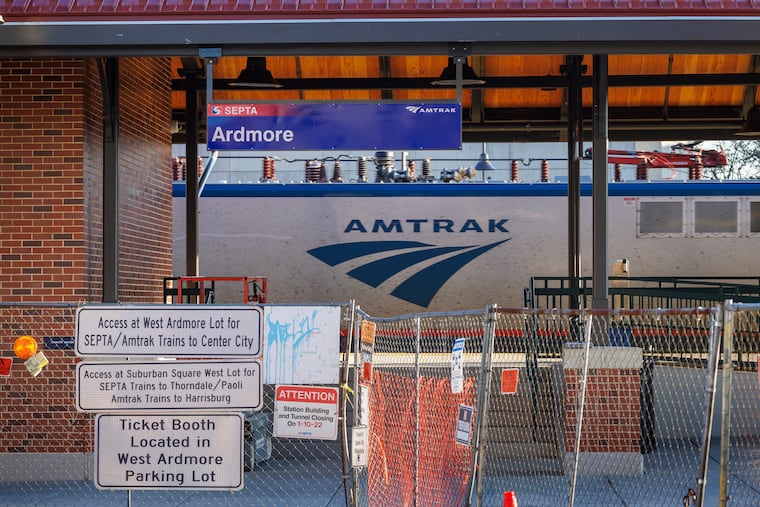
Nicholas Amrani says the long-delayed renovation of Ardmore’s SEPTA station has become “a group joke” among downtown Ardmore businesses.
Amrani is the operations manager at Delice et Chocolat, a French bakery at Station Road and Lancaster Avenue. For six years, Delice et Chocolat has abutted a construction site, as crews have worked to renovate Ardmore’s 70-year-old train station. Orange cones and cordoned-off parking spots have become as familiar as croissants and coffees for Amrani, who said the construction has hurt the bakery’s foot traffic and blocked off delivery access points. The bakery has cut its hours, and employees have become accustomed to racking up parking tickets as they unload shipments.
“It’s been crippling,” he said. “It’s really affected every aspect of our business.”
The Ardmore Station renovation was originally slated to take 2½ years. Instead, it has stretched into more than half a decade, as crews have run up against supply-chain slowdowns and unforeseen infrastructure problems at the aging site. On Monday, the station and adjacent parking lot will finally reopen to riders, who will be able to use new, accessible platforms and waiting areas.
For some Ardmore residents and business owners, a project that began as a manageable inconvenience has become a yearslong headache. As the Main Line community prepares for the station to open its doors, one message is clear: It couldn’t come soon enough.
What took so long?
The Ardmore Station serves SEPTA and Amtrak, taking riders between Philadelphia and its western suburbs on Regional Rail and New York City and Harrisburg on Amtrak. In 2019, around 900 daily riders boarded Regional Rail trains in Ardmore during the workweek. Though Regional Rail ridership has declined since the pandemic, Ardmore continues to be one of SEPTA’s most heavily traveled stations, according to the agency.
SEPTA authorized the renovation of Ardmore’s train station in 2019, budgeting 2½ years and $62 million to build a new, accessible station complete with raised tracks, ramp and elevator access, and upgraded waiting areas.
The project was part of a larger effort by SEPTA to rehabilitate older transit centers and bring them into compliance with the Americans with Disabilities Act (ADA).
The station was slated to be completed in early 2022. However, shortly after crews broke ground, a cascade of issues began delaying the grand opening.
Len Nardone, SEPTA’s chief of capital programs, said the first major roadblock came in the form of the pandemic, which hit just months after construction began, forcing a work stoppage. When crews finally returned, global supply-chain issues slowed them down again.
When work could continue, contractors could only work in limited, four- to six-hour overnight stints, so as to not disrupt daily train service.
On top of supply-chain and work limitations, Nardone said, construction crews ran up against unforeseen challenges hidden behind the walls of the old train station. At one point, they hit an unknown oil tank, necessitating a separate crew to remediate and clean the area. Other times, crews found crumbling walls that needed to be rebuilt. The outbound elevator tower needed to be redesigned entirely because of infrastructure issues that emerged only after construction had started.
“It’s unfortunate, you can’t really see these things until you start doing demolition and uncovering them,” Nardone said.
The Ardmore train station was built in 1957 to replace the first, 1870s-era station.
“There’s just a long history of railroad activity and things that happened at this station that weren’t necessarily documented well,” Nardone said.
During construction, boarding for passengers traveling toward Philadelphia has moved to temporary platforms erected in the Ardmore West Lot, and those traveling toward Paoli have boarded from a temporary platform above the Suburban Square parking lot. The Ardmore Station parking lot, which runs behind Ardmore Music Hall and neighboring Lancaster Avenue businesses, has been closed. At times, crews have also closed down parts of Station Road and Anderson Avenue.
‘It did a lot of damage to our community’
Like Amrani, Robyn Axner-Davis said the construction has been “horrible” for business. She owns Ardmore Grooming Station, a pet-grooming shop on Anderson Avenue.
Axner-Davis said she felt blindsided by sudden road closures, which seemed to appear with no notice. Her clients constantly struggled to find parking. Some of them, she said, abandoned Ardmore Grooming Station for other, more accessible groomers.
“There’s no doubt in my mind that we’ve lost business,” Axner-Davis said.
“We’re in the suburbs,” said Nina Greberman, president of the Ardmore Business Association, who called the construction “such a disruption.”
“People want to be able to drive, park close, and get to where they want to be,” Greberman said.
The train station parking lot closure pushed businesses’ loading and unloading onto Lancaster Avenue, backing up the already congested thoroughfare. The squeeze trickled into other parts of town, like Suburban Square, as commuters sought parking elsewhere.
In addition to the parking issues, business leaders said the ever-present construction scared off foot traffic, and the critical dollars that came with it.
“When the central hub of your town is a construction site, it tends to keep people away,” said Alec Hersh, executive director of the Downtown Ardmore District.
Connectivity between downtown Ardmore and Suburban Square was already shoddy, Hersh said. Forcing shoppers to navigate a construction site and traverse narrow sidewalks under the train tracks to go between the sites discouraged business even further.
It “did a lot of damage to our community,” he said.
Jennifer Wallace, manager of legislative affairs at SEPTA, said the transit provider “did our best to communicate” despite not always having advance notice of changes itself. Wallace said she communicated regularly with stakeholders and took all concerns seriously.
“I can certainly appreciate that this was a long project. It was probably hard to be neighbors to a construction project of this size. I totally, totally understand,” Wallace said. “I appreciate all of their patience and understanding and support throughout the whole duration of the project.”
Hersh said he believes “SEPTA did the best they could with a tricky situation” but noted that the “uncertainty really has an effect on people.”
‘A great frustration’ for one rider
Davis d’Ambly and his husband moved to Ardmore three years ago because of the community’s train access.
It didn’t take d’Ambly long to discover that “in fact, there was not helpful access for me,” he said.
D’Ambly has severe balance issues and uses a cane. Ardmore’s temporary outbound train platform requires riders to traverse around two dozen steps to get to it (there is no elevator or ramp access). D’Ambly tried to take the train twice, realizing quickly that he could not make it down the steps coming back from Philadelphia.
D’Ambly, who does not drive, has been relying on Ubers and rides from friends to get into Philadelphia. He travels into the city considerably less than he would if he could access the train.
“It’s just been a great frustration,” d’Ambly said.
The new station will be ADA-compliant, a major piece of the long-awaited renovation. There will be both ramp and elevator access, and passengers will not have to walk up steps to board the train.
D’Ambly is “thrilled to pieces.”
Turning the page to ‘a better transit hub’
As the Monday opening looms, a mix of lingering frustration and tempered excitement has been hanging in the air around Station Road.
“The people of Ardmore have deserved a better transit hub for over 70 years,” Hersh said.
Hersh believes the new station will “reinforce Ardmore’s rightful position as a key linchpin in the western suburbs.”
Delice et Chocolat plans to hire more staff and expand its hours for commuters. There have been times when the bakery questioned whether it could keep its doors open. On Monday, it hopes to finally turn the page.
“We’re so excited,” Amrani said.

Inquirer Lower Merion
This suburban content is produced with support from the Leslie Miller and Richard Worley Foundation and The Lenfest Institute for Journalism. Editorial content is created independently of the project donors. Gifts to support The Inquirer’s high-impact journalism can be made at inquirer.com/donate. A list of Lenfest Institute donors can be found at lenfestinstitute.org/supporters.