Philly’s e-bike and e-scooter boom comes with a more dangerous price than traditional cycling
Injuries from electric bikes and scooters rose by 40% between 2024 and 2025.
It was the first weekend of summer break. Abigail Gillon, an honor student, had just finished sixth grade. She was free.
“My last text to her was at 2:14” on June 14 last year, said Abby’s mom, Lori Kralle.
An hour later, Kralle received a call from an emergency room nurse about her 12-year-old daughter.
Abby had been riding an electric scooter with her best friend, Isabelle, in Aston Township. The girls were sharing the scooter when they drove off the curb and fell into the street. They were struck by an oncoming car at 2:22 p.m. Emergency responders found them holding each other in fetal position, Kralle said. Abigail died two days later. Her friend was severely injured.
“It didn’t just tear away and take away Abigail’s life, it took apart everybody’s life, her friends and family,” Kralle said.
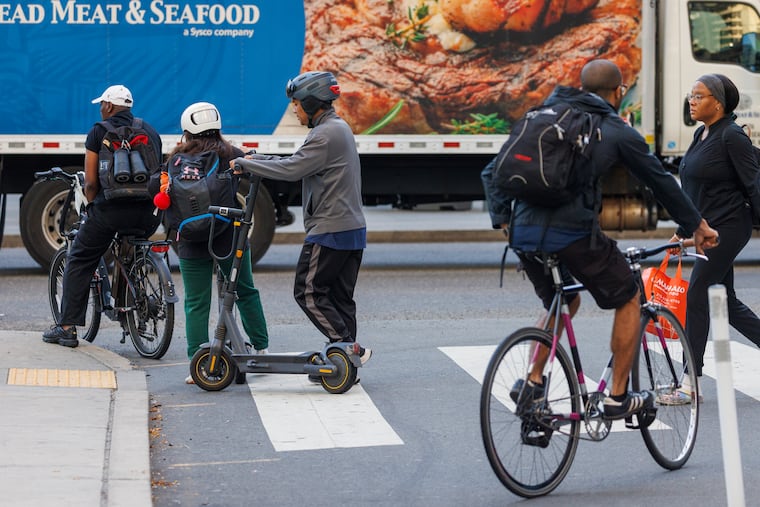
Last year, more traffic crashes causing injury and death in Philadelphia involved electric bikes and scooters than manual ones, according to Pennsylvania Department of Transportation data. The finding highlights a new reality in which e-bikes and e-scooters present a major safety problem, the state confirmed.
The high numbers of injuries and deaths point to the need for legal clarity, statewide safety regulations, and new infrastructure to protect users of e-bikes, e-scooters, and bicycle riders from cars and trucks, traffic safety advocates contend.
“There’s a lot of technology out there and there is no real enforcement and regulation,” said Nicole Brunet, president of PA Safe Roads PAC. “It’s causing devices to be on the road that are unsafe.”
In 2025, e-bikes and e-scooters were involved in 197 crashes on city streets, excluding interstates — a 40% increase over 2024. Four riders were killed and 193 were injured in those collisions, PennDot figures show.
Meanwhile, 193 reported crashes involved standard bikes, more numerous in the city than their electric cousins, as well as traditional foot-propelled scooters, the state figures indicate.
E-bikes and scooters are poorly defined in Pennsylvania law. The ambiguity makes it hard for governments to identify problems; PennDot did not analyze separate crash data for the electric devices until 2024, for instance, due in part to uneven reporting.
State law authorizes the use of low-speed electric bikes — those that weigh less than 100 pounds, have engines that generate no more than 750 watts, and travel below 20 mph — on public roadways. E-scooters are not street legal in Pennsylvania.
This narrow definition, however, does not differentiate among the many new types of electric bikes or e-scooters for sale, which can reach speeds of 60 mph or even 100 mph.
Two states, two speeds
Governmental response has been uneven, with neighboring states moving in opposite directions and local jurisdictions sometimes banning e-bikes and e-scooters or enacting bespoke rules.
“What we’re seeing right now is sort of a wild, wild west,” said State Sen. Tim Kearney, a Delaware County Democrat.
Kearney wrote and introduced “Abby’s Law” — SB 1008 — in September last year.
The bill says no person under 16 could operate a privately owned “low-speed electric scooter” on public roads; a helmet would be required until age 18. The bill would set a uniform 20 mph speed limit and prohibit tandem riding on e-scooters.
Local police would issue summonses for those and other traffic violations by riders. Municipalities could increase penalties for second and third violations, as long as the fine is no more than $250.
In New Jersey, former Gov. Phil Murphy, a Democrat, signed the most restrictive electric cycling law in the nation on his last day in office earlier this year. The law, which takes effect later this month, requires all e-bike users to obtain a license and register their devices with the New Jersey Motor Vehicle Commission, even if they do not go over 20 mph.
Models that can travel between 21 and 28 mph or have a throttle are classified as “motorized bicycles” and must also have liability insurance. The lower-powered e-bikes provide “pedal assist,” which cuts off at 20 mph.
Enforcement could be tricky, especially at the Shore. The MVC says out-of-state visitors can ride legally, but language in the law appears to grant the exemption just to people who have registered devices in their home states. That is not an option in Pennsylvania.
The MVC is now taking reservations for appointments; officials have acknowledged the deadline might need to be extended.
E-scooters with a top speed of 19 mph are legal.
In Pennsylvania, more than a year after Abby Gillon’s death, Kearney’s bill has not had a public hearing or a vote in the Senate.
“We need to get people to acknowledge what’s actually happening on the road, and then stop sticking our heads in the sand about the various bureaucratic reasons not to move forward with it,” Kearney said.
Wide use, thin information
Government officials face challenges identifying and classifying the many varieties of electric bikes and scooters — also known as micromobility vehicles — transportation activists and state officials said. That makes information, including about crashes, hard to come by.
PennDot, for instance, began counting electric bikes and scooters separately from pedal cycles, unmotorized scooters, and pedestrians for its annual tally of crashes only in 2024.
After a vehicular crash, law enforcement is required to report to PennDot details of crashes that involve injuries, fatalities, or significant damage to vehicles.
Regarding the data prior to 2024, Robert A. Ranieri, crash-analysis manager at PennDot, said via email: “I don’t find that fully reliable since we didn’t look at all the narratives and the police may not have reported them properly at the time.”
While his office works to verify the data, “not all reports are touched by my staff,” Ranieri said.
Similarly, the crash data on electric bikes likely include vehicles known as e-motos, which look like pedal bikes but go faster than 20 mph, said John Boyle, research director at the Bicycle Coalition of Greater Philadelphia.
In general, e-motos being lumped in with e-bikes is causing a lot of issues as communities and states try to regulate the higher-speed micromobility devices, Brunet said.
E-scooter law is ‘basically ignored’
The recently released PennDot data include at least 92 crashes in Philly involving e-scooters, which are technically illegal to ride on public streets in Pennsylvania.
Last year, there were four reported fatalities involving e-scooters, though they made up only 14% of micromobility devices, according to the Bicycle Coalition’s 2025 bike count data.
Standard bikes, in comparison, resulted in the same number, a total of four deaths, last year.
“Some of the e-scooters have a top speed of 60 mph, which is crazy fast,” Boyle said, but “the law is basically ignored.”
There is a gray market of electric scooters and bikes available for purchase, transportation experts told The Inquirer.
“You can purchase electric bikes or scooters for $800 on Amazon and they have 1,000 to 2,000 watts,” Boyle said.
The bikes are sometimes marketed as “Class 2,” meaning their motor tops out at 20 mph, but with a few basic adjustments can easily go faster, Boyle said.
Motorcycles, unlike e-motos, have quality standards and regulations. When it comes to selling a motorcycle in Pennsylvania, dealerships are required to handle legal requirements, title transfers, and state registrations.
Reining in the manufacturers and dealers of electric bikes, motos, and scooters is an important step, Boyle said, but the state first needs to better define in the law what electric bikes and scooters are.
Brunet, president of PA Safe Roads PAC, said her organization supports the Safe System approach to transportation safety, which involves education, enforcement, and infrastructure.
“Philly just needs to keep building better bike infrastructure. … There is definitely a lot to do to make roads safer so that the people choosing these devices get home safe,” Brunet said.
Several bills to regulate e-scooters have been proposed in the state legislature, but none have been passed.
Pittsburgh embraced e-scooters
At the same time, State Rep. Emily Kinkead (D., Allegheny) is pushing a proposal to bring a shared e-scooter program back to Pittsburgh and give the option to 53 smaller cities.
Special legislation gave Pittsburgh the right to test a shared e-scooter rental program in partnership with Spin, a private company, from 2021 to 2023, when the trial expired.
Kinkead called it a success, noting her north Pittsburgh district has steep hills and limited transit links.
“What I saw … was not college kids goofing around, it was people who were trying to get around the North Side with grocery bags,” Kinkead said at a recent public hearing on the bill.
The city had 230,000 unique e-scooter users during the test, said Ryan Seiferet, who managed the program for the Pittsburgh Department of Mobility and Infrastructure.
A survey of about 1,000 participants showed 44% of e-scooter riders used them to get to work and one-third to travel between transit stops and home. Regular users tended to have low incomes.
While rules are needed in the state, especially for privately owned scooters, “We want to make sure we aren’t penalizing or disincentivizing a valuable micromobility travel option” for people, said Jessie Amadio, an organizer for Philly Bike Action.
The electric scooter program was relatively safe, with one reported injury per 17,000 rides, according to a DOMI report.
News site Next Pittsburgh found, however, that a handful of the injuries were serious and, in some cases, life-threatening. Spin planned to deploy scooters with larger tires for stability, the site reported.
Kinkead said shared e-scooters can be tightly controlled in agreements between a city and an e-scooter firm; in Pittsburgh, the scooters could not exceed 15 mph, enforced by software. E-scooters stopped working if the rider strayed into a town that did not allow them.
Philadelphia, however, is opting out. Mayor Cherelle L. Parker’s administration asked that the city not be included in the shared e-scooter bill, said State Rep. Ed Neilson, a Democrat who represents a Northeast district and chairs the House Transportation Committee.
“Because of the historic nature of the city and the millions of people that come every year, we just don’t want to block or impede that,” Neilson told colleagues in the hearing.
Most agree that the state needs to take some sort of legislative action soon.
“Getting as far as we have gotten [with Abby’s Law] on the Senate’s desk and to still not have anything signed or put into order is very frustrating,” Lori Kralle said.
“What does it take? For another mother to get that phone call?” she added. “I don’t wish that on anybody.”