E-bikes have evolved into e-motorcycles. Law enforcement is lagging behind.
Serious injuries are on the rise in emergency rooms around the country, as electric cycles become bigger and faster. Lawmakers and police departments are scrambling to address the problem.
The last thing Itamar Drechsler remembers that balmy Sunday afternoon in June was approaching the Norristown Transit Center as he rode his bike along the Schuylkill River Trail.
His memory cuts out just before he was knocked unconscious.
When he woke up, lying in the middle of the trail, Drechsler felt like he’d been beaten half to death. The fork on his bicycle had been sliced in two. His helmet was cracked.
“I was very scared,” he said. “I could tell that something bad had happened.”
Drechsler, 44, a professor at the University of Pennsylvania’s Wharton School, was first assisted by another cyclist who came riding up after the collision.
Then, Drechsler looked over and saw who — and what — had hit him: A man in a full-face helmet with a flip-up visor was standing beside what appeared to be a motorcycle.
“I was on the ground and I could just see very fat tires,” he said.
It had bicycle pedals, but looked like a cross between a Harley Davidson and a prototype from the Batcave. A review of the man’s social media postings later revealed that the so-called e-bike has decorative armor, a headlight, mirrors, brake lights, and a powerful electric motor.
Pennsylvania law limits e-bikes to 750 watts and top speeds of 20 mph. This one was 3000 watts and able to do 50 mph, classifying it as an unregistered electric motorcycle that isn’t legal on a bike path — or pretty much anywhere else.
Yet the Norristown Police Department’s report on the incident describes the e-moto rider as “the other cyclist.” He told police he was entering the trail at the time he collided with Drechsler. It is not known how fast he was traveling. He did not appear to be injured. No charges were filed.
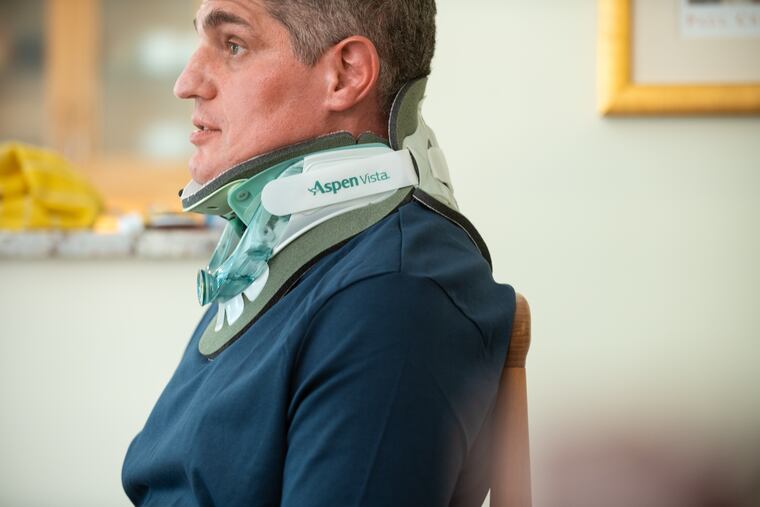
Drechsler, however, suffered a fractured vertebra and partially dissected artery in his neck, which is now supported by a surgically implanted titanium plate. He’s still wearing a neck brace that he can take off only to shower.
“They didn’t cite him. They didn’t fine him for either being on the trail or, in fact, for riding an e-bike that’s illegal,” Drechsler said from his Lower Merion home last month. “Honestly, I don’t really understand.”
E-bikes vs. e-motos
The growing popularity of e-bikes — along with e-scooters and other forms of “micromobility” — has led to a recent spike in reported injuries across the country.
Last month, a 16-year-old in Lancaster County was taken off life support after he collided with a minivan while riding an e-bike. In July, a 14-year-old on an e-bike died in a collision with a vehicle in Somers Point, N.J. In March, police in Greencastle, Pa., reported that a man on an e-bike was killed in an accident that involved no other vehicles.
Lawmakers and police departments are scrambling to address the problem, but there is widespread misunderstanding of how e-bikes have evolved since the COVID pandemic.
Some of the cycles zipping around Philadelphia are not even e-bikes, which are defined in Pennsylvania as low-powered “pedalcycles with electric assist.”
Rather, the newer cycles are high-powered e-motos that are basically motorcycles with bicycle pedals. They can be purchased online and are capable of going two or three times faster than legal e-bikes.
Sunny Jackson, the injury prevention coordinator at Penn Medicine’s Trauma Center, said serious injuries to e-bike riders jumped from eight in 2023 to 28 in 2024. Through July of this year, the trauma center had already recorded 34 life- or limb-threatening injuries to e-bike riders.
“We’re definitely seeing more severe head injuries in our e-bike people than in the past,” Jackson said.
Kelly M. Willman, the trauma medical director at AtlantiCare Regional Medical Center, said her hospital has also been seeing a rise in e-bike and e-scooter injuries.
“The e-bikes just kind of exploded,” Willman said. “It’s like they were not here one day and then everybody had them.”
In the trauma unit alone, Willman said, AtlanticCare has seen a 60% increase in e-bike and e-scooter-related injuries from 2024 to 2025. Along with collisions with vehicles, Willman said, many of the riders lost control and hit pedestrians or stationary objects.
“That much speed creates more kinetic energy, and that energy has to go somewhere,” she said. “It gets distributed to the body.”
Emergency room doctors around the country are reporting similar trends.
Matt Moore, general counsel with People for Bikes, a trade association representing the U.S. bicycle industry, said the COVID pandemic sparked a lot of interest in both bicycles and electric bicycles. E-bike sales soon started outpacing electric car sales nationally.
New companies entered the marketplace around then, selling much more powerful electric bikes online, which Moore’s group defines as e-motos. The unregulated cycles started appearing on roads, trails, and boardwalks.
“The vehicles causing most of the problems aren’t electric bicycles to begin with,” Moore said. “Kids are being given essentially electric motorcycles and being set loose on the street, and that’s having tragic results.”
In rural Uniontown, Fayette County, Steve Smolenski used his engineering degree to tinker with bicycles, putting batteries in them long before they were sold publicly. Today, he runs JoltBike, where he sells and designs e-bikes.
E-bikes, he said, have been a godsend for the elderly, disabled, or people who can’t otherwise drive a car in rural areas. On the other end, he said, are folks looking for electric motorcycles, which should not be lumped together with the e-bicycles.
“Most of my customers are 65 and over and they’re not the problem,” he said. “I’m seeing news stories about the dangers of e-bikes, though, and the photos they’re using are electric motorcycles.”
Some riders will even buy “ghost pedals” for e-motos, which might make them appear to be legal from a distance.
“If someone comes in here,” Smolenski said, “and the first thing they ask me is, ‘How fast can this thing go?’ I tell them we need to have a talk first.”
‘Way too fast for these kids’
Public policy is lagging behind the technological developments in micromobility. Many states have clearly defined e-bike laws, but a lack of awareness among local officials and police officers has led to poor regulation and enforcement.
Norristown Police Capt. Michael Bishop said his officers don’t have a surefire way to determine if an e-bike is legal or not.
“It’s an issue we’re struggling with,” Bishop said. “Unless there is a sign on the bike saying it’s 1,500 watts, the normal patrol officer is not going to know.”
In South Jersey, the issue was thrust into the public spotlight in July, when a 14-year-old Egg Harbor Township resident died in a collision with a vehicle, where a bicycle path crosses Maryland Avenue in Somers Point, Atlantic County.
The teen, who was not wearing a helmet, was airlifted to Cooper University Hospital, where he later died. The driver of the vehicle, a Philadelphia resident, and her three juvenile passengers were not injured. The driver has not been charged.
Days after the collision, Atlantic County Prosecutor William E. Reynolds published an op-ed about the “significant dangers” associated with e-bikes, electric scooters, and golf carts.
Reynolds’s concerns traveled far at the Jersey Shore, picked up by news organizations and shared by thousands of residents and local police departments.
“This is me speaking as a parent, not just a prosecutor, but parents have to understand that giving the kid an electric vehicle, whether it’s a bike or a scooter, that there’s an inherent danger,” Reynolds said in an interview. “The tech has moved faster than we’ve been prepared for, and it’s way too fast for these kids.”
The Somers Point Police Department announced over the summer that it would increase enforcement of e-bike rules. Brigantine police did as well.
In Ocean City, Mayor Jay Gillian promised stricter enforcement after witnessing two e-bike riders run a red light. His town had proposed a total ban on e-bikes on the boardwalk but tabled it in June after getting blowback from seniors and cyclists with disabilities.
E-bikes are banned on the Atlantic City and Ventnor boardwalks, but former Atlantic City Mayor Don Guardian, an avid cyclist, said he sees electric bicycles and scooters every time he rides up there.
“Initially, it seemed more like adults were using them than anything. They were bicycling but just needed a little help,” said Guardian, now a New Jersey state assemblyman. “In the last two years, everyone is on them. They’re on all streets, and they’re on the boardwalk too.”
Weeks after the teen’s death in Somers Point, Guardian, along with New Jersey Sen. Vince Polistina and Assemblywoman Claire Swift, said they’d be proposing new safety requirements for e-bike operators.
Guardian said he’d like e-bikes to be treated like mopeds, which are registered and insured, with license plates, though not nearly as ubiquitous. Moped users must obtain a specific license from the state to operate them.
But John Boyle, research director at the Bicycle Coalition of Greater Philadelphia, said those types of blanket e-bike bans are due to a lack of knowledge about who is riding what.
New e-bike laws should target the fast e-motos, Boyle said, not low-powered e-bikes, which travel at around the same speed as bicycles but require less pedaling.
“We’re sort of in this backlash phase of things,” Boyle said. “There’s a wave of uncertainty, but we all can agree that these out-of-class e-motos need to be dealt with.”
In August, the Montgomery County Board of Commissioners passed an amendment that would raise the fines for “misuse” of e-bikes on trails.
The county’s trail policy restricts e-bikes by weight, power, and speed. Bikes can’t exceed 100 pounds, can’t have a motor larger than 750 watts, and must have “fully functional, operational pedals.” E-bikes and scooters can’t exceed speeds of 15 mph on those trails, either.
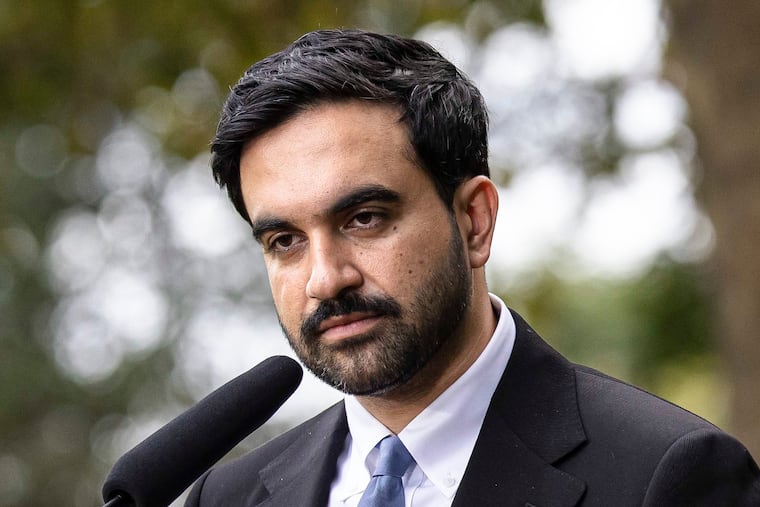
“It seemed clear that there was an explosion in use of e-bikes,” Commissioner Neil Makhija said. “‘It’s extremely dangerous, and we’ve had incidents in Montgomery County where people have been seriously harmed. That was the impetus for raising the fines.”
Enforcement could be done via checkpoints on the trail, he said. A county spokesperson said Friday that she was unaware of any police departments issuing citations for violating the e-bike ordinance.
Data are lacking
Reliable data on e-bike crashes can be hard to come by. Many single-vehicle crashes involving only e-bikes are unlikely to be documented by police. And some documented crashes lack specifics about the type of bicycle involved.
A 2023 report by the U.S. Consumer Product Safety Commission found that e-bike, e-scooter, and hoverboard injuries led to 360,800 emergency room visits between 2017 and 2022. About 25,000 of the injuries involved e-bikes, with nearly half them occurring in the last year of the study, a measure of their increasing use.
In 2024, the Pennsylvania State Police added a way to track e-bikes to their database of vehicle-related crashes. There were 345 vehicle crashes involving e-bikes — about 27% of all bicycle-related crashes, revealing an already substantial use of e-bikes among all riders.
But while police attempt to document the speed of cars and trucks involved in crashes, the role speed played among the bicycle and e-bike crashes is not known.
What is known is that the vast majority of riders were at intersections when the crashes happened, and almost half were crossing a roadway at the time.
The data, which are limited to crashes reported to the State Police, include two e-bike fatalities last year among 19 crash-related bicycle deaths. Another 56 e-bike riders suffered serious injuries. This year, at least six e-bike riders were killed in crashes in Pennsylvania, including a hit-and-run in July that killed a 19-year-old in Westmoreland County.
Not surprisingly, Philadelphia led all Pennsylvania police departments last year with 59 e-bike crashes reported. But the problem has reached all corners of the state, from Pittsburgh to the cities of Erie, York, Reading, Lancaster, and Allentown.
To date, the New Jersey Department of Transportation does not track e-bike crashes as a separate category within bicycles. A spokesperson for the department said this is something they are looking into.
Giving up biking?
As he recovered from his crash this summer, Drechsler noticed boys as young as 10 or 11 speeding around Narberth and Lower Merion on e-motos at 30 mph or faster. He’s notified police, but they don’t seem to have a handle on the problem yet, he said.
“You can hear it, and then you see somebody buzzing by, clearly at a very fast speed,” he said. “I don’t recall this ever happening before.”
Moore, of the bicycle industry trade group, has noticed the same thing in his Minneapolis neighborhood. He said there is another potential snag when it comes to cracking down on e-motos: Parents are buying them for their children. The e-motos cost $1,500 to $4,000 each, and parents are likely to make noise at City Hall if police declare them illegal and start impounding them.
“At some point there still has to be public awareness and enforcement of the law,” Moore said.
Drechsler had started road cycling as a teenager with his dad. They’d begin at their home in Lower Merion and do a loop to Valley Forge Park and back.
As distracted driving became more of a hazard to bikers, Drechsler quit road cycling and started driving his bike to the Schuylkill River Trail to ride.
“It’s a bike trail,” he said, “so I don’t have to worry about cars and motorcycles — I thought.”
Now, for the first time, Drechsler is questioning whether cycling in the Philadelphia area is even worth the risk. His bike was destroyed and he’s lucky he wasn’t paralyzed. He thinks about his responsibility to his wife and daughters.
If the Schuylkill River Trail isn’t safe, he asked, where is?
“I would love to go back one day, but I have to be pretty confident that something like this can’t happen,” he said. “Because I don’t think I necessarily survive another one.”

The Inquirer’s journalism is supported, in part, by the Lenfest Institute for Journalism and readers like you. News and editorial content are created independently of The Inquirer’s donors. Gifts to support The Inquirer’s high-impact journalism can be made at inquirer.com/donate. A list of Lenfest Institute donors can be found at lenfestinstitute.org/supporters.