Is there actually $1 billion sitting in a fund for SEPTA? Explaining the Public Transportation Trust Fund.
SEPTA is planning service cuts without funding in the state budget. But is there money already set aside for the transit agency?

A possible fix for Pennsylvania’s mass transit started with a simple idea floated by Senate President Pro Tempore Kim Ward, a Westmoreland County Republican.
“There’s money sitting in an account,” as she told The Inquirer last week.
Ward was referring to $1.1 billion that GOP staff calculate is available in a part of the relatively obscure but important Public Transportation Trust Fund that pays for transit-system capital projects.
Why not use some of it now to help SEPTA and other mass transit systems keep running amid fiscal crises?
Turns out it wasn’t so simple. All hell broke loose.
The GOP-majority Pennsylvania Senate, in a party-line vote Tuesday, advanced legislation to pull money from the trust fund’s capital side over two years.
SEPTA and other agencies could choose to flex that money into the PTTF’s operations account to keep buses and rail running.
But there was a catch: Rural roads and bridges would get $419 million from the transit trust fund, same as actual public transportation authorities.
That hasn’t happened since the trust fund was born 18 years ago.
Normally spending for maintenance and improvements for roads, highways, and bridges flows from an entirely separate budget within the Pennsylvania Department of Transportation.
Under the plan that cleared the Senate, the money would be supplemented by internet-gambling tax revenue, in total generating $1.2 billion over two years for both species of transportation.
Things moved fast in the Capitol on Tuesday, with little time to read a nuanced bill that was just introduced, even by the people who would vote on it and be directly affected.
On Wednesday, a House committee voted down the Senate’s proposal, effectively killing the bill.
What is the Public Transportation Trust Fund, exactly?
Act 44 of 2007 established the Public Transportation Trust Fund as a special vehicle to pay for mass transit operating subsidies and capital projects.
It got money from the state’s general sales tax, motor vehicle sales and use taxes, various fees and taxes from several other sources, and bonds issued by the Pennsylvania Turnpike backed by toll receipts.
In addition to the PTTF, the state highway fund for road and bridge repairs also received turnpike toll dollars, a growing concern because the gas tax — which flows into the highway fund — had not been raised in years.
Under Act 44, transit and roads split about $750 million a year from the turnpike between the PTTF and the state highway fund. This occurred until 2013, when another crisis was mounting.
That’s when highway and mass transit interests formed an alliance to strengthen state transportation finances.
The turnpike was struggling with debt, the huge number of structurally deficient bridges threatened weight restrictions and closures that would have hurt most parts of the state, and transit systems said they needed more than a half share of the turnpike payments under Act 44.
Act 89 was passed to amend Act 44, cutting the turnpike’s contribution to $450 million a year, all directed into the Public Transit Trust Fund, which also got general sales tax revenue. In 2023, the turnpike’s contribution dropped to $50 million, while at the same time transit systems were struggling to get past the pandemic and inflation was heating up.
How much money is in the fund?
The Public Transportation Trust Fund had $2.4 billion in it as of Wednesday, according to the state treasury.
Senate Republicans say PennDot told them that $1.3 billion in the capital account of the PTTF had been earmarked for future projects. According to the Senate GOP, that leaves more than $1 billion in funds in the trust available.
However, there is disagreement between Democrats and Republicans on whether that money really is available.
What does the Shapiro administration say?
“Every single dollar has an expected use,“ PennDot Secretary Michael Carroll said in testimony Wednesday before the House Rules Committee, essentially agreeing with transit agency operators’ consensus.
“Just to look at the fund balance you can say there’s a billion dollars sitting there [available], but that billion dollars has expected uses tomorrow, a month from now, and a year from now,“ Carroll said.
PennDot Deputy Secretary Meredith Biggica said the department would also need to figure out how to get transit agencies more money after the two years because of a “hold harmless” provision that keeps subsidies from suddenly plummeting.
What do SEPTA officials say about the Senate’s PTTF plan?
SEPTA and Pittsburgh Regional Transit opposed the measure because, they said, it would force them to sacrifice planned and needed projects essential to safety and service improvements to keep the trains running.
SEPTA general manager Scott Sauer said the plan would hurt SEPTA as some needed projects would have to be halted to shift money to the operating side.
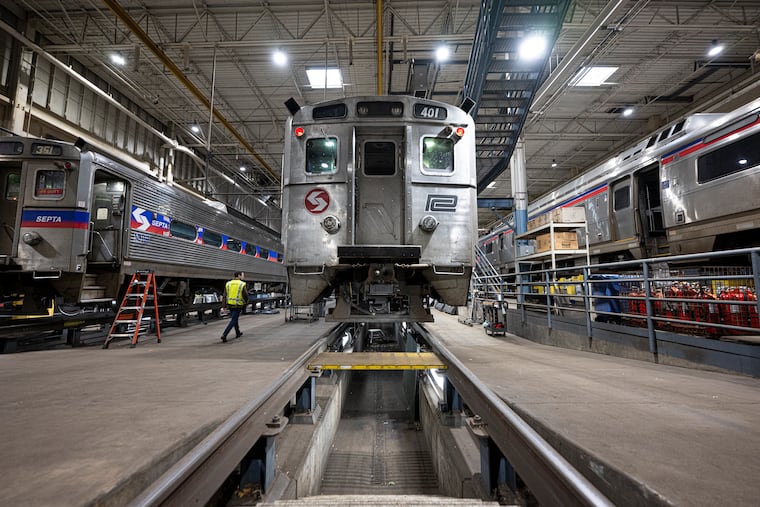
It has a $10 billion backlog of needed repairs to track, signals, and vehicles and must replace nearly all of its rail fleets over the next 10 years, Sauer said. It has begun some of those purchases.
What do advocates say?
Groups advocating for more transit funding are outraged that money in trust for transit would be siphoned to roads.
“It’s robbing already underfunded transit capital projects,” said Connor Descheemaker, coalition manager of Transit for All PA. “That is our red line. This is a false solution.”
What happened to the skill games option?
People have been eyeing skill games — the slot-machine look-alikes that have proliferated in bars, convenience stores, and fraternal clubs — as a potential solution to Pennsylvania’s long-standing mass transit woes.
If lawmakers can ever agree on how to tax and regulate them.
Skill game operators aren’t taxed or need to follow state regulations because they are in a legal gray area. Pennsylvania courts have ruled that they are designed with a skill component — say, pattern recognition or memory — that separates them from slot machines and other games chance that pay out randomly.
» READ MORE: Taxing skill games could help fund SEPTA. Here’s what to know.
Gov. Josh Shapiro has proposed increasing the allocation of general sales taxes to the PTTF to 6.15%, generating nearly $300 million over five years for mass transit operations.
Senate Republican leaders have objected to raising transit’s share of the sales tax because, they say, there are other worthy needs and the state is on a dangerous path of overspending, as Pennsylvania is already on track to spend more than $5.5 billion than it brings in under Shapiro’s initial spending plan.
So Senate Majority Leader Joe Pittman (R., Indiana) has long said any additional funding for mass transit requires a new and recurring funding stream — and it has to generate enough to spend an equal amount for upkeep on roads and bridges.
Republican senators have a “diverse opinion” and cannot agree on how much to tax the skill games, Pittman said.
Shapiro proposed taxing the machines at a 52% rate — the same as slot machines — in his budget pitch in February, estimating it would bring in an additional $369 million in its first year.
“Of all the issues that are out there, [skill games] is the one that has the broadest conceptual agreement that we have to move it forward,” Pittman said.
He said Tuesday evening that gaming reform “absolutely remains a big priority” and will be revisited.