Pennsylvania and N.J. Turnpikes choose a design for a new $1.6 billion Delaware River bridge
Planners say a new turnpike bridge between Bucks and Burlington Counties is crucial because of growth in traffic, especially trucks.
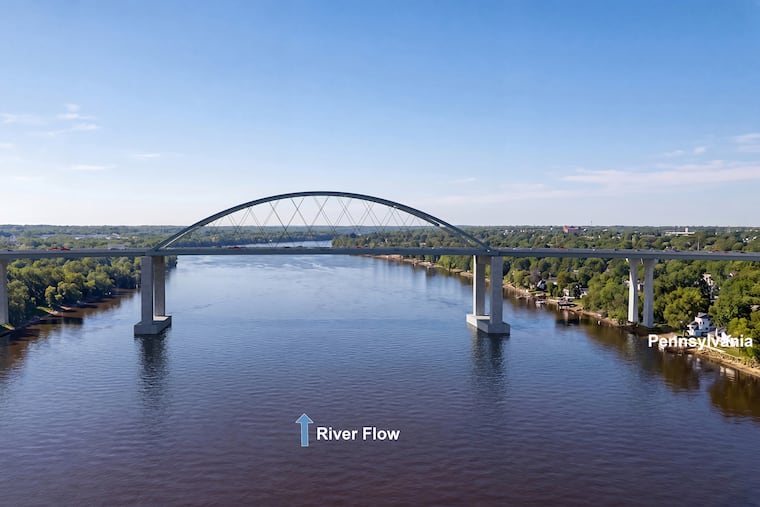
Officials of the Pennsylvania and New Jersey Turnpikes have chosen a design to replace the 70-year-old bridge over the Delaware River linking the toll roads: a six-lane span that would be built about 195 feet north of the existing one.
Called a ”tied-arch” bridge, the $1.6 billion replacement would be cheaper than other styles considered and can be built fastest, said John Boyer, senior engineer for the Pennsylvania Turnpike Commission.
“Shorter time frames mean less disruption to local businesses and daily life for the communities in this area,” said Boyer, the manager of the joint project.
Because the new bridge would be farther from the existing Delaware River Bridge than alternatives, traffic can keep flowing as it’s built, he said.
Planners for years have known that the region would need a new turnpike bridge because of exponential growth in traffic volume, especially trucks.
Freight volumes nationally are projected to grow by 73% by 2050, with warehouses on both sides of the river relying on crossing.
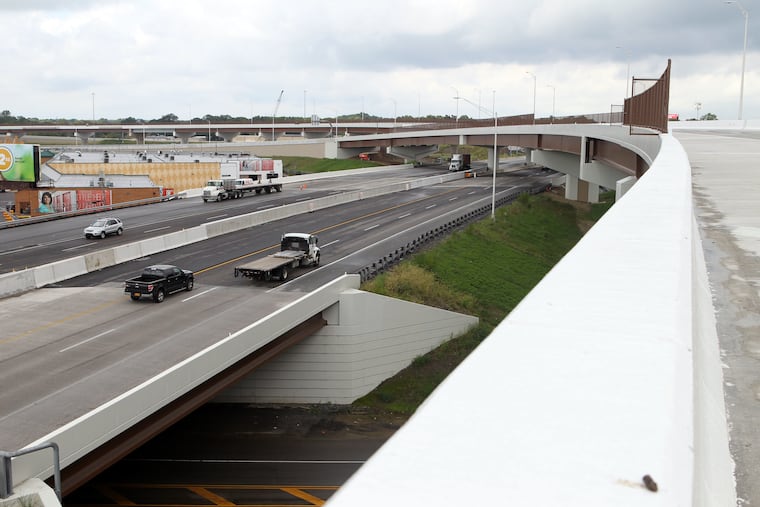
Before the nearby I-95/Pennsylvania Turnpike interchange opened in 2018, an average of 42,000 vehicles a day crossed the four-lane Delaware River Bridge. Now, that’s up to around 70,000. By 2050, projections say an average 93,000 vehicles will need to traverse the replacement.
The surface of a tied-arch bridge provides tension to resist the horizontal forces pressing on either end of the arch, like the taut string that connects a bow. It requires less sturdy foundations than a bridge supported by cables.
“You can be build those river piers while you’re building the arch structure off-site,” Boyer said. When the piers are ready, the arch can be brought in by barge and “you can essentially jack it and elevate it up into place,” he said.
Federal authorities approved a new span in 2003, but the project was put on hold because of problems paying for it.
In 2017, a crack was discovered in a truss supporting the existing bridge’s roadway, and it was closed for about two months.
As congestion increased on the repaired bridge, more traffic capacity became imperative, officials said.
Because the earlier federal approval was so old, officials had to start again with a new environmental impact statement and design studies. Last year, turnpike officials settled on two options.
Now, they’re finishing up the environmental impact statement, with formal public hearings scheduled for the winter.
Turnpike officials expect the Federal Highway Administration to make a decision on the project around April 2028.
In March, Pennsylvania’s U.S. senators announced a $600 million federal grant for construction of the new bridge connecting Bristol, Pa., and Florence, N.J. New Jersey’s congressional delegation also worked on getting the grant.
The two states’ turnpike agencies will finance the balance. Borrowing would be backed by toll revenue, but both say the bridge project won’t increase tolls for drivers.