Bus routes for students will be restored after Mayor Parker agreed to advance city money to SEPTA
The city has committed to advance some of its $135 million SEPTA subsidy that was originally intended to be dependent on Harrisburg lawmakers boosting funding for the transit agency.
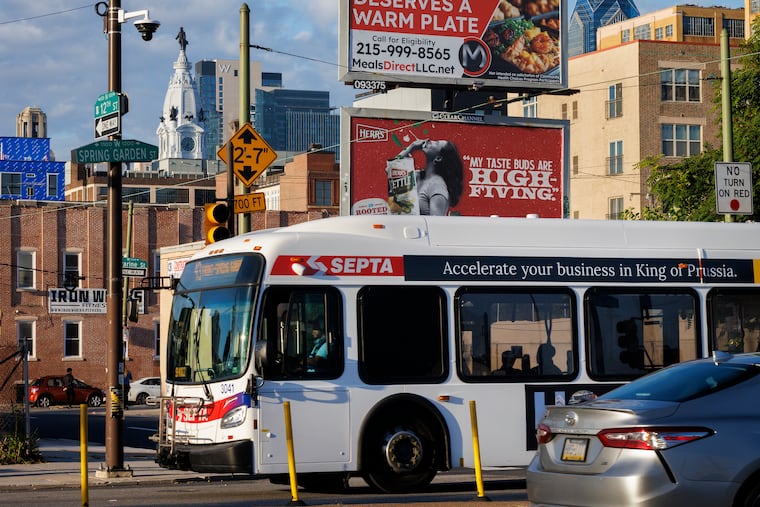
Mayor Cherelle L. Parker announced Thursday that her administration has reached an agreement for SEPTA to use previously allocated city funding to restore service to some bus and trolley routes in areas “where students are most affected by the cutbacks that started on the first day of school this week.”
The restoration of the bus routes, which will take effect Tuesday, is expected to cost approximately $1 million per month, SEPTA spokesperson Andrew Busch said.
“Making sure that all of our city’s children and youth can get to school on time and safely is one of our top priorities,” Parker said in a statement. “We need our students — Philadelphia’s future — to be at school learning and participating in extracurricular activities without interruption or challenges.”
Busch said SEPTA is “grateful for Mayor Parker’s support and advocacy.”
“This is an innovative solution that will greatly enhance service for students amid these challenging circumstances,” he said.
The routes that saw service reductions Monday but will see some added service “to reduce crowding and pass-ups” for students beginning Tuesday are the 14, 20, 23, 26, 47, 63, 67, 70, 82, T2, and T5.
In mid-September, SEPTA will publish schedules for restored service on the 31, 84, and 88, as well as 400-series bus routes, which are specifically designed to serve students.
Philadelphia School District Superintendent Tony B. Watlington Sr. said he was “elated and grateful” for the agreement.
“We looked at attendance figures for the first three days of school compared to last year and found that 63% of District schools showed an increase in late arrivals and 54% reported an increase in student absences,” Watlington said in a statement. “We’re optimistic that the restoration of priority routes will enable more students to attend school and accelerate academic achievement.”
The agreement was made possible because the city has committed to advancing a portion of its $135 million SEPTA subsidy for this fiscal year that was originally intended to be dependent on state lawmakers in Harrisburg fulfilling the beleaguered transit agency’s request for $168 million in new state funding, Busch said.
The city is required to send SEPTA $114 million this year, Busch said. But Parker and City Council allocated an additional $21 million that would be unlocked if the state increased its SEPTA subsidy by $168 million, on top of the $896 million the state is already obligated to send SEPTA, according to Busch.
» READ MORE: Mayor Cherelle Parker hasn’t been front and center in the fight to fund SEPTA. She said that’s no accident.
State budget negotiations, however, have been mired in a two-month impasse that is at the root of SEPTA’s funding crisis.
Consequently, the city is now allowing some of the money it originally intended to withhold until Harrisburg acted to go to SEPTA immediately, despite state lawmakers not yet fulfilling their part of the arrangement, Busch said.
“It’s not new money, but it’s money that we don’t have access to yet because there’s a portion of their local match that the city approved that matches what we hope will be the new state money,” Busch said.
Busch said he did not expect SEPTA to immediately receive the $21 million in added city funding. Instead, he said, the extra money will likely be paid in installments to cover the cost of the restored service.
Staff writer Kristen A. Graham contributed to this article.