SEPTA finished train car inspections, but Regional Rail commutes won’t improve right away. Here’s why.
Of the 223 cars that were part of a sweeping inspection mandated by the Federal Railroad Administration, only 76 were returned to service.
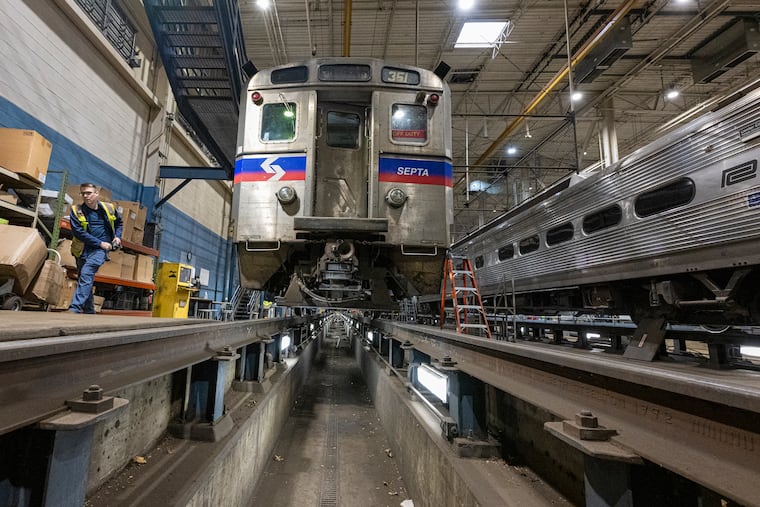
SEPTA finished intensive safety inspections of all 223 Silverliner IV Regional Rail vehicles on Friday morning, hours before a deadline set by federal regulators to finish the job.
Yet only 76 vehicles have returned to service because many of them needed repairs to fix various problems work crews discovered during the inspections.
“Every repair, no matter how minor, is being completed before any car returns to service. This is our new normal,” said SEPTA General Manager Scott Sauer, flanked by workers at a news conference in the Overbrook maintenance shop.
It could take until at least mid-December to restore a semblance of normal service on the region’s commuter system, Sauer said Friday.
On Oct. 1, the Federal Railroad Administration ordered SEPTA to inspect and repair as needed the entire Silverliner IV fleet after five train fires involving the 50-year-old cars this year.
Delays, cancellations, station skips and overcrowded Regional Rail trains running with fewer than the normal number of cars have been regular challenges for riders during six weeks of inspections and repairs.
SEPTA preemptively canceled 22 trains on the Airport, Fox Chase and Chestnut Hill West lines for three straight days this week due to a shortage of available cars. On Monday, dozens of other lines also had delays and cancellations.
Sauer apologized to customers Friday and thanked them for their patience. “I’ll not make any promises about service improvement that we cannot keep,” he said.
He also praised the employees who got the work done.
The effort cost $640,000 in overtime, SEPTA officials said, and overtime is expected to cost about $120,000 per week until the repairs and a required installation of new circuits to detect excessive heat are finished.
SEPTA projects that it will be able to return an average of five cars per day to the rails, officials said.
What needs repair?
Crews discovered traction motors with low insulation ratings in some of the Silverliner IV cars. In addition to carrying passengers, each of the cars is self-propelled. Fixing the issue — one of the longer repairs — takes about a day, officials said.
Other repairs take less time, such as replacing worn electrical contact tips, damaged hardware and cabling. Those jobs can take minutes to hours.
Damaged roof resistors, which dissipate excessive electrical energy in the cars’ braking system, have been replaced.
Work is also being performed on smoother resistors, described as a kind of choke that evens out the electric current in the car’s propulsion system, making the motor run more efficiently and cooler.
Going forward, SEPTA has to finish installing new circuitry to detect excessive heat anywhere in a car’s electrical system by Dec. 5. The warning technology is an improvement over what was available when the Silverliner IVs were built during the Nixon and Ford administrations.
Sauer said that installation takes about four hours per car, meaning those cars can return to action more quickly. As of Friday, 67 cars have had the thermal detectors installed.
Longer-term solutions
SEPTA is leasing 10 passengers coaches from Maryland’s commuter rail agency, called MARC. The rental cars were made by Nippon Sharyo between 1985 and 1987. They are not self-propelled and will be pulled by SEPTA electric locomotives.
The transit agency borrowed the same model of cars from MARC in 2016 when cracks appeared in the undersides of Silverliner V cars, newer than those at issue in this fall’s Regional Rail chaos.
Last week, SEPTA solicited bids from manufacturers for 234 new cars, which they are calling Silverliner VI. After SEPTA awards a contract, it will take from five to seven years for the first new cars to arrive, Sauer said.
Estimated cost for the full set: about $2 billion.
“We’re going to pursue a loan through the federal government — that’s really the only place we can go for this,“ Sauer said. ”We do not have $2 billion.“